


The affiliate program is one of the most powerful growth levers available to a prop firm — and one of the most poorly implemented. Most prop firms treat affiliate marketing as a simple referral link arrangement: give the affiliate a link, pay a commission per challenge purchase, monitor nothing. The result is an affiliate program that attracts low-quality traffic, generates chargeback exposure, and produces inconsistent revenue that cannot be scaled predictably.
A prop firm affiliate program that actually converts is a structured system — with tiered commission logic, tracking infrastructure, content distribution tools, fraud controls, and a feedback loop that identifies which affiliates produce traders who pass challenges and which produce traders who dispute charges. This guide covers how to build that system from the ground up.
Why Most Prop Firm Affiliate Programs Underperform
The most common failure mode in prop firm affiliate marketing is treating all affiliates as equivalent. A YouTube creator with 50,000 engaged trading subscribers and a Telegram channel with 200 members producing copy-paste promotional posts are not the same acquisition channel — but most prop firm affiliate programs pay them the same flat commission per challenge sale and monitor them with the same level of attention.
The consequences are predictable. High-quality affiliates who produce genuine trader interest see no differentiation from affiliates who drive incentivized or fraudulent traffic. The commission structure does not reward quality, so quality affiliates eventually migrate to programs that do. Meanwhile, low-quality affiliates continue driving high-chargeback, low-retention traffic that costs more to process than it generates in revenue. For a detailed breakdown of how chargeback exposure develops in prop firm operations and how to manage it, see the guide on the prop firm chargeback problem and revenue protection.
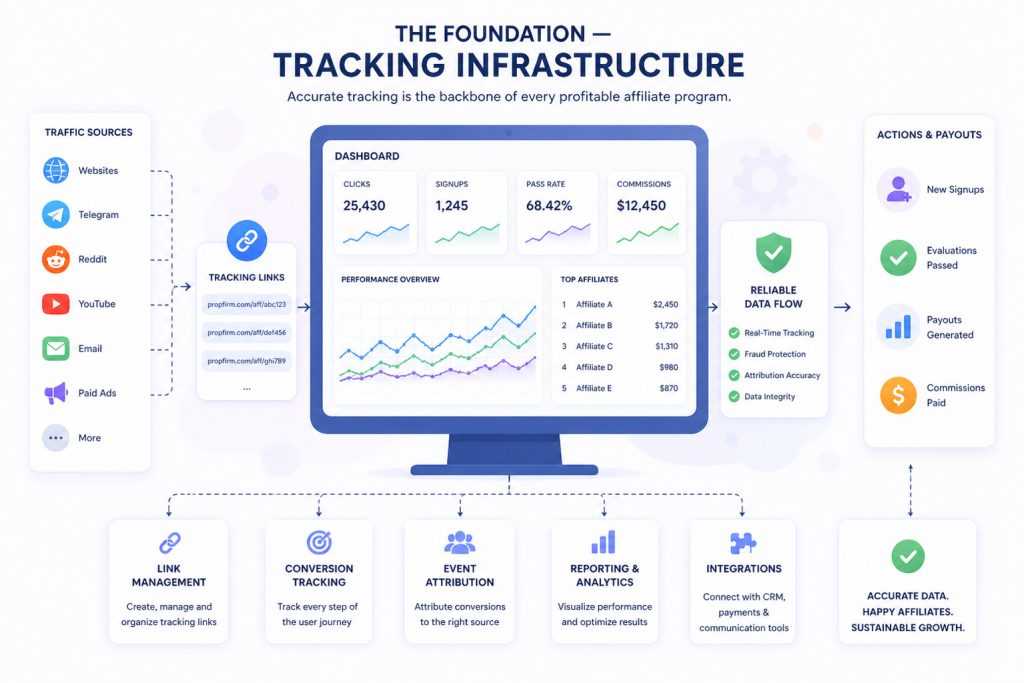
The Foundation — Tracking Infrastructure
Before any affiliate program can be optimised, the tracking infrastructure needs to be in place. Every affiliate action — link click, registration, challenge purchase, challenge pass, payout request — needs to be attributable to the specific affiliate who originated the traffic.
Without this data, there is no basis for differentiating affiliate quality, adjusting commission structures, or identifying fraud.
Minimum tracking requirements for a prop firm affiliate program:
- Unique affiliate links with UTM parameters — each affiliate has a unique referral URL that tracks clicks, registrations, and purchases back to their account
- Cookie-based attribution with defined window — a trader who clicks an affiliate link and registers 3 days later should still be attributed to that affiliate. Define the attribution window explicitly — 30 days is standard
- Event-level tracking — not just “registration” but the full funnel: click → registration → KYC completion → first purchase → challenge result → payout request
- Real-time affiliate dashboard — affiliates who cannot see their performance data in real time disengage. The dashboard should show clicks, registrations, purchases, commissions earned, and payout status
- IP and device fingerprinting — to detect self-referral fraud and coordinated abuse across multiple affiliate accounts
This tracking infrastructure connects directly to the prop firm CRM — so that affiliate attribution data is available alongside trader account data, challenge performance, and payout history in a single system. For more on how the IB and affiliate tracking system works within the Kenmore Design platform, see the guide on promo materials and referral tools for IBs.
Commission Structure — Rewarding Quality, Not Just Volume
A flat commission per challenge sale is the simplest commission structure — and the one most likely to attract low-quality traffic. Any affiliate who can drive volume, regardless of trader quality, earns the same rate as an affiliate whose referred traders consistently pass challenges and become funded accounts.
A tiered commission structure that rewards affiliate quality changes this dynamic. The specific tiers depend on the prop firm’s economics, but the underlying principle is consistent: affiliates who produce traders with better outcomes earn better rates.
The retention tier is the most powerful structural change a prop firm can make to its affiliate program. An affiliate who earns ongoing commission on funded traders they referred has a direct financial incentive to refer traders who are likely to succeed — not just traders who are likely to purchase. This aligns affiliate incentives with operator economics in a way that flat-rate programs cannot.
Multi-level commission structures — where an affiliate earns commission not only on their direct referrals but on the referrals of affiliates they recruit — create compounding network effects. An affiliate who builds a sub-affiliate network under them becomes a distribution channel that grows independently. For a full breakdown of how multi-level commission structures work technically, see the Multi-Level IB system documentation.
Promo Materials — What Affiliates Actually Need
Affiliates perform better when they have high-quality materials to work with. An affiliate who receives only a referral link and no supporting content will produce lower conversion rates than one who receives a full kit of ready-to-use assets.
What a prop firm affiliate kit should include:
- Branded banner ads in multiple sizes — for website placement, social media, and email newsletters. Each banner should be pre-embedded with the affiliate’s tracking parameter
- Short-form video scripts — for YouTube Shorts, Instagram Reels, and TikTok. Pre-written scripts covering challenge rules, funded account benefits, and platform features that affiliates can record and personalise
- Blog article links as trackable promo materials — blog posts about prop trading topics can be shared by affiliates with their referral parameter appended. A trader who reads an educational article and registers is attributed to the affiliate automatically
- Pre-approved Telegram and WhatsApp message templates — for affiliates operating in messaging-dominant markets. Pre-approved copy ensures brand consistency and reduces the compliance risk of affiliates making claims the prop firm cannot support
- Landing pages or Embeddable Registration Forms — for affiliates with their own websites who want to create dedicated prop firm review or comparison pages
Fraud Controls — Protecting Revenue From Affiliate Abuse
Affiliate fraud in prop trading takes several forms, each requiring specific detection and prevention measures:
- Self-referral fraud — affiliates purchasing challenges through their own referral links to collect commission on their own purchases. Detected through IP matching, device fingerprinting, and payment method overlap between affiliate account and referred trader
- Chargeback farming — affiliates driving traffic from incentivized or fraudulent sources who purchase challenges, trigger commission payouts, then dispute the charge. Detected through cohort analysis — affiliates whose referred traders dispute at significantly higher rates than average are flagged for review
- Cookie stuffing — fraudulent attribution of registrations to affiliate cookies without the trader having clicked the affiliate’s link. Detected through click-to-registration timing analysis
- Coordinated account abuse — multiple accounts with shared IP addresses, device fingerprints, or payment methods being referred by the same affiliate. Detected through the same IP clustering tools used for trader rule enforcement

Commission payout timing is the primary lever for fraud risk management. Paying affiliate commissions immediately on challenge purchase creates maximum exposure to chargeback farming. Paying commissions on a 30-day delay after purchase — after the chargeback window has largely closed — significantly reduces exposure. The commission structure should be designed with this timing in mind. For more on how chargeback timing affects prop firm revenue, see the full breakdown of what costs a prop firm capital and how to monitor it.
Recruiting and Managing Affiliates
The quality of the affiliate program is ultimately determined by the quality of the affiliates in it. Recruiting high-quality affiliates requires more effort than opening a public affiliate sign-up form — it requires identifying creators, educators, and community builders with genuine audiences in the trading space and approaching them with a program worth promoting.
High-value affiliate profiles for prop firms:
- YouTube trading educators — channels covering trading strategy, risk management, and platform tutorials with 10,000+ engaged subscribers. Their audience is actively researching trading opportunities
- Trading community operators — Discord servers, Telegram groups, and Facebook groups with active trader membership. A community operator who recommends the prop firm to their members has built-in trust that cold advertising cannot replicate
- Prop firm review creators — YouTube and blog creators who review and compare prop firms. Their audience has high purchase intent — they are actively evaluating which firm to choose
- Trading signal providers — creators who provide market analysis and signals to subscriber bases. Their audience already pays for trading-related content and has demonstrated willingness to invest in trading tools
Affiliate management should include regular communication — monthly performance reviews, updates on new challenge programs, early access to promotions before they go public, and responsive support when affiliates have questions. Affiliates who feel valued and informed promote more consistently than those who receive only commission statements. For more on building effective IB and partner relationships, see the article on trader retention and partner engagement.
Measuring Affiliate Program Performance
The metrics that matter for a prop firm affiliate program go beyond clicks and purchases. The full performance picture requires tracking the quality of referred traders, not just their volume:
| Metric | What it measures |
|---|---|
| Click-to-registration rate | Landing page and offer quality |
| Registration-to-purchase rate | Onboarding funnel effectiveness |
| Challenge pass rate by affiliate | Trader quality from each affiliate source |
| Chargeback rate by affiliate | Fraud exposure and traffic quality |
| Funded trader retention by affiliate | Long-term trader quality |
| Revenue per referred trader by affiliate | True affiliate value vs commission cost |
Affiliates who generate high challenge pass rates and low chargeback rates are producing genuine value. Those metrics justify better commission rates, priority support, and early access to new programs. Affiliates who generate high purchase volume but low pass rates and high chargeback rates are creating costs that exceed their commission revenue — and should be either retrained or removed from the program. For more on how to design challenge rules that produce sustainable pass rates, see the guide on how to design a prop firm challenge.

Request a Consultation on Structuring a Prop Firm Affiliate Program
Get expert guidance on designing a performance-based affiliate framework aligned with long-term prop firm economics. We’ll help you evaluate tiered commission logic, retention incentives, fraud exposure, and attribution models before scaling acquisition.
Together, we’ll review your current affiliate setup and outline a structure that rewards trader quality, not just purchase volume.