


Running a prop firm without real-time risk management is not a calculated risk — it is an operational guarantee that you will eventually absorb losses you could have prevented. The violations are not rare edge cases. They are a predictable percentage of every active trader population, and they follow recognizable patterns.
The question is not whether these situations will appear on your platform. It is whether you will detect them before they cost you. Understanding what each risk looks like — and what conditions allow it to occur — is the first step toward building a prop firm that scales without losing control of its capital exposure. A detailed breakdown of how risk management infrastructure is built for prop firms specifically is worth reviewing before making technology decisions.
Why Risk Management Determines Whether a Prop Firm Survives
Most prop firms that fail do so on the operational side, not the trading side. The funded account is where money leaves the firm. Risk management is what controls when, how much, and under what circumstances that happens.
There are two failure modes, and both are common.
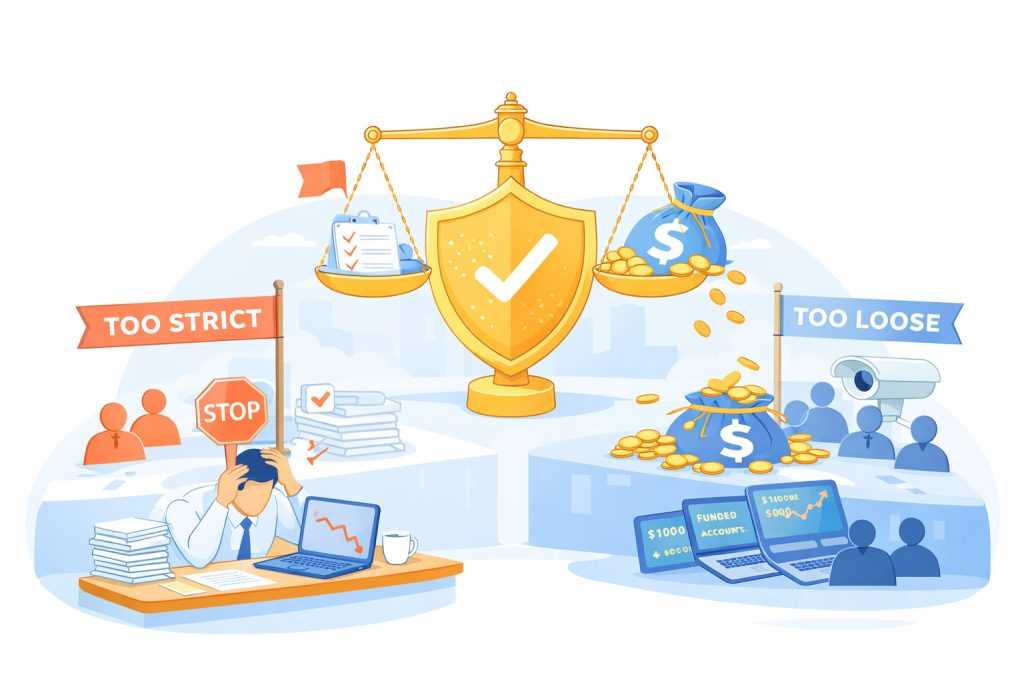
The first is being too strict. Rules so conservative that legitimate traders cannot operate comfortably. High challenge failure rates, high dispute volume, and reputational damage from traders who feel enforcement was arbitrary or inconsistent. This failure mode costs the firm its trader acquisition pipeline.
The second is being too loose. Insufficient detection allows coordinated abuse to develop and compound. A well-organized group running copy trading across ten funded accounts can extract significant capital before the pattern becomes visible in aggregate P&L. This failure mode costs the firm actual capital.
Finding the calibration between these two failure modes requires real-time visibility into trader behavior — not manual review of events that have already happened.
The Risk Categories Every Prop Firm Operator Faces
1. HFT and Algorithmic Abuse
What it is: High-frequency trading strategies that exploit pricing inefficiencies between your platform’s quote feed and external liquidity. These are not market-reading strategies — they are latency arbitrage strategies that profit from the gap between your quoted price and the actual market price at the moment of execution.
What the situation looks like: A burst of trades — typically twelve or more — on the same instrument within five seconds or less. The account shows consistent profitability with unusually short average holding times. The trading pattern does not correlate with normal market events.
Why it matters operationally: The strategy profits from your infrastructure, not from market analysis. You are not funding latency arbitrage — you are funding traders who demonstrate a repeatable edge in actual market conditions. When HFT abuse goes undetected, the firm absorbs artificial losses on positions that would not exist in a properly monitored environment.
Where the complexity lies: Not every algorithmic pattern is abuse. Legitimate traders using Expert Advisors on MT5 or automated entries during news events can produce burst patterns that superficially resemble HFT. The distinction is pattern frequency over time and correlation with market conditions — not the presence of automation alone. This is why detection requires review, not automatic disqualification.
2. Copy Trading Across Multiple Accounts
What it is: One trader running the same strategy across multiple funded accounts registered under different identities, multiplying their effective capital allocation without the firm’s knowledge.
What the situation looks like: Two or more accounts opening the same instrument in the same direction within milliseconds of each other, consistently. The correlation is not coincidental — it repeats across sessions, across instruments, and across different market conditions. As one operator described during a Kenmore demo: “The trades are always matching with three accounts, with the difference of five ticks.”
Why it matters operationally: The firm is effectively paying out on the same trade multiple times. One trader’s funded capital exposure is being multiplied through account fragmentation. The risk is not distributed across independent traders — it is concentrated in a single strategy running simultaneously across multiple accounts.
Where the complexity lies: KYC at onboarding is the first prevention layer — it stops obvious single-identity registrations. But it does not prevent coordinated rings where multiple real identities collaborate, or where one person uses separate legal identities. Detection at the account behavior level is the second necessary layer. Both are required because each addresses a different point of entry for the same abuse pattern.
3. News Trading and Position Spiking
What it is: Opening large positions immediately before or during scheduled high-impact news events — NFP, FOMC, CPI — to exploit the gap between your platform’s delayed quote update and the actual market move.
What the situation looks like: A trader with an otherwise moderate position sizing history suddenly opens a maximum-size position within seconds of a scheduled economic announcement. The position closes within minutes with a large gain. The pattern repeats around the same event types.
Why it matters operationally: The trader is not expressing a market view — they are trading a known technical vulnerability in the platform’s pricing infrastructure. The gap between your quoted price and the actual market price at the moment of a high-impact news release is predictable and exploitable. Position spiking around news events shifts risk asymmetrically against the firm.
Where the complexity lies: The policy decision matters as much as the detection. Some operators hard-block all trading during defined news windows — clean to enforce, but generates complaints from traders with legitimate strategies that happen to be active around economic events. Others flag for review and evaluate the pattern in context. Neither approach is universally correct — it depends on the firm’s trader profile and risk tolerance.
4. Drawdown Breach Gaming
What it is: Exploiting the daily drawdown reset mechanism to extract an additional day’s worth of risk capacity that the rules were designed to prevent.
What the situation looks like: A trader approaches the daily loss limit during a session, closes all positions before the daily reset time, brings their intraday P&L back to zero, and then reopens positions after the reset with a fresh daily limit available. Across multiple days, the pattern shows consistently near-zero end-of-day balances regardless of intraday activity.
Why it matters operationally: The daily drawdown limit is a risk control designed to prevent a single session from causing catastrophic account damage. Gaming the reset mechanism defeats the purpose of the control while technically remaining within the stated rule. The firm carries intraday risk exposure it did not intend to allow.
Where the complexity lies: The pattern is easy to miss at the individual account level. It only becomes visible when you track intraday P&L behavior across multiple days for the same account — not just the end-of-day snapshot. This is one of the monitoring scenarios that requires time-series data, not just point-in-time account checks.

5. Consistency Rule Violations
What it is: A trader hitting their entire profit target on a single outsized trade and then going flat for the remainder of the challenge — passing the evaluation without demonstrating the repeatable performance it was designed to filter for.
What the situation looks like: An account hits 80% or more of its total profit target in a single trading session, then shows minimal activity for the remaining challenge period. The profit distribution across days is heavily skewed toward one or two sessions rather than distributed across the minimum required trading days.
Why it matters operationally: The challenge is designed to identify traders who can generate consistent returns across multiple market sessions and conditions — not traders who get lucky once. A funded account allocated to a trader who passed on a single outsized trade carries risk that the evaluation process was supposed to filter. The firm’s capital allocation model is premised on funded traders demonstrating repeatable behavior.
Where the complexity lies: Whether to implement a formal consistency rule — capping the percentage of total profit that can come from any single day — is a calibration decision. Strict consistency caps filter the single-trade fluke but also penalize legitimate swing traders and news traders who size up for specific high-conviction setups. The threshold matters: too aggressive and it becomes a complaint driver, too loose and it fails to filter what it was designed to catch.
6. Payout-Triggered Fraud
What it is: Manufactured trading activity designed to meet payout eligibility criteria without genuine market exposure — including wash trading, coordinated account balancing, and artificial P&L generation.
What the situation looks like: An account shows trading activity that precisely meets payout thresholds with unusual consistency — profitable days distributed exactly at eligibility minimums, positions that open and close with no meaningful market exposure, or P&L patterns that cannot be explained by the underlying instrument’s price movement.
Why it matters operationally: Payout fraud is the highest-stakes risk category because it targets the moment when capital physically leaves the firm. Unlike challenge abuse — which generates fictitious performance but costs the firm in reset cycles and potential chargebacks — payout fraud attempts to extract real capital based on manufactured eligibility.
Where the complexity lies: Detection requires cross-referencing account behavior with actual market data for the instruments traded. A position that shows a gain during a period when the instrument did not move in the claimed direction is a strong signal. This level of verification requires integration between your trading platform data and external market data — not just internal P&L records.
The Relationship Between Challenge Design and Risk Exposure
The parameters you set for your challenges directly determine which risk situations are likely to appear on your platform. Tight daily loss limits with balance-based calculation reduce the space for drawdown gaming but increase the dispute volume from legitimate traders who hit the limit on normal losing days. Loose consistency rules increase the probability of single-trade pass attempts. No minimum trading day requirement creates space for news-spiking strategies.
Challenge design and risk management are not separate decisions — they are two sides of the same operational problem. The rules you write determine the behaviors you attract. The monitoring you implement determines which of those behaviors you catch before they cost you. How both layers connect through an integrated back-office system is documented here.
What Real-Time Monitoring Actually Requires
Real-time risk monitoring is not a dashboard that updates every few minutes. It is a system that processes platform data continuously, evaluates account behavior against your defined parameters on every event, and triggers automated responses without waiting for human review.
The situations described above share a common characteristic: they all develop and reach critical state faster than manual monitoring can respond. A news spike position opens and closes in minutes. An HFT burst happens in seconds. A drawdown breach occurs in real time as a position moves against the trader.
The gap between when a violation occurs and when it is detected is where the firm’s capital exposure lives. Closing that gap requires automation at the detection layer — not faster human monitoring.
What the monitoring layer needs to cover:
- Per-account real-time equity tracking — current drawdown consumed as a percentage of daily and total limits, updated continuously
- Cross-account pattern matching — comparing open positions across all active accounts simultaneously for copy trading signals
- Event-based flagging — correlating trading activity with economic calendar events for news trading detection
- Time-series behavioral analysis — tracking intraday P&L patterns across multiple sessions for drawdown gaming detection
- Consistency distribution tracking — monitoring the percentage of total profit earned per day relative to the total target
The prop firm dashboard that gives operators visibility into all of this simultaneously — across hundreds of active accounts — is covered here.
The Audit Trail as a Risk Management Asset
Every risk management decision you make will eventually be disputed by a trader who believes their account was handled incorrectly. The quality of your audit trail determines whether that dispute is resolved in minutes or escalates into a public complaint.
An audit trail that documents every trade, every violation flag, every account status change, and every payout decision with timestamps and associated data converts a confrontation into a documentation review. Without it, every dispute is a credibility contest between the firm and the trader — and in a community-driven market where traders share experiences publicly, credibility contests are expensive regardless of who is right.
The audit trail is also how you identify systemic patterns across your trader population — violation types that are increasing in frequency, account profiles that correlate with specific abuse behaviors, challenge parameters that are generating more gaming attempts than genuine filter effects.
Categories of Risk That Require Different Responses
Not every risk situation requires the same response, and not every response should be automated. The boundary between what the system handles automatically and what goes to human review is one of the most consequential operational decisions a prop firm makes.
| Risk Situation | Response Type | Who Acts | Timing |
|---|---|---|---|
| Daily loss limit breach | Automated disable | System | Immediate |
| Total drawdown breach | Automated termination | System | Immediate |
| Challenge profit target hit | Automated provisioning | System | Immediate |
| HFT burst detection | Flag + temporary hold | Risk desk review | Within session |
| Copy trading pattern match | Flag + manual review | Risk desk | Within 24h |
| News trading flag | Flag + policy check | Risk desk | Within session |
| Large payout approval | Manual P&L review | Risk desk | Before payout |
| Trader dispute of violation | Documentation review | Operations | Per SLA |
The automation layer handles unambiguous cases at the speed required. The review queue handles cases where context determines the appropriate response. Designing the boundary between these two categories correctly reduces both capital exposure and the operational overhead of managing disputes at scale.

Request a Consultation on Implementing Real-Time Risk Monitoring
Get expert guidance on implementing automated detection, cross-account monitoring, equity tracking, and violation logging within your prop firm infrastructure. We’ll help you design a system that identifies abuse patterns before they translate into financial loss.
Together, we’ll assess your current back-office capabilities and define a practical roadmap for building a scalable, audit-ready risk environment.