


Data security for forex brokerages is not an abstract IT concern — it is an operational and regulatory requirement. Brokers handle sensitive client data: identity documents, financial records, trading history, payment details, and KYC documentation. A breach affecting any of these categories creates regulatory exposure, reputational damage, and in many jurisdictions, mandatory breach notification obligations that affect every client on the platform.
Most data leaks in the forex industry do not come from sophisticated external attacks on well-secured infrastructure. They come from within — from inadequate access controls, unpatched systems, insecure third-party integrations, and operational shortcuts that accumulate over time. This article covers the practical security measures every forex brokerage should have in place, organized by infrastructure layer.
Backup Strategy — The Foundation of Breach Recovery
Before addressing prevention, address mitigation. A brokerage that cannot recover from a ransomware attack or a server failure because it has no current backups faces a far worse outcome than one that is breached but recovers within hours. Backup infrastructure should be treated as non-negotiable operational overhead, not a future project.
For employee workstations: Automated incremental backups to external drives using dedicated backup software (EaseUS on Windows, Time Machine on Mac) cover the most common failure scenario — hard drive failure or ransomware on individual machines. When ransomware encrypts local files, the perpetrators cannot hold data hostage if a recent backup exists offline. This applies to every employee who handles client data or business-critical documents.
For servers: Cloud-hosted servers can be backed up through the hosting provider’s snapshot service — no hardware or additional software required. For on-premises or non-cloud servers, the same incremental backup approach used for workstations applies. The critical requirement is that at least one backup copy is stored offline or on a network segment that is not accessible from the primary server — an online backup that is mounted to a compromised server is not a backup.
Backup testing: Backups that have never been restored are untested assumptions. Recovery procedures should be tested at least quarterly — verifying that backup files are not corrupted, that restoration completes within an acceptable timeframe, and that the restored system is functional. A backup discovered to be unusable during an actual incident is worse than no backup, because it delays the decision to move to other recovery options.
Website Security — WordPress and Plugin Risk
Most brokerage websites run on WordPress or a similar CMS. WordPress itself is a mature, well-maintained platform — the security risk is not in the core codebase but in the plugin and theme ecosystem. Every plugin installed on a WordPress site is a potential attack vector. Plugins with unpatched vulnerabilities have been exploited to compromise thousands of sites simultaneously through automated scanning and exploitation bots.
The most important rule for brokerage websites: do not store any client data on any system that touches WordPress. The website should handle marketing content, registration form presentation, and public information only. Client data — accounts, KYC documents, trading history, payment records — lives in the CRM and back-office system, not the website database. This architectural separation means that a WordPress compromise does not expose client data, even if the site itself is defaced or taken offline.
Operational requirements for WordPress brokerage sites:
- Assign a responsible person or agency to monitor and apply plugin and theme updates promptly — most WordPress compromises exploit vulnerabilities that have been patched but not yet applied
- Maintain a full site backup before every update cycle
- Run penetration and vulnerability testing after the site is built and before go-live — and after any significant plugin or theme update
- Implement Cloudflare or equivalent CDN for DDoS protection, WAF (Web Application Firewall), and bot filtering
- Remove unused plugins and themes — every inactive plugin that remains installed is a vulnerability that provides no value

Trading Platform Security
MT4, MT5, and other trading platforms expose IPs and ports publicly by design — traders and bridges need to connect to them. This public exposure is unavoidable but needs to be managed carefully.
Key considerations for trading platform server security:
- Firewall configuration — restrict access to management ports to known IP addresses only. Admin and manager access should never be open to the public internet without IP allowlisting
- Strong credentials — manager API credentials and admin passwords should be complex, unique, and stored in a password manager — not in email threads or shared documents
- Server hardening at provisioning — a newly provisioned server that is not hardened before being connected to the internet can be compromised within minutes by automated bots scanning for new IPs. Default credentials, open ports, and unpatched base OS packages are exploited automatically. A new server should be hardened before any application is installed on it.
- Regular patching — the underlying server OS needs to receive security updates regardless of the trading platform software running on top of it
- Separate management network — where infrastructure allows, trading platform management access should run through a VPN rather than being directly internet-accessible
Trading platform providers sell software and leave server setup to the broker. This means the security of the trading platform server is the broker’s responsibility — not the platform vendor’s. Many brokers underestimate this and treat server provisioning as a one-time task rather than an ongoing security obligation.
CRM and Third-Party System Security
A brokerage’s CRM and back-office system is integrated with multiple third-party services — PSPs, payment aggregators, KYC providers, IB systems, reporting tools, marketing platforms. Each integration represents a data connection that needs to be secured. There is no way to eliminate these connections — they are operationally necessary — but they can be managed to minimize exposure.
On self-hosting vs. third-party hosting: The instinct to self-host sensitive data is understandable but often counterproductive. Maintaining a secure server environment requires continuous effort — OS patching, firewall management, intrusion detection, access control, encryption at rest, and incident response capability. Most brokerages do not have the internal resources to do this to the standard that dedicated infrastructure providers maintain as their core business.
A newly provisioned cloud server left unattended for even a few minutes can be compromised by automated bots that scan for new IPs and probe for default credentials or unpatched vulnerabilities. This is not a theoretical risk — it is routine. The question is not whether your server will be probed, but whether it will be hardened before the first probe arrives.
If self-hosting is required: The minimum architecture separates the application server from the database server — on physically separate server instances, not just separate directories. Database access should be restricted to the application server IP address and a designated VPN endpoint only. Direct internet access to the database server should never be permitted. If the application supports data encryption at rest, implement it — and store the encryption keys on a third server, separate from both the application and database. This forces an attacker to compromise at least two separate systems to access decryptable data.
API security: All API integrations between the CRM, trading platform, and third-party services should use encrypted connections (HTTPS/TLS), rotate API keys on a schedule, and implement IP allowlisting where the provider supports it. API credentials that are hardcoded in application code or stored in unencrypted configuration files are a common and avoidable vulnerability.
Access Control and Internal Threat Reduction
Most forex industry data leaks originate internally — from current or former employees who have more access than their role requires, who share credentials, or who are socially engineered into providing access to third parties. Technical security measures are necessary but insufficient without access control practices that limit the blast radius of any single compromised account.
- Principle of least privilege — every staff member should have access only to the systems and data their role requires. A marketing team member does not need access to the full client database. A support agent does not need access to the payment processing admin panel.
- Multi-Factor Authentication (MFA) — required for all admin access to CRM, trading platform management, hosting control panels, and payment system dashboards. MFA significantly reduces the impact of compromised passwords.
- Offboarding procedures — access revocation must be immediate and systematic when an employee leaves. Accounts that remain active after an employee departs are a persistent vulnerability that is easy to prevent and frequently overlooked.
- Audit logging — admin actions in the CRM and back-office system should be logged with timestamps and user identity. Audit logs deter misuse, support incident investigation, and in regulated jurisdictions, satisfy compliance requirements for access monitoring.
Data Security Considerations for Prop Firms
Prop firms face a specific data security consideration that brokers do not: the volume of identity documents collected during KYC before payouts. A prop firm processing thousands of payout requests per month collects passports, national ID cards, and proof of address documents at scale. This collection of identity documents is a high-value target for data theft — both for the identity data itself and for fraudulent use of verified identities.
Specific requirements for prop firm document handling:
- Identity documents should be stored encrypted at rest with access restricted to compliance staff only
- Document retention policies should define how long KYC documents are kept and when they are deleted — GDPR and equivalent regulations require this in most jurisdictions
- Automated KYC providers (Sumsub, Onfido) handle document verification and storage within their own compliant infrastructure — reducing the prop firm’s direct exposure to document storage risk
- Duplicate account detection systems that use biometric or document matching reduce the risk of fraudulent identity reuse across multiple challenge accounts
Security Checklist for Client-Facing Applications
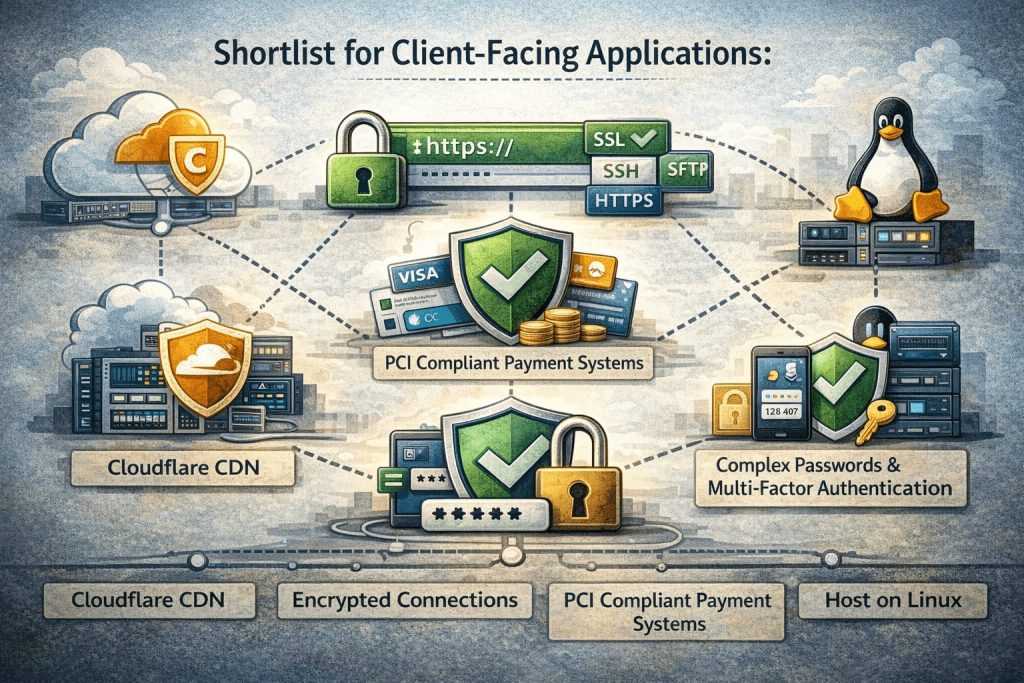
- Implement Cloudflare or equivalent CDN for DDoS protection, WAF, and SSL termination
- Enforce encrypted connections across all layers — SSL/TLS for web traffic, SSH for server access, SFTP for file transfers
- Verify PCI DSS compliance for all payment processing components
- Enforce MFA for all admin and staff access to client-facing systems
- Host on Linux where possible — Linux servers have a significantly smaller attack surface than Windows for web-facing applications
- Run penetration testing before go-live and after significant infrastructure changes
- Maintain an incident response procedure — a documented plan for who does what when a breach is detected, including regulatory notification requirements
- Review and rotate API keys and credentials on a defined schedule
Conclusion
Data security for a forex brokerage or prop firm is not a one-time project — it is an ongoing operational practice. The threat landscape in 2026 is more automated and more targeted than it was when most brokerages set up their initial infrastructure. Bots scan for vulnerable systems within minutes of server provisioning. Plugin vulnerabilities are exploited at scale within hours of public disclosure. Internal access controls that were adequate at ten employees become inadequate at fifty.
The security measures described in this article are not advanced — they are baseline. A brokerage that implements all of them is not immune to attack, but it is significantly more resilient than one that treats security as a future concern. For the Kenmore Design CRM specifically, client data is hosted on infrastructure maintained by a team whose primary responsibility is keeping that infrastructure secure — the broker’s responsibility is to manage access controls, maintain their own systems correctly, and implement the security practices on their side of the integration.

Request a Consultation on Data Security for Forex Brokerages
Get expert guidance on strengthening data security across your forex brokerage infrastructure. We’ll help you review backup strategies, hosting architecture, CRM integrations, and client-facing systems to reduce the risk of data leaks and operational disruption.
Together, we’ll assess your current security setup and outline practical steps to protect sensitive client data, maintain trust, and safeguard your brokerage’s reputation.