


The registration form is the first conversion point in a brokerage’s client acquisition funnel. It is where a prospective trader transitions from visitor to lead — and where the majority of drop-off occurs. Form design decisions that seem minor — how many fields are shown, how KYC is introduced, whether email verification is required before the Trader’s Room is accessible — directly affect how many registrations complete and how many abandon.
This guide covers the main registration form types used by forex brokerages, the tradeoffs between them, how the Forms API enables advanced configurations, and what happens after submission.
Why Registration Form Design Matters More Than Most Brokers Expect
Trader acquisition in forex is expensive. Paid traffic, affiliate commissions, and IB referral fees represent significant cost per visitor. A registration form that causes unnecessary abandonment wastes that acquisition spend before a single trader account is created.
The form design decision is also a regulatory decision. Regulated brokers operating under FCA, CySEC, or equivalent frameworks have minimum data collection requirements that prevent the simplest form implementations. Unregulated or offshore brokers have more flexibility — and can optimize purely for conversion. Understanding which constraints apply to your operation is the starting point for form design.
The Four Main Registration Form Types
Single-Page Forms
A single-page form displays all fields on one screen — typically name, email, phone, country, and password. The trader completes it in one action and is taken directly to the Trader’s Room or a confirmation page.
Advantages: Lowest friction, highest initial completion rate, fastest to deploy. On mobile, a well-optimized single-page form takes under a minute to complete.
Limitations: Field count is practically limited to around 10 fields across all screen sizes before abandonment increases significantly. Cannot collect KYC documents at registration. Not compliant with regulated broker onboarding requirements that mandate suitability questionnaires, risk acknowledgments, and identity verification before account activation.
Best for: Unregulated or offshore brokers prioritizing conversion volume, and demo account registrations where minimal data collection is appropriate.
Multi-Step Forms
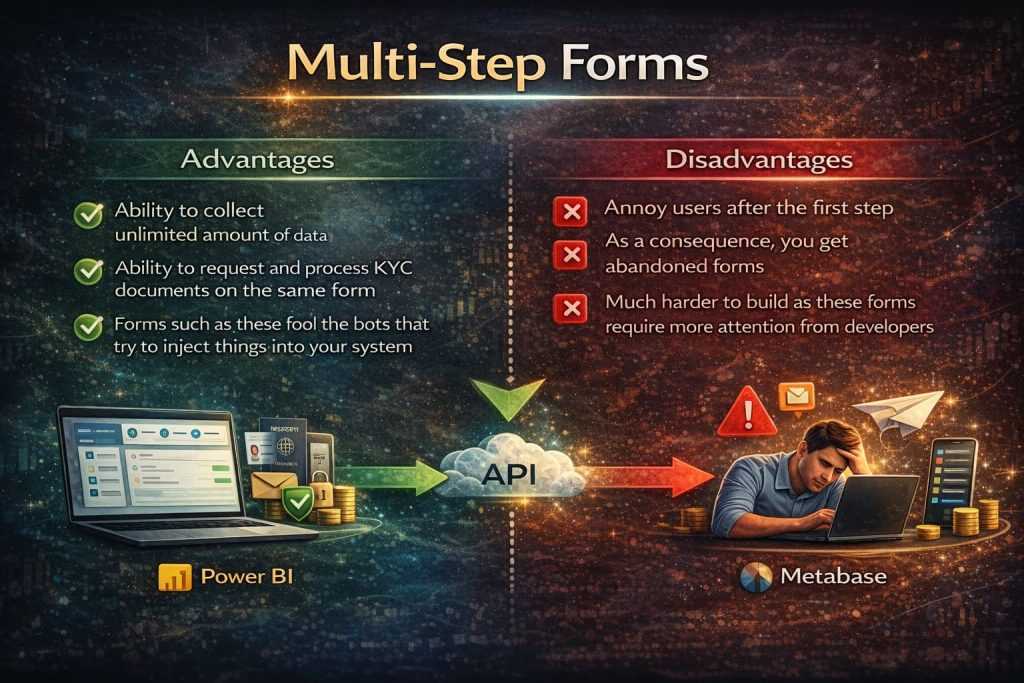
A multi-step form breaks the registration process into sequential screens — basic details on step one, financial information on step two, document upload on step three, and so on. The trader sees one step at a time and progresses through the sequence.
Advantages: No practical limit on data collected. KYC documents can be requested and uploaded within the registration flow. Multi-step forms are significantly more resistant to automated bot submissions than single-page forms, because bots typically complete only the first field set and fail to progress through subsequent steps.
Disadvantages: More complex to build and maintain than single-page forms. The primary operational problem is abandonment after step one — traders who reach step two or three and decide the process is too long simply leave. From our experience across broker deployments, multi-step forms consistently produce the highest abandonment rates of any form type. Any broker implementing multi-step registration should also implement user experience tracking — session recording and funnel analytics — to identify exactly which step causes the most drop-off.
Multi-Phase Forms
The multi-phase form is the most effective approach for brokers that need to collect significant data without sacrificing conversion. The implementation presents a minimal form on the public website — typically just name, email, phone, and country. On submission, the trader is taken inside the Trader’s Room to complete the remaining steps.
The psychological mechanism is important: once a trader has completed phase one and is inside the platform, they have already invested effort and feel committed to finishing. Abandonment rates after phase one are significantly lower than abandonment rates at equivalent points in a multi-step form on the public website.
The additional operational advantage is lead capture. All data from phase one is stored in the Forex CRM immediately on submission — even if the trader abandons before completing phase two. The sales team has a contactable lead with name, email, and phone number regardless of whether the registration was completed. This transforms partial registrations from lost visitors into actionable leads.
Disadvantage: More technically complex to build than either single-page or multi-step forms, as it requires integration between the public website and the CRM at the point of phase one submission.
Best for: Regulated brokers and any broker that needs to collect extensive data while maintaining reasonable conversion rates. This is the recommended implementation for most brokerage operations.
Demo Account Forms
Demo account registration should be as simple as possible — the goal is to get a trader into a demo environment quickly, not to collect compliance data. A single-step form with email and optionally phone number is appropriate. Email confirmation before demo account activation is standard. Phone verification for demo accounts adds friction with minimal compliance benefit and is not recommended.
The Forms API — Custom Registration Flows
For brokers who need registration flows that go beyond the standard form types — advanced landing pages, multi-channel marketing campaigns, custom mobile app registration, or integration with third-party marketing automation — the Client Registration API enables fully custom form implementations that feed directly into the CRM.
The API allows developers to build any registration interface — web, mobile, or third-party platform — while ensuring that submitted data is processed correctly through the CRM’s onboarding logic, KYC workflows, and trading platform account creation. This is particularly useful for brokers running performance marketing campaigns where each campaign landing page needs a tailored registration experience without maintaining separate CRM connections for each.
Post-Registration Flow — Email and Phone Verification
After form submission, the standard verification step is email confirmation. Two options exist:
- Confirmation link — the trader receives an email with a link to click, which activates their account and takes them to the Trader’s Room. This is the most common implementation and has the lowest friction for traders on desktop.
- Confirmation code — the trader receives a numeric code by email and pastes it into the registration form to proceed. This approach works better on mobile where switching between apps to click a link is more disruptive to the registration flow.
Phone verification via SMS or automated call has declined significantly in usage. The additional friction it adds to the registration flow outweighs the verification benefit for most brokerages — approximately 20% of broker deployments use phone verification, primarily those with specific compliance requirements that mandate it.
Choosing the Right Form for Your Brokerage
The decision framework is straightforward:
- Regulated broker — multi-phase form is the recommended implementation. It satisfies data collection requirements while maintaining acceptable conversion rates and captures partial registrations as leads.
- Unregulated or offshore broker prioritizing conversion — single-page form for live accounts, minimal single-step form for demo accounts.
- Broker needing extensive data collection without regulatory mandate — multi-phase form, with UX tracking implemented from day one to monitor abandonment at each phase.
- Custom marketing campaigns or mobile app registration — Forms API with custom implementation tailored to the specific campaign or platform.
Whichever form type is chosen, implement session recording and funnel analytics from launch — not after abandonment becomes a problem. The data collected in the first weeks of a new registration flow identifies friction points that are not visible from conversion rate alone.

Request a Consultation on Implementing Forex Registration Forms
Get expert guidance on implementing optimized registration forms integrated with your Forex CRM and Trader’s Room. We’ll help you configure form logic, data capture, KYC flows, and post-registration automation to reduce abandonment and improve lead conversion.
Together, we’ll assess your current setup and define a form configuration that delivers higher completion rates and smoother onboarding.