


For most of the past five years, “prop firm” has effectively meant “CFD prop firm.” The model was built on contracts for difference: forex pairs, indices, metals, and crypto CFDs, usually traded on MetaTrader, usually priced against a liquidity feed the firm controlled. That version of the industry made a lot of operators wealthy — and it is now the version under the most pressure.
Platform access has become a strategic risk since MetaQuotes began cutting off prop firms. Payment processors treat CFD challenge fees with growing suspicion. And regulators in several jurisdictions have started asking uncomfortable questions about what, exactly, a simulated CFD challenge is. We covered the broader picture in our breakdown of global regulatory risks for prop firms in 2026 — and one of the most common operator responses to those risks is the subject of this article: expanding into futures.
Futures prop firms — Topstep being the oldest and best-known example — run on a meaningfully different stack, with different economics and different rules. This guide walks through what actually changes when a CFD prop operator adds a futures brand: instruments, platforms, market data, risk rules, costs, and compliance posture.
What Makes a Futures Prop Firm Different
The evaluation mechanics look familiar on the surface. A trader pays a fee, trades a simulated account against a set of rules — profit target, daily loss limit, maximum drawdown — and, if successful, receives a funded account and a profit split. The lifecycle is the same one we described in our guide to designing a prop firm challenge.
What changes is everything underneath.
CFDs are over-the-counter instruments. The prop firm (or its broker partner) is the counterparty, the price feed is whatever the firm connects, and the instrument itself exists only as a contract between two parties. Futures are exchange-traded. An E-mini S&P 500 contract is a standardized product listed on CME, with a central limit order book, published volume, and one price for every participant in the world.
For a prop operator, that single difference cascades into the entire business:
| CFD prop firm | Futures prop firm | |
|---|---|---|
| Instruments | OTC CFDs (FX, indices, metals, crypto) | Exchange-listed futures (CME, CBOT, NYMEX, COMEX, Eurex) |
| Price feed | Broker/LP feed chosen by the firm | Official exchange market data, licensed per user |
| Typical platforms | MT4/MT5, cTrader, DXtrade, Match-Trader, TradeLocker | NinjaTrader, Tradovate, Quantower, TradingView (via broker), Rithmic front ends |
| Connectivity layer | Platform server + bridge/LP | Order routing and data via Rithmic, CQG, Tradovate/Teton, dxFeed |
| US retail traders | Effectively off-limits for CFDs; platform vendors restricting access | Core market — futures are a US-native product |
| Regulatory optics | Contested; several regulators reviewing the model | Cleaner — instruments are exchange-regulated, sim trading is established practice |
| Market data cost | Usually bundled or negligible | Real, recurring, per-user exchange fees |
Notice the last row. Data is a profit line in CFD prop and a cost line in futures prop. That inversion drives most of the operational differences below.
Why CFD Operators Are Adding Futures Brands
1. The US market opens up
The United States is the largest pool of retail trading demand in the world, and CFD prop firms have always had an awkward relationship with it — CFDs cannot legally be offered to US retail clients, and platform vendors have been closing the workarounds. Futures have no such problem. They are an American product, traded on American exchanges, familiar to American traders. A futures brand lets an operator market openly in the one geography its CFD brand cannot touch.
2. Independence from MetaTrader politics
Every CFD prop operator who lived through the MetaQuotes crackdowns understands platform concentration risk viscerally. The futures stack — Rithmic, CQG, Tradovate, NinjaTrader, Quantower — has no equivalent single point of failure, and its vendors have served the sim-funding model for over a decade without turning against it. Topstep built the category on this stack; hundreds of firms have followed.
3. A cleaner regulatory story
Whether a CFD challenge constitutes a disguised brokerage offering is an open question in several jurisdictions — we walked through the arguments in our legal breakdown of the prop firm model. Futures prop sits on firmer ground: the instruments themselves are exchange-regulated, the sim environment is clearly simulated, and funded trading is typically routed through established, licensed FCMs and brokers. It is not “regulated prop trading” — no such license exists — but the surface area for regulatory challenge is smaller, and banks and payment providers can see that.
4. Payments and chargebacks get easier
Acquirers price risk by category and by history. Futures education and evaluation products have a longer, calmer processing history than CFD challenges, and several operators report materially better approval rates and lower reserve requirements on their futures brands. If you have fought the chargeback battles we described elsewhere on this blog, you will appreciate the difference.
5. Diversification of the trader base
Futures attracts a somewhat different trader: more US and Canadian, more index- and energy-focused, often older and better capitalized than the typical CFD challenge buyer. For an operator, that is a second, partially uncorrelated demand pool — useful insurance in a business where, as we wrote in Why Most Prop Firms Fail in Year Two, revenue concentration is one of the classic killers.
The Cost Structure: Where Futures Prop Differs Most
This is the section to read twice, because the P&L of a futures prop firm surprises CFD operators.
Market data is a real, per-trader cost
Every evaluation account that sees live CME prices needs licensed market data. Non-professional data fees are charged per user, per exchange group, per month, and the firm — not the trader — typically absorbs or re-bills them. Multiply a modest data fee by thousands of active evaluations and you get a five-figure monthly line item that simply does not exist in CFD prop. Many firms manage this by defaulting evaluations to delayed data where acceptable, re-billing data fees to the trader as part of the subscription, or aggressively expiring inactive accounts.
Connectivity is licensed per seat
Rithmic, CQG, and Tradovate connections carry per-user or per-account costs, and platform licenses (NinjaTrader, Quantower, and others) may add their own. Your challenge pricing has to carry these costs — which is why futures evaluations are typically sold as monthly subscriptions rather than one-time fees. The subscription model, in turn, changes your churn math and your marketing funnel.
Funded traders can be pass-through
On the funded side, many futures firms route their best traders to live accounts at an FCM, where the firm posts real margin and the trader trades real contracts. Others keep funded traders on simulation and pay from evaluation revenue, the same way CFD firms run their books. The hybrid — sim funding with the top decile moved to live — is common, and choosing where that line sits is one of the most consequential risk decisions you will make. Our article on how prop firms lose capital applies to futures with full force: the instruments change, the payout liability math does not.
Risk Rules: What Transfers and What Doesn’t
Your challenge-design experience transfers. The specific parameters do not. Futures prop has evolved its own rule conventions, and traders coming from established futures firms will expect them:
- Trailing drawdown. The signature futures-prop rule: the maximum-loss threshold trails the account’s high-water mark (often computed intraday and including unrealized profit) until it locks at breakeven or a set level. It is stricter than the static or EOD drawdowns common in CFD prop, and it is the single biggest source of trader confusion and support tickets — document it exhaustively.
- End-of-day vs. intraday calculation. Firms differentiate themselves by how the drawdown is computed. EOD-calculated drawdown is friendlier to traders and increasingly a marketing point. Your risk engine has to support both.
- Contract scaling plans. Instead of account-size tiers alone, futures firms limit how many contracts a trader may run at each equity level, scaling up as the account grows. Micro contracts (MES, MNQ, MGC) make granular scaling possible and should be in your instrument set from day one.
- Consistency rules. Common in futures prop: no single day may account for more than a set percentage of total profit, discouraging one-shot gambling ahead of payouts.
- Session and news constraints. Exchange sessions, daily settlement, and scheduled economic releases play the role that weekend gaps and rollover play in CFD-land. Holding through settlement or major releases is commonly restricted for evaluation accounts.
None of this works on spreadsheet-and-goodwill. Trailing drawdown with intraday unrealized P&L requires tick-level position tracking against every account in real time — which is precisely the kind of rule engine we described in our overview of prop firm CRM software. If your current stack can only evaluate rules on closed trades or at end of day, it cannot run a competitive futures product.
The Technology Stack, Concretely
A workable futures prop stack in 2026 looks like this:
- Trading front end: one or more of NinjaTrader, Tradovate, Quantower, TradingView (through a supporting broker), or Rithmic’s own front ends. Traders have strong preferences here; established futures firms usually offer several.
- Data and order routing: Rithmic or CQG connections for professional-grade routing and the account-level control APIs your risk engine will consume; Tradovate/Teton as an increasingly popular alternative.
- Risk and evaluation engine: consumes fills and quotes from the routing layer, computes trailing drawdown and rule state per account, and executes enforcement actions (flatten, lock, fail) automatically.
- CRM, dashboard, and payouts: the commercial layer — challenge sales, subscription billing, KYC, trader dashboard, affiliate tracking, payout workflows — which has no reason to be futures-specific at all.
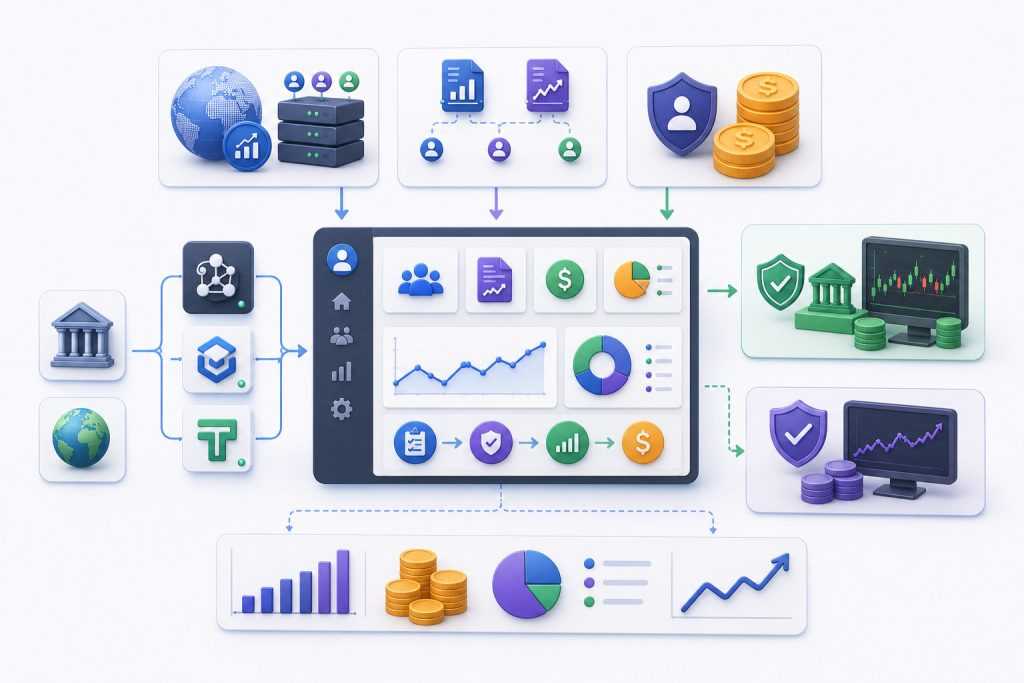
That last point is the practical takeaway for CFD operators: your commercial infrastructure should be reused, not rebuilt. If your CRM was built around one platform’s account model, adding Rithmic- or Tradovate-based accounts means another silo, another dashboard, another support queue. A multi-trading-platform prop firm CRM lets the futures brand share billing, affiliates, support, and trader identity with your existing CFD brands while the trading layer differs underneath — the same architecture our clients use to run multiple brands from a single back office.
Compliance Posture: Better, Not Bulletproof
A futures brand improves your regulatory story; it does not eliminate the need for one. The main points your counsel will walk you through:
- You are still selling an evaluation, not employment. Marketing language, terms of service, and payout representations need the same discipline as in CFD prop. US regulators pay particular attention to income claims and “funded” terminology.
- Live funded accounts change your obligations. The moment real capital trades through an FCM, you have agreements, margin, and potentially registration questions that sim-only firms never face. Get the FCM relationship and its paperwork right before marketing “live funding.”
- Exchange data agreements are contracts with teeth. Misclassifying professional users as non-professional, or redistributing data outside your license, is the kind of violation exchanges actually pursue. Build data-policy compliance into onboarding.
- State-level and tax considerations exist once you meaningfully operate in the US market. This is solvable — the largest futures firms are US companies — but it is a different legal project than an offshore CFD entity.
A Realistic Expansion Sequence
Operators who have done this well tend to follow the same order:
- Validate demand with your existing audience. Survey your funded and failed CFD traders; a surprising share already trade or want to trade futures.
- Choose the routing layer first (Rithmic, CQG, or Tradovate), because it constrains platform choice, risk-engine integration, and cost per seat.
- Launch with micros and a narrow instrument list. MES, MNQ, MGC, MCL cover most demand and keep data and margin complexity down.
- Reuse your commercial stack. Same CRM, same affiliate system, same payment orchestration, same support desk — new trading layer only.
- Run futures as a separate brand. Different audience, different message, and clean separation if either model faces regulatory turbulence.
- Only then consider live funding. Sim-funded payouts from subscription revenue are the training wheels; put real margin at an FCM when your data says the trader pool is stable.
Frequently Asked Questions
Is a futures prop firm regulated?
The firm itself typically is not — like CFD prop, there is no “prop firm license.” But the instruments trade on regulated exchanges, and live funded accounts run through licensed FCMs and brokers, which places much of the activity inside an established regulatory perimeter.
Can I run CFD and futures challenges in one back office?
Yes, and you should. The trading and risk layers differ; the CRM, billing, affiliate, KYC, and payout layers do not need to. Multi-platform, multi-brand architecture is exactly what makes the expansion economical.
Why are futures evaluations sold as subscriptions?
Because the firm carries recurring per-user costs — market data and connectivity — that CFD firms do not. Monthly pricing matches the cost structure and, as a side effect, smooths revenue.
Is trailing drawdown mandatory?
No, but it is the market convention, and your pricing assumptions (pass rates, payout liability) are calibrated to it. Softening it — for example, computing it end-of-day — is a legitimate differentiator as long as your risk engine and your math keep up.
The Bottom Line
Futures is not an escape hatch from the hard parts of prop — payout liability, risk discipline, and trader trust follow you across asset classes. What it offers is structural: exchange-traded instruments, a platform ecosystem with no single choke point, access to the US market, and a story that banks, processors, and regulators find easier to accept. For a CFD operator with a working commercial machine, adding a futures brand is less a pivot than a second engine — provided the back office was built to run more than one.

Request a Consultation on Expanding from CFD to Futures Prop Trading
Get expert guidance on evaluating whether a futures prop trading model fits your firm’s growth strategy. We’ll help you assess trading infrastructure, market data requirements, routing providers, platform selection, and commercial architecture before expanding into a new asset class.
Together, we’ll review your current operation and outline a practical roadmap for adding a futures business without duplicating your back-office infrastructure.