


Most prop firms lose traders the same way: a trader fails a challenge, doesn’t repurchase, and disappears. The business model depends on repeat engagement, but the product experience offers almost nothing between “pass the challenge” and “get funded.” That gap is where gamification fits in.
Gamification isn’t about turning trading into a game. It’s about applying behavioral mechanics — progression, feedback loops, status, streaks, and social proof — to an experience that’s otherwise binary: pass or fail. The prop firms that are growing fastest in 2026 aren’t the ones with the tightest spreads or the lowest challenge fees. They’re the ones that make traders want to come back, even after a loss.
This article covers the specific mechanics that work, how to implement them without trivializing the trading experience, and the infrastructure decisions that make gamification operationally sustainable.

Why Gamification Works in Prop Trading
The prop firm business model has a structural retention problem. The typical cycle looks like this:
- Trader buys a challenge
- Trader either passes or fails
- If they fail, they either repurchase or leave
- If they pass, they trade funded until they either earn a payout or blow the account
At every stage, the default outcome is the trader leaving. Gamification creates reasons to stay that exist outside the pass/fail binary. It gives traders a sense of progress even when they haven’t passed yet, a sense of status that they don’t want to lose, and a set of micro-goals that keep them engaged between major milestones.
The Psychology Behind It
The mechanics that drive engagement in prop trading map directly to established behavioral principles:
| Principle | What it means | Prop firm application |
|---|---|---|
| Loss aversion | People work harder to avoid losing something they already have | Streaks, status levels that decay without activity |
| Progress illusion | Visible progress toward a goal increases motivation | XP bars, milestone trackers, phase progression |
| Social proof | People follow what others are doing | Leaderboards, funded trader showcases, community badges |
| Variable reward | Unpredictable rewards are more engaging than fixed ones | Random bonus challenges, mystery rewards at milestones |
| Endowment effect | People overvalue what they already own | Earned badges, accumulated XP, loyalty tier status |
These aren’t tricks. They’re the same mechanics that make any long-term engagement system work — from airline loyalty programs to professional certification paths.
Core Gamification Mechanics for Prop Firms
1. XP and Leveling Systems
An XP (experience points) system gives traders a persistent sense of progress that’s independent of whether they pass or fail a challenge.
How it works:
- Traders earn XP for specific actions: completing a challenge (pass or fail), hitting daily targets, maintaining drawdown discipline, logging consecutive trading days, referring other traders
- XP accumulates into levels (Bronze → Silver → Gold → Platinum → Elite)
- Each level unlocks perks: reduced challenge fees, higher profit splits, faster payouts, access to larger account sizes
Example XP structure:
| Action | XP earned | Rationale |
|---|---|---|
| Complete a challenge (pass) | 500 XP | Reward the goal |
| Complete a challenge (fail, but within drawdown limits) | 100 XP | Reward discipline even in failure |
| Trade 5 consecutive days | 50 XP | Reward consistency |
| First payout received | 300 XP | Reinforce the milestone |
| Refer a trader who purchases | 200 XP | Tie referrals into progression |
| Pass a scaling evaluation | 400 XP | Reward advancement |
Why it works: A trader who failed three challenges but accumulated 600 XP and is halfway to Silver has a reason to buy a fourth challenge. Without the XP system, they have no progress to show for their failures and no incentive beyond “try again.”
2. Streaks and Consistency Rewards
Streaks reward traders for showing up regularly, which directly correlates with repurchase rates and funded account longevity.
Implementation options:
- Daily trading streak — trade at least one position per day for X consecutive days
- Weekly discipline streak — stay within daily loss limits every day for a full trading week
- Challenge streak — complete consecutive challenges without violating rules (regardless of pass/fail)
Streak rewards:
| Streak length | Reward |
|---|---|
| 7 days | Badge + small XP bonus |
| 30 days | Challenge fee discount (10–15%) |
| 60 days | Priority payout processing |
| 90 days | Account size upgrade eligibility |
Critical design rule: Streaks must decay gracefully. If a trader misses one day after a 45-day streak and loses everything, they’ll feel punished, not motivated. Use a “freeze” mechanic — allow one or two missed days per streak without breaking it. Airlines do this with status qualification; prop firms should too.
3. Badges and Achievements
Badges are visible markers of accomplishment that create status and identity within the trading community.
Categories of Badges
Skill badges:
- First Funded Account
- 10% Profit in a Single Phase
- Zero Drawdown Day (traded profitably without hitting any drawdown)
- Passed on First Attempt
Consistency badges:
- 30-Day Streak
- 100 Trading Days Logged
- 5 Consecutive Challenges Completed
Community badges:
- Top 10 Monthly Leaderboard
- 5 Successful Referrals
- Beta Tester (participated in a new feature rollout)
Milestone badges:
- $10K Total Payouts Received
- $50K Total Payouts Received
- Gold Tier Achieved
Where badges appear:
- Trader’s profile in the client portal
- Leaderboard entries
- Community forum profiles (if applicable)
- Certificates (shareable on social media)
Badges work because they’re both intrinsic (personal achievement) and extrinsic (visible to others). A trader who has earned 12 badges has built an identity on your platform that they don’t want to abandon.
4. Progression Paths and Scaling Programs
A scaling program is gamification at the account level — the trader progresses through increasingly larger funded accounts based on performance.
Typical scaling path:
| Stage | Account size | Profit split | Requirement to advance |
|---|---|---|---|
| Stage 1 | $25,000 | 75/25 | 10% profit, no rule violations, 2 payout cycles |
| Stage 2 | $50,000 | 80/20 | 10% profit, no rule violations, 2 payout cycles |
| Stage 3 | $100,000 | 80/20 | 8% profit, no rule violations, 3 payout cycles |
| Stage 4 | $200,000 | 85/15 | 8% profit, no rule violations, 3 payout cycles |
| Stage 5 | $400,000 | 90/10 | Invitation only |
Why it works: The scaling path gives funded traders a long-term reason to stay. Without it, a trader who’s been profitable on a $25K account for six months has no reason not to move to a competitor offering a $100K account directly. With a scaling path, they’re invested in their progression and the improving terms that come with it.
This mechanic also aligns operator and trader incentives — the firm only increases capital allocation to traders who’ve proven consistent profitability across multiple cycles.
5. Leaderboards
Leaderboards are the most visible gamification mechanic and the one most likely to be implemented poorly.
What Works
- Time-boxed leaderboards — monthly or weekly resets keep the competition fresh and give new traders a chance to compete
- Multiple categories — not just “highest profit” but also “best risk-adjusted return,” “longest streak,” “most consistent,” “highest XP earned this month”
- Anonymized options — let traders choose a display name; not everyone wants their real name visible
- Tier-based competition — Bronze traders compete against Bronze, Gold against Gold, preventing newcomers from feeling outclassed
What Doesn’t Work
- All-time leaderboards with no reset — dominated by early adopters, demotivating for everyone else
- Profit-only rankings — incentivizes reckless trading to chase the top spot
- Cash prizes for top positions — creates a gambling dynamic rather than a skill-development one; use XP, badges, or account upgrades instead
6. Challenges Within Challenges
Micro-challenges layered on top of the standard evaluation create additional engagement touchpoints.
Examples:
- Daily Target Challenge: Hit 1% profit today without exceeding 0.5% drawdown → earn bonus XP
- Consistency Challenge: Trade every day this week within your risk parameters → earn a badge
- Community Challenge: Collectively, all traders hit 10,000 profitable trades this month → everyone gets a fee discount on their next purchase
- Seasonal Events: “Summer Trading Sprint” — modified rules for a limited-time challenge with unique badges
These micro-challenges keep the experience dynamic. A trader who’s in the middle of a two-phase evaluation has something to aim for today, not just at the end of the evaluation period.
What Not to Gamify
Gamification applied carelessly can damage the product experience and even create regulatory risk.
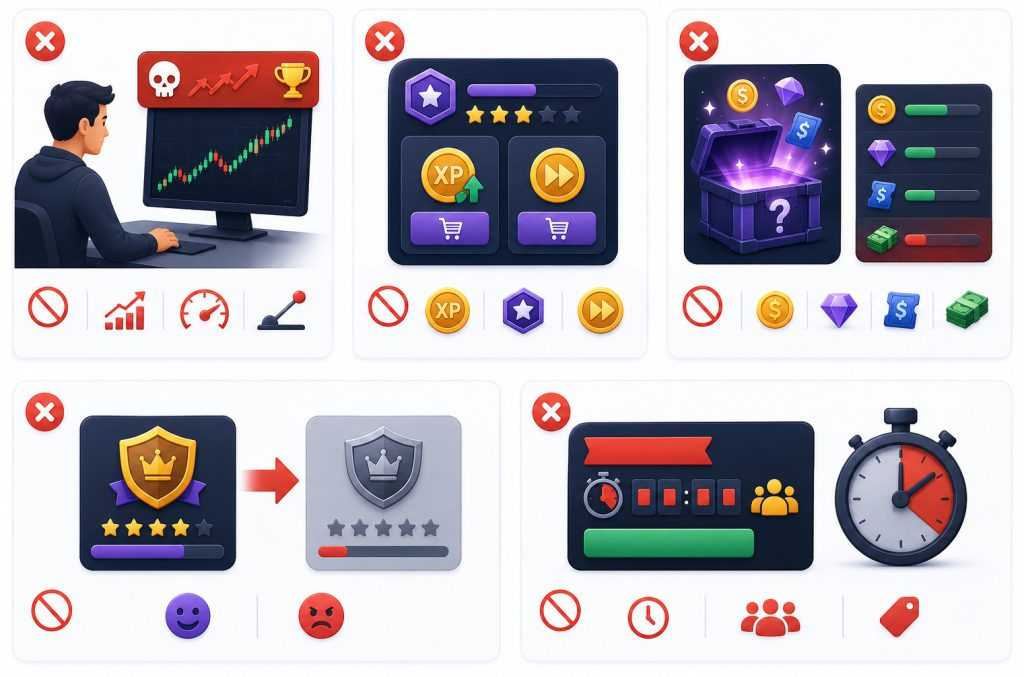
Avoid These Patterns
- Gamifying risk-taking. Never reward traders for taking larger positions, trading more frequently, or using higher leverage. The mechanics should reward discipline, consistency, and skill — not volume.
- Pay-to-progress. XP and levels should be earned through trading activity and achievements, not purchased. If traders can buy XP boosts or skip levels, the system loses credibility.
- Loot boxes and random-chance mechanics tied to real money. Variable rewards are fine when the reward is XP, badges, or fee discounts. They become a regulatory problem when tied to real capital or payouts.
- Punitive mechanics. Taking away earned status as punishment (versus natural decay from inactivity) creates resentment, not motivation.
- Fake urgency. Countdown timers, “limited spots” that aren’t really limited, or artificial scarcity around challenge purchases. Traders see through it, and it damages trust.
Implementation: CRM and Infrastructure Requirements
Gamification doesn’t work as a bolt-on feature. It needs to be integrated into the core trading and CRM infrastructure.
Data Requirements
To power gamification mechanics, the CRM needs access to:
- Trade-level data — every position opened, closed, P&L, drawdown, lot size, duration
- Account-level data — challenge status, phase, rule compliance, payout history
- Behavioral data — login frequency, trading days, streak status, referral activity
- Historical data — XP balance, level, badges earned, leaderboard positions
This data already exists across the trading platform (MT4/MT5/cTrader/DXtrade) and the CRM. The challenge is aggregating it into a real-time scoring engine that can calculate XP, evaluate badge criteria, update leaderboards, and trigger notifications.
Architecture Overview
| Component | Role | Where it lives |
|---|---|---|
| Trading platform | Source of truth for trade data | MT4/MT5/cTrader/DXtrade |
| CRM | Aggregates data, stores XP/levels/badges, manages payout logic | Your CRM deployment |
| Gamification engine | Calculates XP, evaluates rules, triggers events | CRM module or microservice |
| Client portal | Displays progress, badges, leaderboards, streaks | Trader’s room |
| Notification layer | Sends alerts for achievements, streak warnings, level-ups | Email, push, SMS, Telegram |
Build vs Buy
Most prop firm CRMs don’t include gamification out of the box. The options are:
- Build custom — full control, tailored to your program, requires development resources
- Third-party gamification API (e.g., Gamedock, Captain Up, Bunchball) — faster to implement, but may not integrate cleanly with forex-specific data
- CRM-native modules — if your CRM provider offers gamification features, this is the lowest-friction path
The challenge design and risk monitoring infrastructure you already have provides most of the data foundation. Gamification is a presentation and logic layer on top of data you’re already collecting.
Measuring Gamification ROI
Gamification is an investment, and it needs to be measured like one.
Key Metrics to Track
| Metric | What it tells you | Target direction |
|---|---|---|
| Challenge repurchase rate | Are failed traders coming back? | ↑ |
| Funded account longevity | How long do funded traders stay active? | ↑ |
| Average trader LTV | Total revenue per trader over their lifetime | ↑ |
| Daily active traders | Is the platform sticky? | ↑ |
| Streak participation rate | Are traders engaging with streak mechanics? | ↑ |
| Badge completion rate | Are achievement targets set at the right difficulty? | 40–60% is healthy |
| Leaderboard opt-in rate | Do traders care about rankings? | ↑ |
| Time to second purchase | How quickly do failed traders repurchase? | ↓ |
A/B Testing
Roll out gamification features to a subset of traders first. Compare:
- Repurchase rates between gamified and non-gamified cohorts
- Funded account survival rates
- Payout request frequency (are gamified traders trading longer before withdrawing?)
- Support ticket volume (gamification done wrong creates confusion)
If the gamified cohort shows higher LTV and lower churn at statistical significance, roll out to everyone. If not, iterate on the mechanics before scaling.
Conclusion
Gamification isn’t a marketing gimmick — it’s an engagement architecture. The prop firms that implement it well don’t just add badges to their portal and call it done. They build progression systems that align with their business model, reward the behaviors they want to see (discipline, consistency, skill development), and create a long-term relationship between the trader and the platform.
The core insight is simple: a trader who has accumulated status, progress, and identity on your platform is significantly less likely to leave than one who’s just trading on an account number. Every XP point earned, every badge unlocked, every level achieved is a reason to stay — and in a market with dozens of prop firms competing for the same traders, reasons to stay are the most valuable thing you can build.

Request a Consultation on Designing a Gamified Prop Firm Model
Get expert guidance on structuring XP systems, progression paths, scaling tiers, and leaderboard mechanics that align with your prop firm’s economics. We’ll help you evaluate how gamification impacts retention, repurchase rates, and trader lifetime value before deploying it at scale.
Together, we’ll review your current challenge model and outline an engagement architecture built for long-term sustainability.