


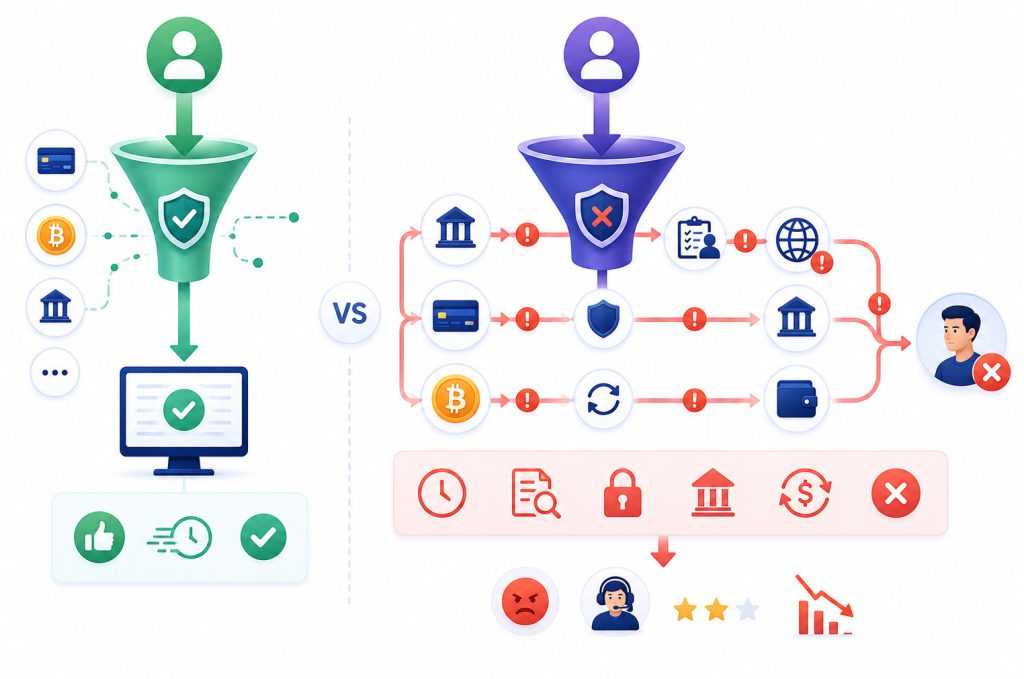
Deposits get all the attention. Payment gateway guides, PSP comparisons, crypto onramps — the industry has no shortage of content about getting money into a brokerage. But the other side of the equation, getting money out, is where operator credibility is built or destroyed.
For traders, payout speed is the single most visible trust signal a broker or prop firm can offer. A funded account means nothing if withdrawals take five business days, get stuck in manual review, or fail without explanation. For operators, payouts are an operational minefield — fraud exposure, compliance friction, liquidity management, and reconciliation complexity all converge on the same workflow.
This article covers how payout infrastructure actually works, what methods are available, where the operational risks sit, and how to build a withdrawal process that’s fast for traders and safe for the business.
Why Payouts Are Harder Than Deposits
Deposits are relatively straightforward. A trader sends money, the PSP confirms it, the CRM credits the account. The flow is one-directional and the incentives are aligned — both the trader and the broker want the money to arrive.
Payouts reverse that dynamic. The money is leaving, and every withdrawal request triggers a chain of checks:
- Is the trader fully KYC verified?
- Does the account have sufficient withdrawable balance?
- Has the profit been legitimately earned?
- Is there a pending bonus or credit that affects the withdrawable amount?
- Are there any chargeback flags on the original deposit?
- Does the withdrawal method match the deposit method for AML compliance?
For prop firms, the complexity multiplies. The money being withdrawn isn’t the trader’s deposit — it’s the firm’s capital, paid out as a profit split. This means the firm needs to verify that the profit is real, that it was earned within the rules of the challenge, and that the trading activity doesn’t show signs of manipulation before any money moves.
Payout Methods: What’s Available and What Each Costs
The methods available for payouts largely mirror deposit methods, but with different cost structures, speed profiles, and geographic coverage.
| Method | Speed | Cost per transaction | Best for | Limitations |
|---|---|---|---|---|
| Bank wire | 2–5 business days | $15–$50 | Large payouts, regulated environments | Slow, expensive, correspondent bank delays |
| E-wallets (Skrill, Neteller, FasaPay) | Same-day / instant | 1–3% | Retail forex, small-medium payouts | Not available in every jurisdiction |
| Crypto (USDT TRC-20, BTC) | Minutes | $0.50–$5 | Prop firms, borderless payouts | Volatility risk, regulatory ambiguity, irreversible |
| Card refund | 3–10 business days | Varies by issuer | Deposit-matching compliance | Only up to original deposit amount |
| Local payment methods (M-Pesa, Help2Pay, DragonPay) | Same-day | Low | Region-specific expansion | Limited geographic coverage |
Bank Wire Transfers
Bank wires remain the default for larger payouts, especially in regulated environments. They’re reliable, widely available, and create a clear audit trail. The downside is speed and cost. For brokerages operating across multiple regions, maintaining wire transfer relationships with banks that serve different corridors is an ongoing operational task.
E-Wallets
Skrill, Neteller, and FasaPay are popular in retail forex because they’re fast and cheaper than wires. The tradeoffs:
- Not every jurisdiction supports every e-wallet
- Some providers have their own compliance requirements that can delay payouts
- Creates an extra reconciliation layer (you’re reconciling against the e-wallet provider, not the trader’s bank)
Crypto Payouts
Crypto (primarily USDT on TRC-20 or ERC-20, and Bitcoin) has become standard for prop firms and increasingly common among retail brokerages. Advantages:
- Speed: minutes, not days
- Cost: low, especially on TRC-20
- Reach: borderless, no banking relationship required
Disadvantages:
- Volatility risk if holding crypto reserves
- Regulatory ambiguity in some jurisdictions
- Irreversible — if fraud is discovered after sending, the funds are gone
Card Refunds
Sometimes required by regulation or PSP policy for the amount equal to the original deposit. This is a compliance mechanism more than a payout method — it ensures the withdrawal path matches the deposit path. Profits above the deposit amount then go out via wire, e-wallet, or crypto.
Local Payment Methods
Vary by region:
- Southeast Asia: local bank transfers via Help2Pay, DragonPay — faster and cheaper than international wires
- Africa: mobile money (M-Pesa, MTN Mobile Money) — sometimes the only practical option
- Latin America: local bank transfers via providers like dLocal or PayRetailers
Brokerages expanding into new regions need to evaluate local payout rails as part of the market entry plan, not as an afterthought.
The Payout Workflow Inside the CRM
A well-built payout system isn’t a button that sends money. It’s a workflow with multiple gates, each designed to catch a specific category of risk before funds leave the business.
Step-by-Step Flow
- Trader submits request through the client portal
- Automated validation — CRM checks:
- KYC status
- Available balance (after open positions, bonuses, credits)
- Withdrawal method matches deposit source
- Minimum/maximum thresholds
- Routing decision:
- Below threshold + verified + clean history → auto-approved
- Above threshold or flagged → manual review queue
- Approval — manual or automatic
- Payout instruction sent to payment provider via API
- Provider processes and sends status callback (success / pending / failed)
- CRM updates the request status; trader sees it in portal
- Reconciliation — daily matching against provider settlements
The CRM automation layer handles the routing logic. Small, clean withdrawals from verified traders with normal activity patterns get processed automatically. Large, unusual, or first-time withdrawals get flagged for human review.
Payout Speed as a KPI
The entire cycle, from request to completion, should be measurable. The best operators track:
- Median payout time (from request to funds sent)
- Auto-approval rate (percentage of payouts processed without manual review)
- Failed payout rate (and reasons for failure)
- First-payout time (how long the first withdrawal takes for new traders)
“Same-day withdrawals” or “payouts processed within 2 hours” is a stronger marketing claim than any spread comparison.
Prop Firm Payouts: A Different Problem
Prop firm payouts deserve separate treatment because the operational model is fundamentally different from a retail brokerage.
Retail Brokerage vs Prop Firm Payouts
| Retail Brokerage | Prop Firm | |
|---|---|---|
| What’s being withdrawn | Trader’s own funds + profits | Firm’s capital (profit split) |
| Verification focus | AML, balance, method matching | Rule compliance, trade legitimacy, profit verification |
| Frequency | On demand | Typically biweekly or monthly |
| Fraud risk | Deposit-withdraw schemes, chargebacks | Profit manipulation, coordinated trading |
| Payout calculation | Balance minus open positions | Gross profit × split ratio − fees |
Verification Before Payout
Before processing a prop firm payout, the operator needs to verify:
Rule Compliance
Did the trader violate any challenge parameters? Check against:
- Daily loss limits
- Maximum drawdown
- Minimum trading days
- Lot size restrictions
- News trading rules
- Weekend holding restrictions
If the trader hit their profit target but violated a rule along the way, the payout may be invalidated.
Trading Manipulation Detection
Common patterns to flag:
- Latency arbitrage — exploiting price feed delays between providers
- HFT scalping — designed to game the evaluation, not demonstrate real trading skill
- Undisclosed copy trading — copying from a known profitable source
- Coordinated accounts — one account long, one short on the same pair, guaranteeing a payout on one
These checks can be partially automated — rule violations are straightforward to detect programmatically — but pattern-based fraud detection typically requires automated flags plus human review. The risk monitoring infrastructure is directly relevant here.
Payout Frequency and Scheduling
Most prop firms offer payouts on a fixed schedule rather than on demand:
| Schedule | Pros | Cons |
|---|---|---|
| Monthly | Maximum time for verification, easier cash flow management | Traders dislike waiting |
| Biweekly | Good balance of speed and safety | Moderate verification pressure |
| On demand | Best trader experience, strong marketing angle | Requires real-time verification pipeline, higher fraud risk |
Fraud Prevention on the Payout Side
Payout fraud is a distinct category from deposit fraud, and it requires its own controls.
Common Fraud Vectors
Deposit-and-Withdraw (Retail)
A trader deposits via credit card, makes a few small trades, then requests withdrawal to a different method (typically crypto or e-wallet). If the withdrawal processes before the card issuer initiates a chargeback, the brokerage loses both amounts.
Defenses:
- Enforce same-method withdrawal for at least the deposit amount
- Implement hold periods on new deposits before funds become withdrawable
- Flag first-time withdrawals for manual review
Profit Manipulation (Prop Firms)
Earning payouts through rule exploitation rather than genuine trading.
Defenses:
- Automated rule compliance checks before payout approval
- Behavioral analysis over time (trader consistently hits exact profit target with minimal drawdown every cycle)
- Minimum trading day requirements to prevent quick-flip strategies
Account Takeover (Both)
A bad actor gains access and changes the withdrawal method.
Defenses:
- Two-factor authentication on withdrawal requests (separate from login 2FA)
- Email confirmation for withdrawal method changes
- IP-based anomaly detection
- Cooling-off period after payment method changes
Identity Fraud (Both)
Accounts created with stolen or synthetic identities. Caught earlier through KYC verification, but intersects with payouts when the withdrawal method doesn’t match the verified identity.
Defense: Name mismatches between trading account and receiving bank/wallet should always trigger manual review.
Reconciliation and Accounting
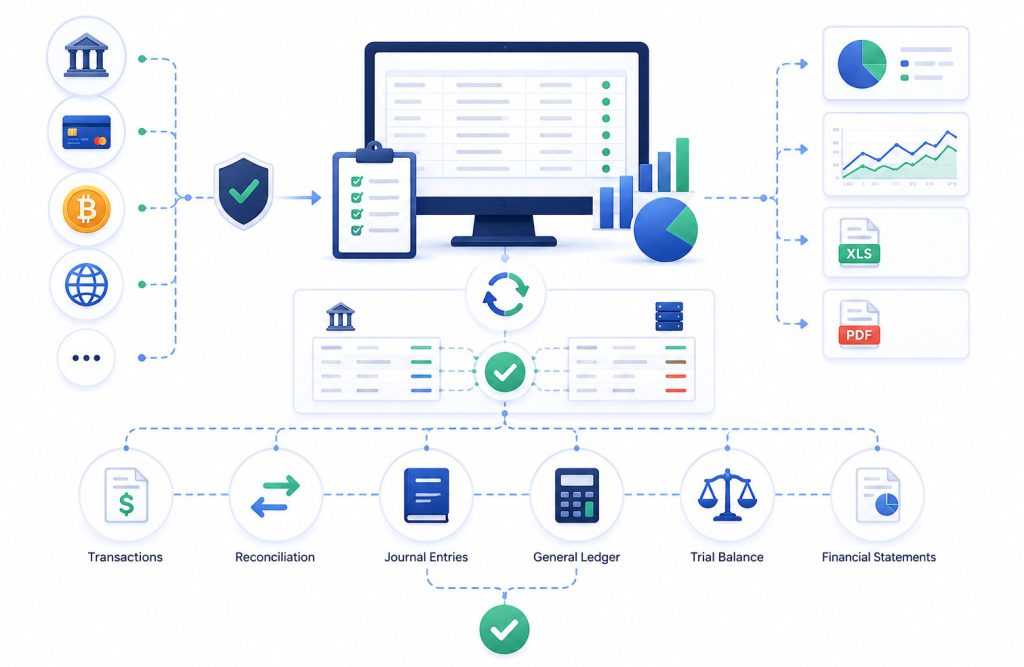
Every payout creates an accounting event that needs to be reconciled against multiple systems.
Daily Reconciliation Checklist
- Match CRM payout records against payment provider settlement statements
- Verify amounts in both trader currency and base currency
- Identify and investigate discrepancies (currency conversion differences, failed transactions not reflected in CRM, delayed crypto confirmations)
- Reconcile against operator bank statements
- For prop firms: verify profit split calculations (gross profit × split ratio − performance fees = net payout)
Common Reconciliation Issues
| Issue | Cause | Fix |
|---|---|---|
| Amount mismatch | Currency conversion by provider | Reconcile at settlement rate, not request rate |
| Missing status update | Provider callback failed | Implement webhook retry + manual status check job |
| Crypto payout stuck | Blockchain congestion | Monitor confirmations; auto-escalate after timeout |
| Batch payout partial failure | One transaction in batch rejected | Process failures individually; don’t block the batch |
Don’t let reconciliation become a monthly manual exercise. Daily automated matching with exception handling for discrepancies is the baseline.
Payout Speed as a Competitive Advantage
In a market where most brokerages offer similar spreads, platforms, and account types, payout speed is one of the few genuine differentiators left. Traders talk about withdrawal experiences more than execution quality — a quick scan of any forex forum or prop firm subreddit confirms this.
What Winning Operators Do
- Automate small, clean withdrawals to reduce manual review queues
- Maintain multiple payout providers with automatic failover — a single provider outage shouldn’t freeze all withdrawals
- Publish transparent policies — methods, timeframes, and fees visible on the website
- Track and publish actual metrics — “average payout time: 4 hours” is a conversion driver
- Invest in CRM workflow — the payment gateway infrastructure built for deposits is only half the story
Some prop firms have turned fast payouts into their primary brand identity. “Payouts processed within 24 hours” or “instant crypto withdrawals” are headlines that convert — because they address the single biggest anxiety a funded trader has: will I actually get my money?
Building Your Payout Infrastructure: Key Decisions
| Decision | Question to answer | Recommendation |
|---|---|---|
| Methods | How many payout methods? | Minimum: wire + one e-wallet (retail). Add crypto for prop firms. Local methods per region. |
| Automation threshold | Below what amount is auto-approval safe? | Start conservative, adjust monthly based on fraud data |
| Failed payout handling | Retry, flag, or return to balance? | Depends on failure reason — CRM must handle all three paths |
| Reconciliation | Daily or monthly? | Daily automated matching. Monthly manual = guaranteed discrepancies |
| Prop firm verification | Automated or manual? | Rule checks automated; pattern analysis = automated flags + human review |
| Provider redundancy | Single or multiple? | Always multiple. One provider down = all withdrawals frozen |
Conclusion
Payout operations sit at the intersection of compliance, risk management, treasury, and client experience. Getting them right requires infrastructure investment, process design, and ongoing operational attention. Getting them wrong costs you traders, reputation, and revenue.
The brokerages and prop firms that treat payouts as a first-class operational concern — fast, transparent, automated where possible, and secure where necessary — build the kind of trust that no marketing campaign can replicate. In an industry where traders have dozens of alternatives, the ability to get money out quickly and reliably is often the reason they stay.

Request a Consultation on Payout Infrastructure Strategy
Get expert guidance on structuring a payout system that balances speed, compliance, and fraud control. We’ll help you evaluate payment methods, approval thresholds, reconciliation workflows, and provider redundancy before scaling withdrawal volumes.
Together, we’ll review your current payout model and outline an infrastructure strategy aligned with operational stability and trader trust.