


MT4 and MT5 are trading platforms. But a brokerage is more than the trading server. A real broker also needs onboarding, KYC, deposits, withdrawals, IB management, support, reporting, permissions, email notifications, and trader room workflows.
That is where an MT4/MT5 API becomes important. The API connects the trading platform to the broker’s operating systems so that data and actions do not stay trapped inside separate tools.
For a growing broker, this is not a minor technical detail. Without clean integration, teams end up copying account numbers, checking balances manually, exporting reports, asking developers for status updates, and reconciling trader activity across disconnected systems. A proper API makes platform data usable inside the Forex CRM and back office.
What is an MT4/MT5 API?
An MT4/MT5 API is an integration layer that connects MetaTrader data and actions with external systems. Depending on the broker’s setup, it can connect MT4 or MT5 with:
- Forex CRM
- trader room software
- back-office dashboards
- reporting systems
- payment workflows
- IB and affiliate tools
- risk management tools
- data warehouses
- support and notification systems
- custom broker applications
One thing worth clarifying is how our API actually works, because it comes in two parts. The first is a standard JSON API service that lets the broker query the trading platform directly: send an account number and get back trade history, deposits, or withdrawals; submit a request for a new account and get back the account number. The second part is direct access to a database that mirrors the data held in the trading platform itself. Instead of asking the platform for a trade history every time, you query the mirror — which means no additional load on the trading server, and no risk of API traffic competing with live trading operations. It also opens the door to better reporting and more reliable tooling, since far more data is available for instant querying: trading data, user records, symbols, groups, securities, and more.
When a trader completes onboarding, the CRM may need to create or display a trading account. When a deposit is approved, the account balance may need to be updated. When the trader requests a withdrawal, the finance team may need current balance and account data before approving it. When an IB receives commission, the back office may need trading volume and account attribution.
None of these workflows should depend on manual exports if the broker wants to scale.
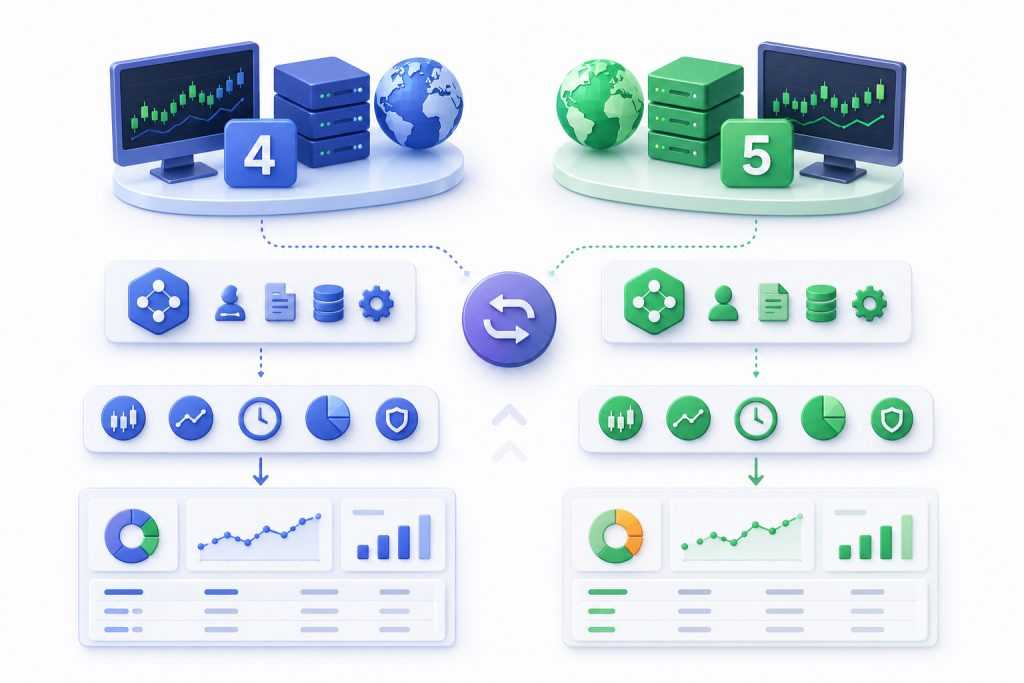
MT4 vs MT5 API: what changes?
MT4 and MT5 are related platforms, but they are not identical. Brokers should not assume that an integration built for one platform can be copied directly to the other without planning.
MT4 API may be designed around older server-side patterns, account structures, and reporting expectations. An MT5 API may support different account models, data structures, and server capabilities. The technical implementation depends on the broker’s platform environment, permissions, hosting model, and required use cases.
From an operations point of view, the broker usually cares about the same business outcomes:
- Can the trader see account information in the client portal?
- Can the admin team see account status in the CRM?
- Can deposits, withdrawals, and internal transfers be reviewed correctly?
- Can the broker pull trading activity for reports?
- Can IB commissions be calculated from accurate account data?
- Can support investigate trader issues without logging into too many systems?
- Can risk and compliance teams access the data they need?
The API should be designed around these workflows first, not around a generic list of endpoints.
Kenmore’s MT5 API JSON and MT4 API JSON resources show how platform data can be made available for broker-side applications and integrations.
What an MT4/MT5 API usually connects
A broker can cover many different workflows, but most projects start with a few common areas.
1. Account creation and account visibility
When a trader opens an account, the CRM or trader room needs to show the right account details. Depending on the setup, the API may support account creation, account lookup, account status, account group assignment, or display of trading credentials.
This is important for both retail brokers and prop firms. A trader should not need to wait for manual account setup if the business process can be automated.
2. Balance and transaction workflows
Deposits, withdrawals, bonuses, adjustments, and transfers often need platform-side balance information. The API helps the broker avoid manual reconciliation between the CRM, payment providers, and trading platform.
This connects naturally with forex payment solutions and payment gateway workflows. A deposit is not complete just because a payment provider approves it. The broker still needs the account workflow to reflect the funding event correctly.
3. Trading history and reporting
Back-office teams need access to trading data for support, compliance, IB calculations, and operational analysis. The API can help move trading history into the CRM, reporting dashboard, or database environment.
Kenmore also provides data replication resources such as MT4 data replication to MySQL and MT5 data replication to MySQL for brokers that need structured platform data outside the trading server.
4. IB and affiliate calculations
Introducing broker programs depend on accurate trader attribution and trading activity. If the CRM cannot access platform-side volume or account activity reliably, commission workflows become fragile.
The API can support the data flow needed for IB management, affiliate reporting, and partner commission review. This is especially important for brokers that run multi-level IB programs or use partner networks as a major acquisition channel.
5. Risk and operational monitoring
Risk teams may need trading activity, open positions, account equity, or behavioral signals to make decisions. The exact data depends on the broker’s business model, but the integration principle is the same: risk workflows should not rely only on manual platform checks.
For prop firms, platform data also connects with challenge rules, breaches, funded trader status, and payout review. This is why the platform data can become part of the larger prop firm CRM operating model.
Why brokers need an API instead of manual exports
Manual exports can work in the earliest stage of a brokerage. But they become expensive as soon as the business grows.
The common symptoms are easy to recognize:
- support asks operations to check account status manually
- finance waits for platform data before approving withdrawals
- IB commissions require spreadsheet cleanup
- reports are generated from several systems and do not match
- traders contact support because account updates are delayed
- compliance cannot quickly review account history
- developers become the bottleneck for routine data requests
the SQL DB reduces this friction by turning platform data into operational data. The CRM can become the place where teams work instead of forcing every department to log into separate systems.
This is the same reason brokers invest in a Forex CRM integration rather than treating the CRM as a standalone contact database. Brokerage workflows are connected by nature. Account data, payments, KYC, support, and reporting all affect each other.
When a broker should consider a custom MT4/MT5 API
The API may be worth considering when:
- the broker uses several platforms or account types
- the CRM needs real-time or near-real-time platform data
- deposits and withdrawals require platform-side balance actions
- the broker has a large IB or affiliate program
- support teams spend too much time checking platform status manually
- risk teams need better access to account and trading activity
- the broker wants custom trader room features
- reports from the CRM and platform do not match cleanly
- the business is migrating from one CRM or platform setup to another
- the broker needs data replication for analytics or compliance review
For brokers planning a larger technology change, the API should be included in the migration plan. Kenmore’s guide on migrating a brokerage to a new CRM is useful because platform integration is often one of the areas where migrations become risky.
How the APIs complete the Trader’s Room
A trader room is the client-facing layer where users manage their profile, documents, accounts, deposits, withdrawals, downloads, support requests, and trading-related activity. If the trader room cannot access platform data, the trader experience becomes incomplete.
The API enable the Trader’s Room show account information, trading history, account status, and funding-related updates. This gives the trader a more connected experience without forcing them to rely only on the trading terminal.
Kenmore’s article on the Forex CRM client portal and trader room dashboard explains why the trader room should be treated as part of the broker’s operating system, not as a cosmetic frontend.
API implementation planning checklist
Before starting an MT4/MT5 integration project, the broker should define the business workflows first. Technical endpoints matter, but they should follow the operational requirements.
Useful questions include:
- Which platform is being connected: MT4, MT5, or both?
- Does the broker need account creation, account lookup, or only reporting?
- Which data must appear in the CRM and trader room?
- Which actions should be automated and which should stay manual?
- How should deposits and withdrawals interact with the platform?
- What does support need to see without logging into the trading server?
- What data does finance need before approving withdrawals?
- What does the IB or affiliate workflow require?
- Does the broker need data replication to a database?
- What permissions and audit trails are required?
- How will errors, failed actions, and sync delays be handled?
- Who owns the integration after launch?
The answers should become part of the integration specification. An API that only moves data without supporting real workflows may still leave the broker with manual operations.
Common mistakes in MT4/MT5 API implementation projects
The biggest mistake is treating the API as a purely technical connector. Brokers often ask for “MT5 integration” without first defining what the business needs the integration to do.
Other common mistakes include:
- building only for deposits but not withdrawals
- ignoring support and finance workflows
- failing to plan for IB commission data
- depending on manual exports for reporting
- not documenting permissions and error handling
- assuming MT4 and MT5 will behave the same way
- building a trader room that does not reflect real account status
- postponing data migration and reconciliation planning
A good API integration project starts with the broker’s operating model: trader signup, KYC, account creation, funding, trading, reporting, support, withdrawals, and partner management.
How this connects with broker growth
As a broker grows, operational gaps become more expensive. A manual account check that was acceptable with 50 traders becomes a bottleneck with 5,000. A spreadsheet-based IB calculation may work for a small partner program, but not for a serious acquisition channel. A delayed withdrawal review may be manageable early on, but damaging when trader volume increases.
An MT4/MT5 API helps the broker build a scalable connection between trading activity and business operations. It gives the CRM and back office the data they need to run the brokerage, while keeping the trading platform focused on trading.
For brokers comparing platform and infrastructure options, Kenmore’s Forex aggregator guide can also help clarify how trading infrastructure, liquidity, and operations fit together.
Final thought
An MT4/MT5 API is not just a developer tool. It is the connection between the trading platform and the broker’s day-to-day operating system.
When the API implementation project is planned properly, the broker can reduce manual work, improve reporting, support payment workflows, strengthen IB operations, and give traders a better client portal experience. When it is planned poorly, teams still end up relying on manual checks, exports, and disconnected dashboards.
The right approach is to start with the business workflow, then implement the API to the data and actions each team needs. For forex brokers and prop firms, that is how platform integration becomes operational infrastructure instead of another isolated technical project.

Request a Consultation on MT4/MT5 Integration Strategy
Get expert guidance on planning an MT4 or MT5 integration that supports your brokerage’s operational workflows—not just data exchange. We’ll help you evaluate account management, payment processes, reporting, IB operations, Trader Room functionality, and CRM connectivity before development begins.
Together, we’ll review your current infrastructure and outline an integration strategy built around your business processes.