


For most retail forex brokerages, Introducing Brokers (IBs) and affiliate networks deliver between 30 and 70 percent of new client acquisition. The economics are compelling: pay only for results, leverage local market knowledge in regions where the broker has no presence, and scale acquisition channels without proportionally scaling marketing headcount.
But the operational complexity grows fast. A flat referral structure is easy. A two-tier IB program is manageable. A network of 500 partners across five tiers, with mixed commission models, volume-based bonuses, and sub-IB overrides — that’s a full-time job to administer manually, and the kind of system that breaks down loudly when it breaks.
This guide covers how multi-level IB management systems actually work, what the architecture needs to support, how commission models stack and interact, what makes partner portals effective, how to prevent fraud, and where the most expensive operational mistakes get made.
Why IB Networks Matter
The economics of paid forex marketing have shifted. Facebook and Google have steadily tightened restrictions on financial services advertising. CPCs in competitive geographies have multiplied. Direct-response acquisition that worked at $300 CPA five years ago now costs $1,200 in many markets, with worse retention.
IB networks bypass much of this. A regional IB with an existing audience — a trading-focused Telegram channel, a YouTube presence, a closed Discord — can deliver pre-qualified leads at a fraction of paid-acquisition cost. The broker pays only on conversion, the IB earns recurring commission, and both sides have aligned incentive to keep the trader profitable.
For a foundational view of what an IB is and how the relationship works, see the complete guide to introducing brokers.
Multi-level IB networks extend this further. Top-tier “master IBs” recruit sub-IBs, who in turn recruit clients. Each tier earns from the activity below them. This structure incentivizes the master IBs to do recruitment work the broker would otherwise have to do itself.
IB Hierarchy: How Multi-Tier Structures Work
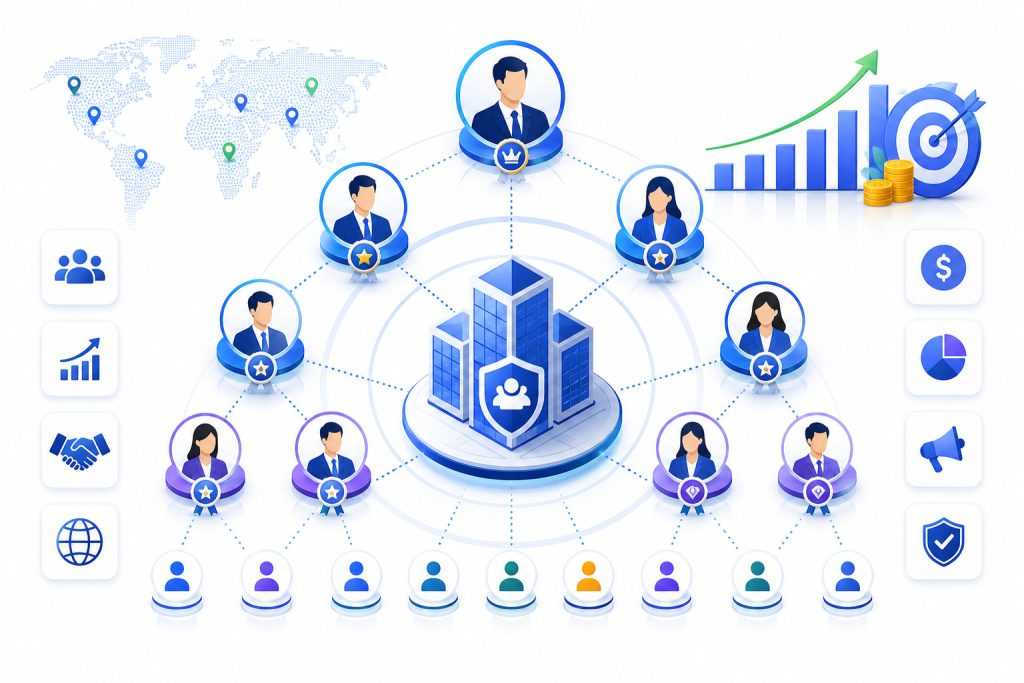
A multi-level IB program is built around a tree. The broker sits at the top. Each IB has a parent (the IB or entity that recruited them) and zero or more children (the IBs they’ve recruited). Below the IBs sit the actual trading clients.
A common structure:
| Tier | Role | Typical commission |
|---|---|---|
| 1 | Recruits sub-IBs; brings own clients | 50 – 70% of broker’s net |
| 2 | Recruits sub-IBs; brings own clients | 30 – 50% of broker’s net |
| 3 | Brings own clients | 20 – 40% of broker’s net |
| 4 | Brings own clients only | 15 – 30% of broker’s net |
| Client | Trades | — |
When a client trades, the system walks up the tree and pays each IB level the commissions per Broker’s settings. The exact commissions vary widely, and allow per-relationship overrides — a particular master IB may have negotiated a different deal than the default.
The tree depth varies by broker. Most cap at three to five tiers. Deeper structures rarely add value and start to resemble multi-level marketing schemes, which some jurisdictions explicitly restrict for financial products.
A purpose-built multi-level IB system is essential for managing this structure at any scale — manual tracking of multi-tier commissions in spreadsheets breaks down past about 20 active partners.
Commission Models
There are three primary commission models in forex IB programs. Most brokerages run more than one simultaneously, and many run all three in different combinations per partner.
Revenue share (rebate from spread)
The IB earns a percentage of profit or the spread or commission generated by their clients’ trades.
Pros: Recurring revenue for the IB; aligned long-term incentive; works for any client size. Cons: Slower to ramp up; new IBs may wait months to see meaningful payouts.
Pips (Points)
The IB earns a set number of pips on every trade their clients place — for example, 1 pip per lot — so the more clients trade, the more the IB earns. Because it’s measured in pips, the commission scales automatically with trade size and volume.
Cash Per lot
The IB earns a fixed cash amount for every lot their clients trade — for example, $5 per lot — regardless of the spread or the instrument. Earnings depend purely on trading volume, so the more lots clients trade, the more the IB earns.
Volume-tiered bonuses
Many programs layer volume bonuses on top of the base model. An IB whose clients trade over 10,000 lots in a month moves from to higher commission automatically. Some programs add additional tiers — 20,000 lots, 50,000 lots, 100,000 lots — with progressively better rates.
These tiers create strong incentives for IBs to scale, but they need to be tracked in real time. Manual recalculation at month-end means partners can’t see what they’re earning, which kills motivation. Modern systems show running totals and projected tier achievement live.
IB Back-office (Partner Portal) Essentials
The partner portal is to IBs what the traders room is to end-traders — the daily interface that determines whether the relationship feels professional or amateur.
A well-designed partner portal should expose:
- Real-time earnings dashboard. Today, this week, this month, all-time. Broken down by referral, by commission type, and by tier (own clients vs sub-IB activity).
- Referral tracking. Every click on the IB’s referral links, every registration, every account funded, every active trader. With clear attribution and the ability to drill down to specific clients (within privacy limits).
- Sub-IB management. For master IBs, the ability to invite new sub-IBs, see their performance, and (in many programs) adjust commission splits within configured limits.
- Marketing materials library. Banners, landing pages, social posts, video assets — sized and formatted for the platforms IBs actually use.
- Custom landing pages. Some IBs need branded landing pages or modified registration forms for their audience. The portal should support this within compliance limits.
- Payout history. Every payout, when it was paid, what method, what reference. Plus pending balances and next payout date.
- Reports. Daily, weekly, monthly performance reports IBs can download for their own records.
The marketing materials piece is often underweighted. IBs are running their own businesses; the easier the broker makes promotion, the more the IB will promote. Promo materials and referral tools for IBs covers the asset mix that typically drives the highest IB activation.
Referral Tracking and Attribution
The technical foundation of any IB program is referral tracking. Every click, registration, and funded account needs to be attributed to the right IB — and in a multi-level system, attributed through the chain.
The standard mechanics:
- Referral links with embedded IB identifier (e.g.,
broker.com/?ib=12345). - Cookies that persist the IB ID on the visitor’s browser.
- Server-side attribution for registrations — when a new client registers, the IB ID from the cookie is captured and stored permanently against that client record.
- Persistent attribution. Once a client is attributed to an IB, that relationship is permanent for the lifetime of the account (or until the broker explicitly transfers it).
Edge cases that need careful handling:
- Multiple IBs touching the same client. Different brokers handle this differently — first-touch attribution, last-touch attribution, or split commission. Pick a policy and document it clearly in the IB contract.
- Cookie expiry. A client who clicks an IB link, doesn’t register for two months, then registers without going through the link again — does the original IB get credit? Configurable, but document the rule.
- Cross-device tracking. A client clicks on their phone, registers on their laptop — without proper cross-device attribution, the IB loses credit. Modern systems use fingerprinting, email matching, or login-based attribution to bridge devices.
- Direct registrations claimed by IBs. An IB may claim that a client who registered directly is theirs because they referred verbally. Without proof of attribution, this becomes a relationship-management problem. Some brokers allow manual attribution with documentation; others refuse it as policy.
Payout Reports and Automation
Once commissions are calculated and approved, they can be paid directly into the Introducing Broker’s trading platform account.
From there, the funds become available for withdrawal or internal transfer to a trading account, depending on the broker’s setup and payment policy. Many brokers also apply a minimum transfer or withdrawal amount, ensuring that commission payouts are processed efficiently and in line with their internal financial rules. Most brokerages require human approval for larger amounts.
For brokers handling significant payout volume, the same operational rigor applies as to client withdrawals — see forex trader payout solutions for the cross-cutting operational pattern.
Fraud Prevention
IB programs attract fraud. The fraud patterns are predictable and the defenses are well understood, but only if the broker is paying attention.
Self-referrals
An IB creates a fake client account using their own funds, generates trading activity to harvest CPA or rebate, then closes the account or withdraws funds. Detection:
- IP address matching between IB account and referred client.
- Device fingerprint matching.
- Funding source matching (same card, same bank, same crypto wallet).
- Behavioral patterns (immediate funding, immediate trading to threshold, immediate stop).
Bonus abuse
Where the broker offers welcome bonuses, IBs may create rings of fake clients to harvest bonuses. Detection: KYC document analysis, geographic clustering, payment method clustering.
Pre-trading volume manipulation
Sophisticated IBs may instruct their referred clients to trade large lot sizes against tight stop-losses, generating volume (and rebate) without real trading intent. Detection: looking for patterns of high-volume, low-net-P&L trading with quick stop-outs.
Two-account trading (matched trades)
Two related accounts (often referred by the same IB) trade opposing positions, generating volume for both with no net market exposure. The IB earns rebate on both sides. Detection: cross-account trade timing analysis.
A robust fraud-prevention layer reviews all of these patterns automatically, flags suspicious activity for human review, and can claw back commissions for confirmed fraud. Some brokers also include explicit anti-fraud clauses in IB contracts with the right to suspend payouts and accounts on investigation.
CRM Integration
The IB management system isn’t a standalone product — it’s a core part of the CRM. Every trade flows in from the trading platform. Every client interaction flows in from the sales and support teams. Every payment flows in from the PSP layer. The IB system sits in the middle, attributing activity and crediting accordingly.
The integration points:
- Trade feed. The IB system needs real-time visibility into every executed trade, with full attribution to the client and (through the client) to the IB hierarchy.
- Deposit feed. Funding events trigger CPA calculations, qualification thresholds, and bonus releases.
- Client lifecycle events. Account opening, KYC approval, first deposit, first trade — each may have IB-side consequences.
- Partner portal. The portal pulls from the same CRM database, with read-only access scoped to the IB’s own hierarchy.
- Support and sales tools. Internal staff see the IB attribution on every client, which informs how they handle the relationship.
This deep integration is why bolt-on IB tracking tools rarely work well at scale. The data needs to be native to the CRM, not synced from a separate system with latency and reconciliation overhead.
Common Pitfalls
- Vague commission terms. “Up to 50% revenue share” with no defined tier structure invites disputes and undermines IB trust. Document the exact formula in the contract.
- No partner portal transparency. IBs who can’t see their earnings in real time lose motivation and assume the worst. Visibility is a major retention tool.
- Manual commission calculation. Doesn’t scale, breaks under load, generates errors that damage partner relationships.
- Underestimating fraud. “Our IBs are all legitimate” is a common famous-last-words scenario. Build fraud detection in from the start.
- Slow payouts. Brokers who pay late lose partners faster than any other failure mode. Predictable payout schedules with clear timelines are non-negotiable.
- Treating all IBs the same. A master IB driving $50,000 of monthly net revenue needs a different relationship than a junior affiliate driving $500. Tier the support and the contract terms accordingly.
Conclusion
Multi-level IB programs are one of the highest-leverage growth channels in forex brokerage. The mechanics are well understood, but the operational discipline required to run them well is what separates programs that scale from programs that stall.
The brokerages that get this right invest in proper infrastructure — multi-tier commission engines, transparent partner portals, fraud detection, automated payouts — and treat their top partners as strategic relationships, not transactional sources of leads. The result is an acquisition engine that compounds over time. Master IBs recruit sub-IBs. Sub-IBs build their own audiences. The network grows beyond what the broker could ever do alone.
The brokerages that try to run multi-tier IB programs on spreadsheets, with vague commission terms and slow payouts, end up with a different outcome: small partners drift away, large partners take their networks to a competitor, and the broker is left with the same direct-acquisition challenge they were trying to solve. The infrastructure investment pays back many times over — but only if it’s made deliberately, not after the program has already broken under its own complexity.

Request a Consultation on Building a Multi-Level IB Program
Get expert guidance on structuring a scalable IB network that aligns partner incentives with long-term brokerage growth. We’ll help you evaluate commission models, hierarchy design, partner segmentation, and fraud controls before your network reaches operational complexity.
Together, we’ll review your current acquisition strategy and outline an IB framework built for sustainable expansion.