


Forex brokerages operate in a market that never sleeps. Traders expect 24/7 access to their accounts, instant deposits, and uninterrupted order execution. When something breaks — a server goes down, a payment provider stops responding, a database gets corrupted — the clock starts immediately. Every minute of downtime costs money, erodes trust, and pushes traders toward competitors who are still online.
Yet most small and mid-size brokerages have no formal disaster recovery plan. They rely on their hosting provider’s uptime guarantee, their CRM vendor’s backups, and the assumption that nothing catastrophic will happen. This article covers the scenarios that actually take brokerages offline, the infrastructure decisions that determine how fast you recover, and the planning process that turns a crisis from a business-ending event into a manageable disruption.
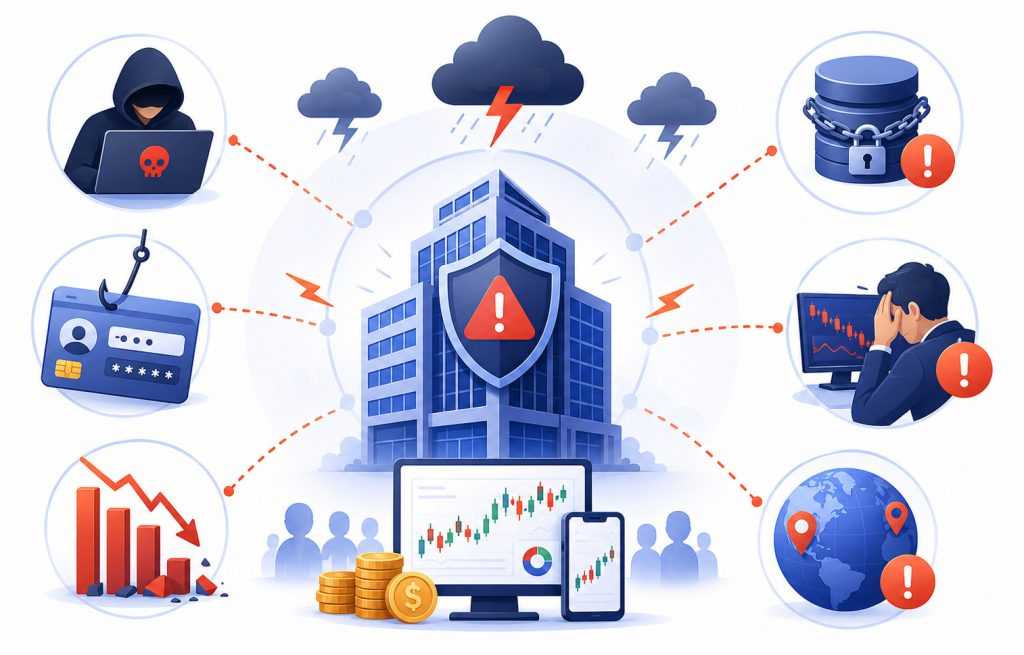
Why Brokerages Are Especially Vulnerable
A typical forex brokerage runs a complex stack of interconnected systems: one or more trading platforms (MT4, MT5, cTrader, DXtrade), a CRM with client data and compliance records, multiple payment gateways, KYC verification services, email and communication tools, and a client-facing portal. A failure in any one of these components can cascade into the others.
The 24/7 nature of forex makes this worse: If the trading platform bridge goes down, clients can’t execute trades. If the CRM database becomes unavailable, the back office can’t process withdrawals or verify new accounts. If a PSP integration breaks, deposits stop flowing. These aren’t hypothetical scenarios — they happen regularly across the industry, and the brokerages that survive them are the ones that planned for them in advance.
The Threats That Actually Take Brokerages Down
Before building a disaster recovery plan, it helps to understand what you’re defending against. The threats fall into a few categories.
Hardware and infrastructure failures are the most common. A server crashes, a disk fails, a data center has a power outage. If your trading platform or CRM runs on a single physical server with no redundancy, a single hardware failure can take your entire operation offline. Cloud hosting reduces this risk but doesn’t eliminate it — even AWS and Azure have regional outages.
Cyberattacks are a growing concern. DDoS attacks are particularly common against forex brokerages because attackers know the business is time-sensitive and operators may pay to make the problem go away. Ransomware is another escalating threat, especially for brokerages that store sensitive client data including KYC documents. A solid data security foundation is the first line of defense, but it needs to be paired with a recovery plan for when defenses fail.
Third-party service outages affect brokerages that depend on external providers. A payment gateway goes down, a KYC verification API stops responding, or a trading platform provider has server issues. You can’t control these, but you can plan for them. Brokerages that rely on a single PSP for all deposits are one outage away from a complete revenue freeze, which is one reason why diversifying across multiple payment gateways is an operational necessity, not just a convenience.
Human error is the cause of more outages than most operators want to admit. A database migration script runs against production instead of staging. A firewall rule change blocks all inbound traffic. A server gets rebooted during peak hours because someone forgot to check the trading calendar. These are preventable with proper access controls and change management procedures, but they still need to be part of the recovery plan.
RTO and RPO: The Two Numbers That Define Your Plan
Every disaster recovery plan is built around two metrics: Recovery Time Objective (RTO) and Recovery Point Objective (RPO).
- RTO is the maximum amount of time your business can be offline before the impact becomes unacceptable. For a forex brokerage, this is typically measured in minutes to low single-digit hours. If your trading platform is down for four hours during the London session, you’ll lose traders permanently — not just for that session, but for good.
- RPO is the maximum amount of data you can afford to lose. If your last database backup was 24 hours ago and the server fails now, you lose a full day of client registrations, deposits, withdrawal requests, and trading account changes. For most brokerages, an RPO of more than one hour is already a compliance risk — you may not be able to reconstruct KYC approvals, financial transactions, or IB commission calculations.
These two numbers drive every infrastructure decision that follows. A brokerage that needs a 15-minute RTO and a 5-minute RPO needs real-time database replication, automated failover, and pre-configured standby systems. A brokerage that can tolerate a 4-hour RTO and a 1-hour RPO can use scheduled snapshots and manual failover procedures. The cost difference between these two approaches is significant, so the first step is to be realistic about what your business actually needs.
Building the Infrastructure for Recovery
Once you’ve defined your RTO and RPO, the infrastructure requirements follow logically.
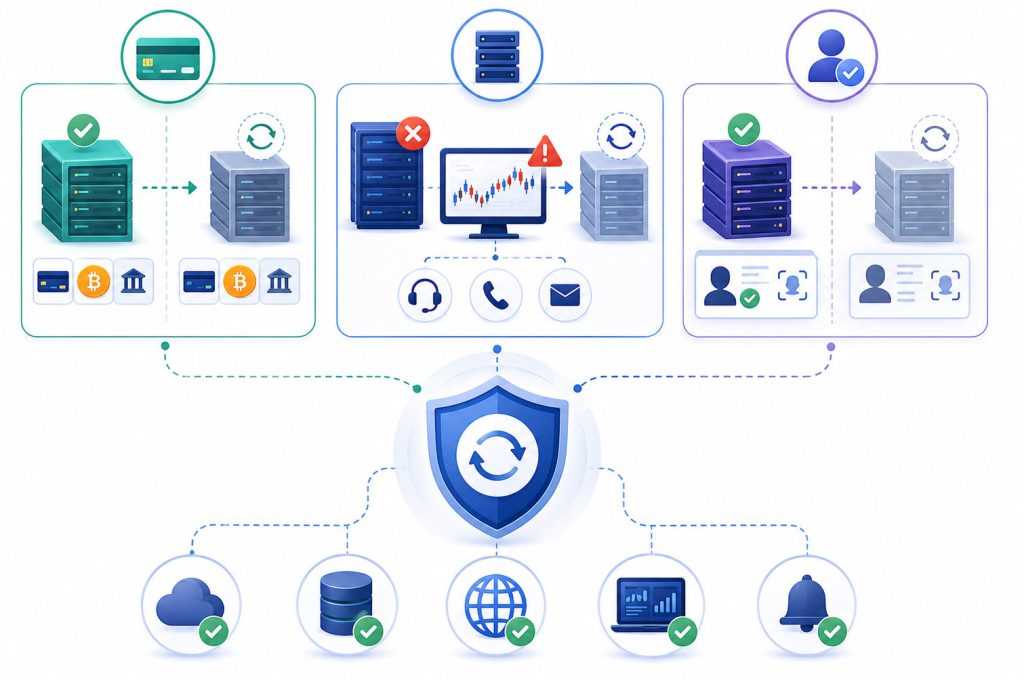
Database replication is the foundation. Your CRM database, which holds every client record, every transaction, every compliance document, and every IB relationship, needs to be replicated to at least one secondary location in near-real-time. Most modern database engines support synchronous or asynchronous replication. Synchronous replication (where every write is confirmed on both primary and replica before it’s acknowledged) gives you an RPO of zero but adds latency. Asynchronous replication is faster but introduces a small window of potential data loss.
Geographic redundancy means your backup systems are in a different physical location than your primary systems. If your brokerage runs out of a single data center in London and that data center has a power failure, a replica in the same building does nothing. A replica in Frankfurt or Amsterdam keeps you running. This applies to every critical component: the CRM, the client portal, file storage for KYC documents, and the trading platform bridge infrastructure.
Automated failover is what separates a 15-minute RTO from a 4-hour one. If your primary database server fails and someone needs to wake up, login into the backup server, promote the replica to primary, update DNS, and restart services, that’s hours. If a load balancer or database proxy automatically routes traffic to the healthy replica, that’s minutes. The automation needs to be tested regularly — failover that works in theory but has never been triggered in practice is not failover at all.
Backup strategy goes beyond database replication. You also need periodic full backups stored in a separate location (ideally a different cloud provider or offline storage) for protection against ransomware or accidental deletion. Daily full backups with hourly incrementals is a reasonable baseline for most brokerages. These backups need to be encrypted, tested for restorability on a regular schedule, and retained according to your compliance requirements.
Planning for Third-Party Failures
Not everything that breaks is under your control. Your disaster recovery plan needs to account for failures in the services you depend on.
For payment processing, the answer is redundancy. Never rely on a single PSP for all deposit methods. If your primary card processor goes down, a secondary processor should be ready to take over — ideally with automatic routing so clients don’t notice the switch. The same applies to crypto payment providers and wire transfer intermediaries. Your CRM deployment should support multiple PSP integrations that can be activated or deactivated without code changes.
For trading platform outages (MT4/MT5 server issues, cTrader downtime), the options are more limited because you typically can’t run a backup MetaTrader server on a different provider. What you can do is have a clear communication plan, documented escalation paths with your platform provider, and SLAs that define response times. If you’re evaluating platform providers, ask about their own disaster recovery infrastructure before signing.
For KYC and verification services, maintain integrations with at least two providers. If your primary ID verification API goes down, the fallback should be pre-configured and tested, not something your development team scrambles to set up during an outage.
The Communication Plan
Technical recovery is half the job. The other half is telling the right people what’s happening, fast.
Your communication plan should cover three audiences: clients, internal team, and partners.
For clients, prepare templates in advance for the most likely scenarios: trading platform downtime, deposit processing delays, portal unavailability, and scheduled maintenance. These templates should be ready to deploy through email, SMS, and your client portal’s notification system. During an actual outage, the worst thing you can do is stay silent — traders will assume the worst and start posting on forums and social media.
For your internal team, define an escalation matrix. Who gets called first when the CRM goes down at 3 AM? Who has the authority to trigger a failover? Who communicates with clients? These roles need to be assigned in advance, with backup people for every role. A runbook that lives in a shared document is useless if the shared document is hosted on the same server that just went down — keep a copy somewhere independently accessible.
For partners — IBs, payment providers, liquidity providers — they need to know about outages that affect their operations. IBs whose referral links are broken need to hear from you before they hear from their traders. Payment providers need to know if you’re switching to a backup processor so they can monitor for reconciliation issues.
Testing the Plan
A disaster recovery plan that hasn’t been tested is a document, not a plan. Regular testing is what turns it into something your team can actually execute under pressure.
Tabletop exercises are the simplest form of testing. Gather your team, present a scenario (“The primary database server just failed at 10 AM London time”), and walk through every step of the response. Who does what? In what order? Where are the access credentials for the backup systems? How long does each step take? These exercises consistently reveal gaps that look obvious in retrospect but that nobody noticed on paper.
Failover drills go further — you actually trigger the failover to the backup system, verify that everything works, and then fail back to the primary. Do this quarterly at minimum, ideally monthly. Track how long the process takes and whether the result matches your RTO and RPO targets. If your target RTO is 30 minutes but your last drill took 90 minutes, you know where to invest.
Backup restoration tests verify that your backups are actually usable. At least once a quarter, take a backup and restore it to a separate environment. Verify that client data is intact, that KYC documents are accessible, that trading account mappings are correct, and that IB structures are complete. A backup that can’t be restored is not a backup.
Compliance Considerations
Depending on your regulatory environment, disaster recovery may not be optional — it may be a licensing requirement.
Regulated brokerages under CySEC, FCA, ASIC, or other authorities are typically required to maintain business continuity plans, demonstrate data recovery capabilities, and report significant outages to their regulator. Even if your brokerage operates in a lighter regulatory environment, having a documented and tested DR plan is a trust signal to potential clients and partners who conduct due diligence before working with you.
Data retention requirements also intersect with disaster recovery. If a regulator requires you to retain client records for seven years, your backup and archival strategy needs to guarantee that data remains accessible and recoverable for that entire period. This means backup media rotation, integrity checks, and clear documentation of what data is stored where.
What a Minimum Viable DR Plan Looks Like
Not every brokerage needs a multi-region active-active setup with zero-downtime failover. That costs serious money and engineering resources. But every brokerage, regardless of size, should have the following:
Automated daily database backups stored in a geographically separate location, encrypted, with monthly restoration tests. At least two PSP integrations active and tested, so deposits can continue if one goes down. A documented escalation matrix — who gets called, in what order, with current phone numbers (not emails — email might be down too). Pre-written client communication templates for the three most likely outage scenarios. A runbook for each critical system (CRM, trading platform bridge, client portal) that covers manual restart, failover, and rollback procedures. Quarterly tabletop exercises that walk through at least one failure scenario end to end.
This doesn’t require a six-figure infrastructure investment. It requires time, documentation, and the discipline to test regularly.
Conclusion
Disaster recovery isn’t something most brokerage operators think about until something goes wrong. By then, it’s too late to plan — you’re reacting, improvising, and hoping the damage is contained. The brokerages that weather outages, cyberattacks, and provider failures are the ones that decided in advance what they would do, built the infrastructure to support it, and tested their plan before they needed it.
The market doesn’t wait for you to recover. Your competitors don’t pause while your systems are down. And your clients don’t give you a second chance if they can’t access their funds or execute their trades when it matters. The time to build your disaster recovery plan is now — while everything is still working.

Request a Consultation on Brokerage Disaster Recovery Strategy
Get expert guidance on defining realistic RTO and RPO targets for your brokerage and aligning them with your operational and regulatory obligations. We’ll help you assess infrastructure redundancy, payment resiliency, communication workflows, and failover readiness before a crisis tests your systems.
Together, we’ll review your current continuity posture and outline a structured disaster recovery framework built for 24/5 trading environments.