


The global retail forex market processed over $9.6 trillion in daily volume in 2025, according to the Bank for International Settlements — a 28% increase from 2022. As trading volume grows and competition intensifies, the technology infrastructure a brokerage runs on has become one of its primary competitive differentiators. Brokerages that operate on fragmented, manually intensive systems consistently underperform those running integrated, automated stacks — in onboarding speed, client retention, compliance posture, and operational cost.
This guide covers the core components of forex broker software, how each layer of the technology stack works operationally, and what to evaluate when selecting or upgrading brokerage infrastructure.
What Is Forex Broker Software?
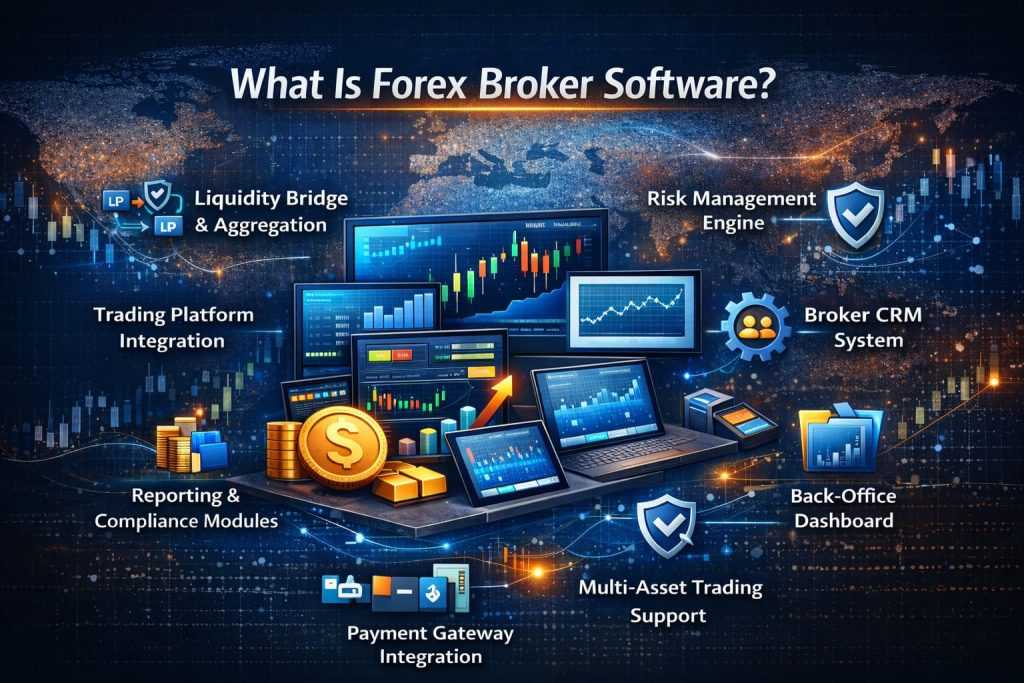
Forex broker software is the complete technological infrastructure that allows a brokerage to operate trading services, manage liquidity, monitor risk, handle compliance, and automate client management. It is not a single product — it is a stack of interconnected systems that must work together in real time to deliver a functional brokerage operation.
A fully operational forex brokerage requires technology across seven functional layers: trading platform, liquidity bridge, risk management engine, CRM and back-office system, client portal, payment infrastructure, and reporting and compliance tools. Each layer is a distinct software system — and the quality of integration between them determines how efficiently the brokerage operates.
Core Components of Forex Brokerage Technology
1. Trading Platform
The trading platform is the interface traders interact with daily — it defines their execution experience, determines which instruments they can trade, and sets the technical baseline for the broker’s product offering. Platform choice is one of the most significant infrastructure decisions a brokerage makes, as it affects trader acquisition (traders prefer platforms they already know), retention (unfamiliar or unreliable platforms drive churn), and integration complexity (each platform has different API and back-office connectivity requirements).
The platforms most widely deployed by forex brokerages in 2026 are MetaTrader 4, MetaTrader 5, cTrader, DXtrade, and Match-Trader. Each has different strengths across asset class coverage, execution transparency, API capability, and white-label architecture. For a detailed breakdown of how execution model choice — A-book, B-book, or hybrid — interacts with platform selection, see the guide on A-book vs B-book vs hybrid execution models.
2. Liquidity Bridge and Aggregation
The liquidity bridge connects the trading platform to one or more liquidity providers, routing orders and managing price feeds. For brokerages operating an STP or ECN model, the bridge determines execution quality — how quickly orders reach the LP, how slippage is handled, and how price feeds are aggregated across multiple providers. For brokerages operating a B-book or hybrid model, the bridge determines how internalized flow is managed and when positions are hedged externally.
Key capabilities in a modern liquidity bridge: multi-LP aggregation with smart order routing, spread markup management, real-time execution analytics, and slippage protection under volatile market conditions. The bridge is one of the most operationally critical components in the stack — and one of the most often underspecified when brokerages evaluate their initial technology choices.
3. Risk Management Engine
Risk management in a forex brokerage operates at two levels: trader-level risk controls (margin requirements, position limits, margin call automation) and book-level exposure management (net position monitoring, automated hedging thresholds, instrument-level risk parameters). Both need to operate in real time — a risk management system that updates on a delay creates exposure during volatile periods that the brokerage cannot respond to quickly enough.
For prop firms, the risk management layer extends to challenge rule enforcement — monitoring trader equity against drawdown limits and automatically closing accounts or restricting trading when thresholds are crossed. This requires the risk system to be connected to the trading platform in real time, not just pulling end-of-day position data. For a full overview of how prop firm risk management works technically, see the guide on Prop Firm Risk Management.
4. Forex CRM and Back-Office System
The CRM is the operational hub of the brokerage — the system where client records, sales pipeline, compliance documentation, IB relationships, and reporting all live. A forex-specific CRM is fundamentally different from a general-purpose CRM: it integrates directly with the trading platform to display live account balances, trade history, and equity data alongside the client record, and it connects to the payment system to track deposits, withdrawals, and balance changes in real time.
The back-office functionality within the CRM covers client onboarding automation, KYC document management, multi-level IB commission tracking, automated task assignment, and compliance reporting. For brokerages that operate multiple brands or regional entities, the CRM needs to support multi-tenant architecture — managing separate front-end environments from a single admin installation. For a full breakdown of how the Forex CRM connects these workflows, see the product page.
5. Trader’s Room and Client Portal
The Trader’s Room is the client-facing layer of the brokerage back office — the interface where traders register, complete KYC, deposit and withdraw funds, view their trading account, access IB tools, and interact with support. It sits between the public-facing website and the trading platform, and its quality directly affects onboarding completion rates, first deposit conversion, and trader retention.
A well-designed Trader’s Room reduces support ticket volume by making account management self-service, reduces manual back-office work by automating deposit confirmation and KYC status updates, and improves retention by giving traders a branded, consistent experience that reinforces the brokerage’s identity at every interaction point. For more on the Trader’s Room feature set, see the Trader’s Room page.
6. Payment Gateway and Financial Automation
Payment infrastructure for a forex brokerage is significantly more complex than standard e-commerce payment processing. Deposits need to credit trading accounts immediately. Withdrawals need to be verified against KYC status before release. Multiple payment methods need to be available simultaneously — cards, bank transfers, e-wallets, and crypto — with intelligent routing that selects the optimal processor for each transaction based on geography, method, and approval rate history.
Payment automation — confirming deposits automatically by method and amount, synchronizing balances to the trading platform without manual reconciliation, flagging suspicious transaction patterns for compliance review — is the difference between a payment system that scales with client volume and one that creates an operational bottleneck as the brokerage grows. For a full overview of payment infrastructure options, see the guide on forex payment gateway options for regulated brokers.
7. Reporting, Analytics, and Compliance
The reporting layer aggregates data from the trading platform, CRM, and payment system into operational dashboards and compliance-ready exports. For regulated brokerages, this includes transaction reporting for regulators, KYC and AML audit trails, client communication logs, and MiFID II-compliant suitability documentation. For all brokerages, it includes the internal analytics that inform commercial decisions — IB performance, trader retention by cohort, deposit and withdrawal volumes by method and geography, and deal desk exposure by instrument.
The reporting system also powers CRM triggers — automated actions that fire when specific data conditions are met. A trader who goes 30 days without a deposit triggers a re-engagement sequence. A trader whose account equity drops below a threshold triggers a risk management alert. These automation workflows require the reporting layer to process data in real time, not on a daily batch schedule.

White Label vs Turnkey Forex Broker Software
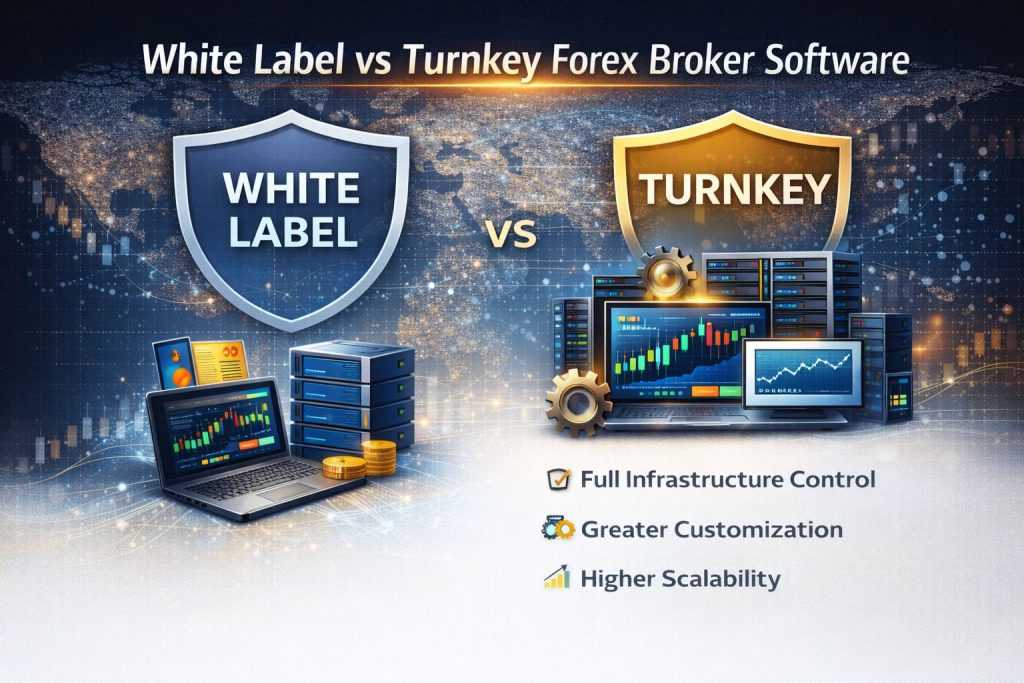
The choice between white-label and turnkey brokerage software comes down to infrastructure control, time to market, and capital availability. White-label solutions provide a faster launch path — the provider hosts and maintains the infrastructure, and the brokerage operates under a pre-built system with brand customisation. Turnkey solutions give the brokerage full control over the infrastructure it runs on, with higher initial investment and longer implementation timelines.
The practical consideration that most operators underweight is vendor concentration risk. A brokerage that takes its trading platform, CRM, payment processing, and risk management from a single provider creates a single point of failure — if that provider raises prices, degrades service, or terminates the relationship, every layer of the operation is affected simultaneously. Diversifying across specialist providers for each stack layer is more complex to manage but significantly more resilient. For a full analysis of vendor lock-in risk and how to structure a resilient infrastructure, see the guide on avoiding vendor lock-in when setting up a broker or prop firm.
How to Evaluate Forex Broker Software
When evaluating forex brokerage technology, the questions that matter most are not about feature lists — they are about operational outcomes:
- Integration depth — how completely does the CRM connect to the trading platform? Can deposit events automatically credit trading accounts, or does this require manual reconciliation?
- Automation capability — which workflows can be automated, and which require human intervention? KYC verification, deposit confirmation, IB commission calculation, and compliance reporting should all be automatable at volume
- Scalability architecture — does the system performance degrade as client volume grows? A CRM that handles 500 accounts smoothly but slows under 5,000 is not a scalable foundation
- Pricing model — flat monthly fee, per-account pricing, or revenue share? Per-account and revenue share models create increasing costs as the brokerage grows, which directly compresses margins. Flat-fee models provide predictable cost structure regardless of trading volume
- Compliance readiness — does the system generate the reports and audit trails required by the jurisdiction the brokerage operates in? Compliance gaps discovered after launch are significantly more expensive to address than those identified during evaluation
Forex Brokerage Technology Trends in 2026
Several structural shifts are affecting how brokerages think about their technology infrastructure in 2026:
- Mobile-first platform architecture — more than 80% of new forex traders begin on mobile. Brokerages that offer browser-based or native mobile trading without desktop software installation requirements see materially higher onboarding completion rates
- Social and copy trading integration — copy trading has matured from a niche feature into a mainstream expectation among retail traders. Brokerages that integrate copy trading natively into the platform report higher engagement and lower churn rates. For more on how social trading drives brokerage growth, see the guide on social trading for forex brokers
- Infrastructure consolidation — brokerages operating fragmented technology stacks are increasingly migrating to unified platforms that connect CRM, trading platform, payments, and compliance into a single operational system. The data advantage from unified infrastructure compounds over time — brokerages with connected systems can act on retention signals and compliance events that fragmented operators never see
- Multi-asset expansion — retail traders increasingly expect access to forex, CFDs, crypto, and futures from a single account. Platform and CRM infrastructure that supports multi-asset operation without requiring separate systems per instrument class is becoming a competitive requirement rather than a differentiator
FAQ: Forex Broker Software
What is the difference between forex broker software and a trading platform?
The trading platform is one component of forex broker software — specifically the interface traders use to execute orders. Forex broker software refers to the complete technology stack: trading platform, CRM, back-office system, payment infrastructure, risk management engine, and reporting tools working together.
How much does forex broker software cost?
Costs vary significantly by model and scope. White-label solutions can launch for USD 10,000–30,000 including setup and first-year operation. Full custom infrastructure with proprietary platform licensing, independent CRM, and dedicated server infrastructure represents a substantially higher investment. The pricing model matters as much as the initial cost — flat monthly fees are preferable to per-account or revenue-share models as client volume grows.
Can forex broker software be customised?
Yes — most modern forex broker software supports branding customisation, commission structure configuration, and CRM workflow adjustments. The degree of customisation available varies significantly between providers. Turnkey solutions generally offer greater customisation than white-label solutions, at higher cost and longer implementation timeline.
How long does it take to launch a forex brokerage with turnkey software?
With a well-integrated turnkey solution covering CRM, trading platform, and payment infrastructure, a new brokerage can typically go live in 4–8 weeks. Custom infrastructure builds take significantly longer — typically 3–6 months depending on scope and regulatory requirements.
What is the most important factor when choosing forex broker software?
Integration depth between the CRM and trading platform is typically the most operationally significant factor — it determines whether deposit confirmation, account management, and reporting can be automated, or whether they require ongoing manual reconciliation. Brokerages that underspecify integration requirements at evaluation stage consistently face operational bottlenecks as volume grows.

Request a Consultation on Forex Broker Software Strategy
Get expert guidance on selecting and structuring the right forex broker software for your business model. We’ll help you evaluate trading infrastructure, liquidity tools, CRM integration, risk controls, and scalability requirements to ensure your technology supports long-term growth.
Together, we’ll review your brokerage goals and outline a software strategy aligned with performance, compliance, and operational efficiency.