


Starting your own Prop Firm or Forex Brokerage is an ambitious and rewarding endeavour. However, many new brokers overlook a decision that shapes every aspect of their operations for years: how dependent they become on a single technology provider.
Vendor lock-in occurs when a brokerage or prop firm becomes so reliant on one provider — for CRM, trading platform, liquidity, web infrastructure, or payment processing — that switching becomes operationally and financially prohibitive. The dependency compounds over time: client data lives in the provider’s system, integrations are proprietary, and the cost of migration grows with every month of continued use.
The services most commonly affected include Forex CRM and back-office systems, trading platform hosting and support, liquidity provision, web design and client portals, MAM/PAMM and copy trading infrastructure, payment gateway integrations, and risk management and reporting tools. When all of these sit under one vendor, the business does not own its infrastructure — it rents it, on the vendor’s terms.

A one-stop shop approach may appear convenient at the start. The real cost becomes visible when you need to change something — pricing, features, compliance configuration, or the vendor relationship itself — and discover that the cost of leaving outweighs the cost of staying.
Why Vendor Lock-in Is Risky for Your Prop Firm or Forex Brokerage
The risks of vendor lock-in are not theoretical. They show up at predictable moments in a brokerage’s growth cycle — when the business scales and pricing tiers change, when a compliance requirement appears that the vendor does not support, or when the vendor is acquired and product direction shifts. Here are the primary risk categories operators encounter.
1. Limited Flexibility and Innovation
When all critical components run through one provider, your product roadmap is effectively their product roadmap. If the vendor does not prioritize a feature — a new trading platform integration, a compliance workflow change, a new payment method — you wait. In an industry where regulatory requirements shift and trader expectations evolve quickly, being tied to a vendor’s development pace is a structural competitive disadvantage.
In 2026, this is particularly relevant for prop firms that need to respond quickly to regulatory changes — new KYC requirements, payout model adjustments, challenge rule modifications — where operators using modular, API-accessible infrastructure can adapt in days, while those on monolithic one-stop systems wait for vendor development cycles.
2. Higher Costs Over Time
Bundled services from a single provider often appear cost-effective at the point of sale. The pricing model changes as the business scales. Per-active-account fees, revenue share arrangements, and tiered pricing structures that seemed reasonable at 500 clients become significant cost burdens at 10,000 clients. Because migration is expensive and disruptive, operators often absorb escalating costs rather than switch — which is precisely the commercial logic the vendor is relying on.
Flat-fee, modular infrastructure eliminates this exposure. When each provider charges for their specific service without a stake in your revenue or client volume, scaling the business does not automatically scale your technology costs.
3. Lack of Customization
One-stop shop solutions are built for the median broker — the average use case across their entire client base. Customization requests compete with platform-wide feature development, and individual client needs rarely win that competition. Brokerages and prop firms with specific operational requirements — custom IB commission structures, unusual challenge rule configurations, regional compliance workflows — consistently find that monolithic providers cannot accommodate them.
Specialized providers, by contrast, build their business on exactly those specific requirements. A CRM provider focused exclusively on forex and prop firm infrastructure has already solved the edge cases that a generalist one-stop shop has not encountered or deprioritized.
4. Operational Risks and Downtime
A single provider means a single point of failure. When the vendor experiences an outage — platform downtime, payment processing disruption, CRM unavailability — the entire brokerage operation is affected simultaneously. There is no fallback, no redundancy at the vendor level, and no ability to route around the problem.
Distributed infrastructure across specialized providers creates natural redundancy. A payment processor outage does not take down the CRM. A CRM maintenance window does not interrupt trading platform access. Each component can be maintained, updated, or replaced independently without cascading operational impact.
5. Compliance and Regulatory Concerns
Regulatory requirements vary significantly by jurisdiction, and they are changing faster in 2026 than at any previous point in the industry’s history. FCA guidance in the UK, CySEC requirements in Cyprus, FSCA developments in South Africa, and evolving CFTC positions in the United States create a compliance environment where a provider’s ability to support jurisdiction-specific configurations is a genuine operational requirement — not a nice-to-have.
A single provider whose compliance tooling is built around one regulatory framework creates exposure when operating across multiple jurisdictions. Specialized providers, particularly those focused on specific compliance functions, can be selected and replaced based on jurisdictional fit — giving operators the flexibility to maintain compliance as requirements evolve.

Why Specialized Providers Outperform One-Stop Shops
The argument for one-stop shops is convenience — one contract, one support contact, one invoice. The argument against them is everything else. Here is why operators who choose specialized providers consistently build more resilient, more adaptable, and ultimately more profitable operations.
1. Depth of Expertise in Specific Areas
A provider that builds exclusively for forex brokers and prop firms has solved problems that a generalist provider has not encountered. Their support team understands IB commission structures. Their development team has built MT5 integrations dozens of times. Their compliance tooling reflects the actual regulatory environment their clients operate in. That depth of domain expertise is not replicated by a provider serving ten different industries from a single platform.
2. Superior Risk Management and Reporting
Specialized risk management and reporting tools give operators visibility that generic platforms cannot provide. For prop firms specifically, real-time drawdown monitoring, automated breach detection, and audit-ready reporting are not optional features — they are operational requirements. Providers built specifically for this function deliver capabilities that a one-stop shop CRM treats as secondary to its core product.
3. Customization and Flexibility
Specialized providers can adapt to specific operational requirements because their business model depends on it. Custom IB commission tiers, non-standard challenge evaluation rules, region-specific onboarding flows, unique payout logic — these are standard requests for a specialist, and development backlog items for a generalist. The difference in response time and implementation quality is significant.
4. Cost Management and Scalability
Modular infrastructure gives operators direct control over their technology cost structure. Each provider is paid for their specific service. Adding traders, adding brands, or entering new markets does not automatically trigger cost increases across the entire stack — only in the components where additional capacity is actually consumed. This predictability is structurally different from the revenue-linked or volume-linked pricing models common in one-stop shop arrangements.
5. Access to Best-in-Class Technology
Specialized providers compete for their specific function against other specialists in that function. This competition drives better technology, faster feature development, and more responsive support than a generalist provider competing across ten different service categories. Operators who assemble their infrastructure from specialized providers consistently have access to better individual components than those who accept whatever the one-stop shop includes in their bundle.
Why Kenmore Design Should Be Part of Your Independent Infrastructure
Kenmore Design has been building forex and prop firm infrastructure since 2006 — not as a white-label reseller, not as a bundle provider, but as the developer of the actual platform that brokers and prop firms run their operations on. The distinction matters because it determines what operators actually own when they work with us.
Our position in a multi-vendor infrastructure is specific: we provide the CRM, Traders Room, IB management, prop firm challenge logic, risk tools, and payment integrations. We do not provide liquidity. We do not provide trading platforms. We do not try to be everything. That boundary is intentional — it is how we ensure that the components we do build are built to the depth that operators actually need.
1. Comprehensive Web Development Solutions
Kenmore Design provides custom web development for brokerages and prop firms — including real-time currency tickers, economic calendars, integrated FX news feeds, and client-facing portals built around the broker’s brand. For operators who want to build their own front end, we provide the APIs needed to connect any custom interface to our backend infrastructure.
2. CRM and Trader’s Room
The Kenmore Design Forex CRM and Trader’s Room support both forex broker and prop firm operations from a single platform. Marketing, sales, onboarding, client engagement, accounting, and analytics all run through one system — with deep integration across multiple trading platforms and payment providers. Critically, your data is not locked in: third-party integrations and custom applications can connect to your system through our API with your authorization.
3. Multi-Level IB Management
The Multi-Level IB System supports flexible commission structures across multiple tiers, with instant payout processing through an intuitive web interface. For brokers running complex IB networks or prop firms managing affiliate programs, this is one of the most operationally significant components of the platform.
4. MAM, PAMM, and Copy Trading Integration
Rather than building proprietary MAM/PAMM functionality, Kenmore Design integrates with leading MAM, PAMM, and copy trading providers via API. This means brokers can choose the best provider for their specific requirements and connect it to the Kenmore infrastructure — rather than accepting whatever the CRM vendor happens to have built.
5. Payment Gateway Integrations
Kenmore Design is not a payment processor. We provide comprehensive payment integrations with PSPs and aggregators across multiple regions and payment methods. Operators choose their payment providers based on their geographic coverage, fee structure, and compliance requirements — we connect them to the platform.
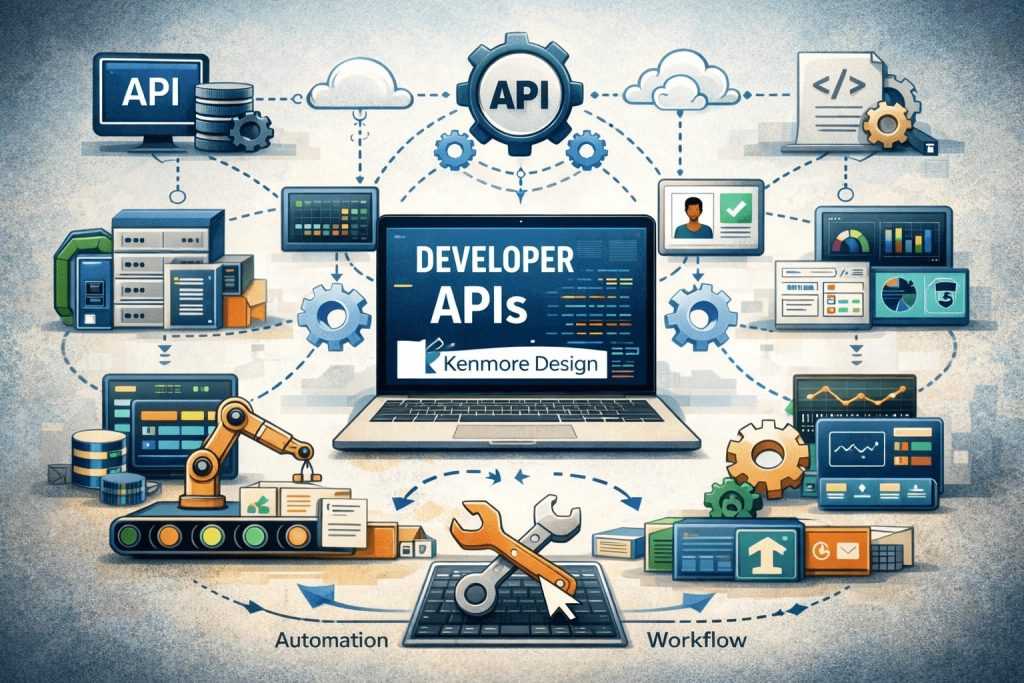
6. Developer APIs
For brokers and prop firms that want to build custom applications, connect third-party tools, or create unique front-end experiences, Kenmore Design provides a comprehensive API layer. Full documentation is available on the Forex Developer API page. The API is how we ensure operators are never locked into our front-end decisions — they can build whatever interface their business requires on top of our infrastructure.
Always Opt for Specialized Providers
Building a successful prop firm or forex brokerage requires making infrastructure decisions that hold up over time — not just at launch. Vendor lock-in is not a problem that appears on day one. It appears when the business needs to change something and discovers that the cost of change has been built into the architecture from the start.
Specialized providers give operators the ability to replace, upgrade, or restructure individual components without rebuilding the entire stack. When a payment provider relationship changes, you switch the payment provider. When a better risk management tool becomes available, you integrate it. When regulatory requirements shift in a new market, you add a compliance component that meets those requirements. The rest of the infrastructure keeps running.
Kenmore Design is one component of that infrastructure — the CRM, Traders Room, IB management, prop firm operations, and API layer. We build it to work alongside the providers you choose for everything else. That is how infrastructure should work: each component doing its job well, owned by the operator, replaceable when something better exists.
Ready to build a brokerage or prop firm infrastructure that you actually own? Schedule a demo and we will show you how the platform fits into your specific stack.

Request a Consultation on Avoiding Vendor Lock-in for Prop Firms & FX Brokers
Get expert guidance on building a flexible, vendor-independent infrastructure for your prop firm or forex brokerage. We’ll help you evaluate technology dependencies, identify lock-in risks, and design an architecture that supports long-term scalability, compliance, and innovation.
Together, we’ll review your current or planned setup and outline a strategy that keeps your business in control — not your vendors.