


Payments are one of the first operational bottlenecks a forex broker feels when it starts to grow. A trader can complete registration, pass KYC, and be ready to fund an account, but if the payment route fails, the business loses momentum immediately. The trader may retry, contact support, or leave and open an account somewhere else.
That is why more brokers are moving away from a single payment provider setup and toward multi-PSP routing. Instead of relying on one processor, one card route, or one crypto gateway, the broker can use several payment service providers and decide which option should be shown, prioritized, or used for different trader segments.
Multi-PSP routing is not only a technical payment feature. For a broker, it is part of the operating system: deposits, withdrawals, currencies, countries, markup rules, visibility, finance reviews, support workflows, and reporting all need to stay connected. This is where the payment stack should work together with the Forex CRM, trader room, and back office.
What multi-PSP routing means for a forex broker
A PSP, or payment service provider, helps a broker process payments through cards, bank transfers, wallets, crypto, local payment methods, or other payment rails. A single-PSP setup means the broker depends on one main provider for most transaction flows.
Multi-PSP routing means the broker has more than one payment route available. Depending on the setup, the broker can:
- offer different payment methods by country or region
- prioritize one provider over another
- hide or show providers for specific trader groups
- set different minimum and maximum amounts
- manage different currencies or exchange-rate rules
- keep backup routes available if one provider has issues
- separate deposit and withdrawal methods
- support card, bank, wallet, and crypto flows in the same operating environment
The goal is simple: make payment completion more reliable without forcing the operations team to manage every exception manually.
Why single-PSP setups break as brokers scale
A single payment provider can be enough during launch. It keeps the setup simple and gives the team one contract, one integration, and one reporting source. But as the broker expands, the limitations become more visible.
The most common problems are:
- failed card deposits in specific countries
- unsupported currencies
- high decline rates for certain banks or regions
- sudden PSP downtime
- account reviews or processing limits
- chargeback pressure
- delays in adding new local payment methods
- weak coverage for crypto deposits or payouts
- manual work when traders need an alternative payment route
When the payment stack is too narrow, support and finance teams become the workaround. They send manual instructions, update spreadsheets, answer repetitive tickets, and try to rescue deposits that should have been completed automatically.
For a broker, this is not just a payment problem. It affects trader activation, sales follow-up, operational reporting, and finance control. That is why payment routing should be connected to the broader broker workflow, not treated as a disconnected plugin.
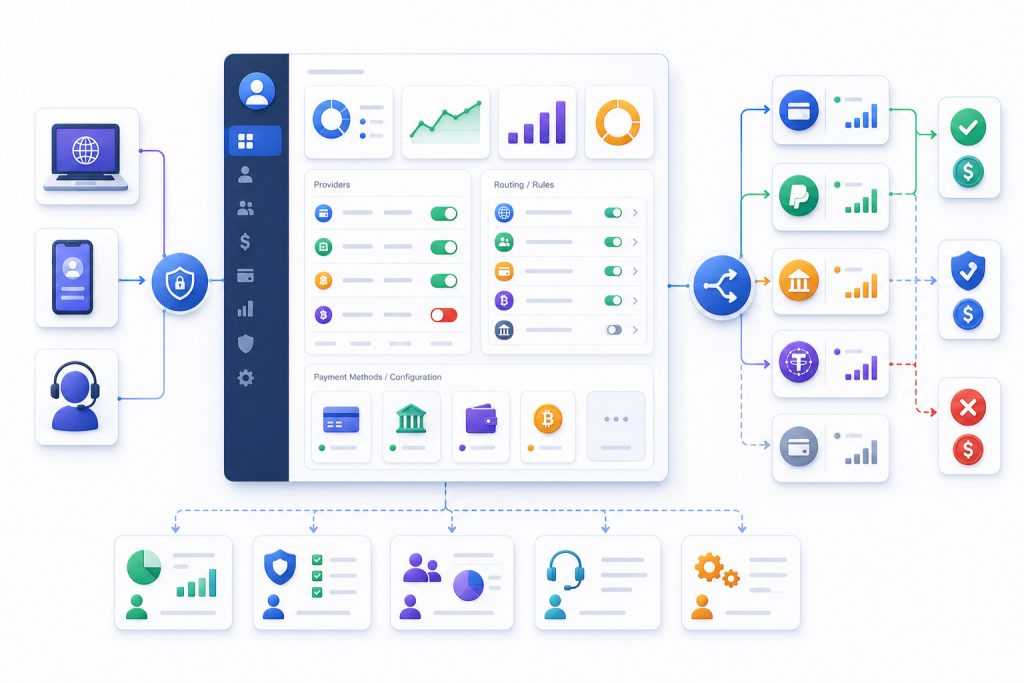
Where multi-PSP routing fits inside the broker CRM
The strongest payment setup is not only about how many providers a broker has. It is about how those providers are managed inside the back office.
Inside the Kenmore Design CRM, payment administration can include integrated merchant management, bank and wallet records, public visibility controls, markup settings, exchange-rate rules, and minimum or maximum transaction amounts. This gives the broker a centralized way to manage payment methods rather than spreading payment logic across disconnected tools.
For example, a broker may want to:
- show card payments first for one region
- show crypto options for another market
- hide a provider while it is under review
- set a minimum amount for a specific payment method
- apply a markup for a certain payment route
- keep a backup provider configured but not public
- use different forms for different withdrawal methods
These are operational decisions, not only technical settings. Finance, compliance, sales, and support teams all need visibility into how payments are configured and what the trader is allowed to use.
A broker that already uses Kenmore’s forex payment solutions or payment gateway workflows should think about PSP routing as the next layer of payment maturity.
Deposit routing: reducing failed funding attempts
Deposits are where routing has the most direct impact. If a trader cannot fund the account quickly, the broker may lose the conversion.
A multi-PSP setup can help the broker route traders toward payment options that are more likely to work for their market. It can also reduce dependency on one processor when approval rates change or a provider becomes unstable.
For deposit workflows, brokers should look at:
- which payment methods are visible by region
- whether the trader sees too many or too few choices
- minimum and maximum deposit amounts per route
- currency support
- crypto wallet and bank account instructions
- automated vs manual payment confirmation
- how failed deposits are tracked in the CRM
- whether sales and support teams can quickly see payment status
The best setup is not always the one with the most providers. Too many payment choices can confuse traders. The goal is to present the right payment options in the right order, backed by clear internal controls.
Withdrawal routing: payout accuracy and finance control
Withdrawals need a different level of care. A deposit route can be optimized for speed, but withdrawal routes must also support review, accuracy, risk checks, and documentation.
Brokers may need different withdrawal forms for bank transfer, crypto, local methods, or special payout requirements. A configurable withdrawal workflow helps the firm collect the right details before finance reviews the request.
This matters because payout errors create support pressure and reputational risk. A broker should be able to control:
- which withdrawal methods are public
- what information traders must submit
- which fields are required for each payout route
- how requests are reviewed internally
- whether certain methods should be temporarily hidden
- how payment details are updated when providers change
For prop firms, this is even more important because payouts may be tied to funded trader reviews, challenge rules, and anti-abuse checks. Kenmore’s prop firm payment solutions connect the payment discussion to the wider funded trader lifecycle.
Multi-PSP routing for prop firms
Prop firms often experience payment pressure differently from retail brokers. The business may process many small challenge purchases, refunds, chargebacks, upgrades, resets, subscriptions, and funded trader payouts.
A single provider can become a risk if it cannot support a market, if chargebacks increase, or if challenge payments spike during promotions. A multi-PSP strategy gives the firm more flexibility, especially when combined with a Prop Firm CRM that already manages challenges, competitions, leaderboards, affiliates, and payouts.
For prop firms, useful routing questions include:
- Which PSP handles challenge purchases best in each market?
- Should crypto be available for high-risk or international regions?
- Should payout methods differ from purchase methods?
- Can finance hide a provider without removing it from the system?
- Can support see which payment route a trader used?
- Can the firm separate payment issues from challenge-rule issues?
Payment routing is not a replacement for risk management, but it gives operators more control when payment behavior changes.
What to monitor after adding multiple PSPs
Adding providers is not the finish line. Brokers need to monitor whether the payment stack is actually improving operations.
Important metrics and signals include:
- deposit attempts vs successful deposits
- failed deposits by provider
- failed deposits by country or currency
- support tickets related to payment issues
- average time to confirm manual payments
- withdrawal review time
- chargeback patterns
- hidden or inactive payment methods
- trader drop-off during funding
These signals should be reviewed alongside CRM and trader activity data. If payment failures are rising in one region, the solution may be a routing change, a provider change, clearer instructions, or a different payment method.
This is why payment routing belongs in the broker back office. A standalone provider dashboard may show transaction data, but it usually does not show the full trader journey from signup to KYC, deposit, account creation, trading activity, withdrawal, and support.
How multi-PSP routing connects with API and integration work
A broker’s payment stack should not be isolated from its platform and CRM integrations. Deposits may need to trigger account funding, trader status changes, notifications, or back-office tasks. Withdrawals may need review before any balance update or external payout action.
If a broker is building custom infrastructure, the payment workflow should be mapped together with CRM and trading platform integrations. Kenmore’s Forex CRM API and broader Forex API for developers resources are useful for thinking through where payment events connect with account, trader, and reporting workflows.
For brokers using MT4 or MT5, payment events often need to align with platform-side account management. That is why payment routing, CRM integrations, and platform APIs should be planned as one operating model rather than separate projects.
Practical checklist before choosing a multi-PSP setup
Before adding another provider, the broker should answer a few operational questions:
- Which regions or currencies are causing the most payment failures?
- Which payment methods do traders actually request?
- Which provider should be primary, backup, or hidden?
- Can the CRM control provider visibility by business need?
- Do deposit and withdrawal workflows need different rules?
- Who owns payment configuration: finance, operations, compliance, or admin?
- Can support see payment status without logging into several systems?
- Are crypto wallets, bank accounts, and automated merchants managed centrally?
- How will failed payments be reported?
- What happens if the main PSP goes offline?
A good multi-PSP setup should make the broker more resilient, not more complicated.
Final thought
Multi-PSP routing is not about adding payment providers for the sake of it. It is about giving the broker control over how traders fund accounts, request withdrawals, and move through the operating workflow.
For small brokers, this can reduce failed deposits and manual support. For larger brokers, it can improve regional payment coverage and reduce dependency on one provider. For prop firms, it can support challenge purchases, crypto payments, payout methods, and promotion-driven volume.
The key is to manage payment routing inside the same operational layer that handles traders, accounts, KYC, reporting, and support. When payments live inside the CRM workflow, the broker can make faster decisions, reduce manual exceptions, and build a more reliable trader experience.

Request a Consultation on Building a Multi-PSP Payment Strategy
Get expert guidance on designing a payment infrastructure that supports multiple PSPs, regional payment methods, crypto gateways, and withdrawal workflows without adding unnecessary operational complexity. We’ll help you evaluate routing logic, provider redundancy, payment visibility, and CRM integration to improve resilience as your brokerage grows.
Together, we’ll review your current payment stack and outline a strategy aligned with operational efficiency and long-term scalability.