


Running a prop firm is not just about building a challenge structure and waiting for sign-ups. The firms that grow consistently treat trader engagement as an operational priority — not an afterthought. Acquisition is expensive. Retention and referral are where the unit economics of a prop firm actually work.
The four mechanisms that drive engagement most effectively are competition modules that create ongoing activity and community, multi-level affiliate systems that turn traders into distribution channels, funded trader certificates that create shareable proof of achievement, and promo code systems that give operators precise control over conversion and promotional activity. Each works independently — but together they form a compounding growth engine that most prop firms underutilise. Understanding how each tool works — and how they interact — is the difference between a firm that grows through paid acquisition alone and one that builds a self-sustaining trader ecosystem.

Why Trader Engagement Determines Prop Firm Profitability
Most prop firm operators focus their attention on challenge design — the drawdown rules, profit targets, evaluation phases, and payout structure. These matter. But they are largely commoditised. Dozens of firms offer similar challenge parameters at similar price points.
What differentiates a prop firm in a crowded market is the experience it creates around the challenge. Traders who feel part of a trading community, who are recognised for their achievements, who have financial incentives to refer others, and who receive targeted promotional offers at the right moment — these traders stay longer, attempt more challenges, and generate more referrals.
The economics are straightforward. Customer Acquisition Cost (CAC) in paid channels — Google, LinkedIn, influencer partnerships — is high and rising. A trader who passes one challenge and never returns has a fixed trader lifetime value (LTV). A trader who passes, retakes after a challenge reset, participates in competitions, refers two friends through an affiliate link, and shares their certificate on social media has an LTV that is multiples higher — and has brought in additional revenue through referrals at zero acquisition cost.
Prop firms that track LTV by trader segment — by challenge type, account size, region, and acquisition channel — consistently find that engaged traders from referral and community channels outperform paid acquisition cohorts on every retention metric. Churn rate drops. Time-to-second-purchase shortens. Funded trader retention after first payout improves.
Quick Overview: Prop Firm Engagement Tools
| Tool | Primary Function | Key Metric |
|---|---|---|
| Competitions | Ongoing engagement, community building | Active traders per month |
| Multi-Level Affiliates | Referral distribution, zero-cost acquisition | Cost per referred conversion |
| Funded Trader Certificates | Social proof, organic marketing | Shares per certificate issued |
| Promo Codes | Conversion control, channel attribution | Conversion rate by code |
1. Competitions — Creating Ongoing Reasons to Trade
What Competitions Do for a Prop Firm
A competition module transforms the prop firm experience from a transactional evaluation into an ongoing community event. Instead of traders completing a funded account challenge and disengaging until their next purchase, competitions give active traders a reason to remain engaged with the platform continuously.
The best-performing prop firms — FundedNext, The5ers, FunderPro — have built competitions into the core of their trader recruitment and retention model. They use competitions as a pre-evaluation funnel to identify disciplined traders before allocating capital, and as an ongoing engagement mechanism to keep funded traders active between evaluation cycles.
How Competition Mechanics Work
- Leaderboard-based competitions — traders compete on performance metrics over a defined period, with prizes for top performers ranked by profit, consistency, and drawdown management
- Challenge-specific competitions — all traders in a particular challenge phase compete simultaneously, creating peer comparison and competitive motivation
- Seasonal or event-based competitions — time-limited trading contests tied to market events, calendar periods, or firm milestones
- Free-entry competitions — zero-cost entry competitions that attract new traders and expose them to the firm’s platform and challenge structure
- Custom prize structures — cash prizes, funded account allocations, challenge fee waivers, or account upgrades for winners
The Business Impact
Competitions increase the average number of active sessions per trader. They generate organic social media activity as traders share their real-time leaderboard positions. They create natural content for the firm’s marketing channels — weekly leaderboard updates, winner announcements, prize ceremony content. They function as a talent filter — identifying consistently disciplined traders before funded capital is allocated. And they give the firm a recurring reason to communicate with its entire trader base through email and push notifications.
The full technical scope of how a competition module integrates with challenge management and trader dashboards is covered in detail here.
2. Multi-Level Affiliate System — Turning Traders Into a Distribution Channel
Why Affiliates Are the Most Cost-Effective Growth Channel for Prop Firms
Paid acquisition is expensive and competitive. The prop firm affiliate program model turns the existing trader base into a distribution channel that operates at zero fixed cost and pays only on conversion. A trader who has passed a challenge and had a positive experience is the most credible possible advocate for the firm — their referral carries social proof that no paid ad can replicate.
Multi-level affiliate logic — also known as multi-tier IB (Introducing Broker) structure in the forex brokerage context — structures this natural advocacy into a scalable, trackable, automated growth mechanism. Top prop firms including FTMO, FundedNext, and The5ers run affiliate programs that generate a significant proportion of their new trader volume through referral channels at CAC far below paid acquisition.
How Multi-Level Affiliate Logic Works
| Level | Participant | Commission Structure |
|---|---|---|
| Level 1 | Direct referrer | Commission on each referred challenge purchase |
| Level 2 | Referrer’s referrals | Reduced commission on downstream purchases |
| Level 3+ | Further downstream | Configurable per firm’s IB logic |
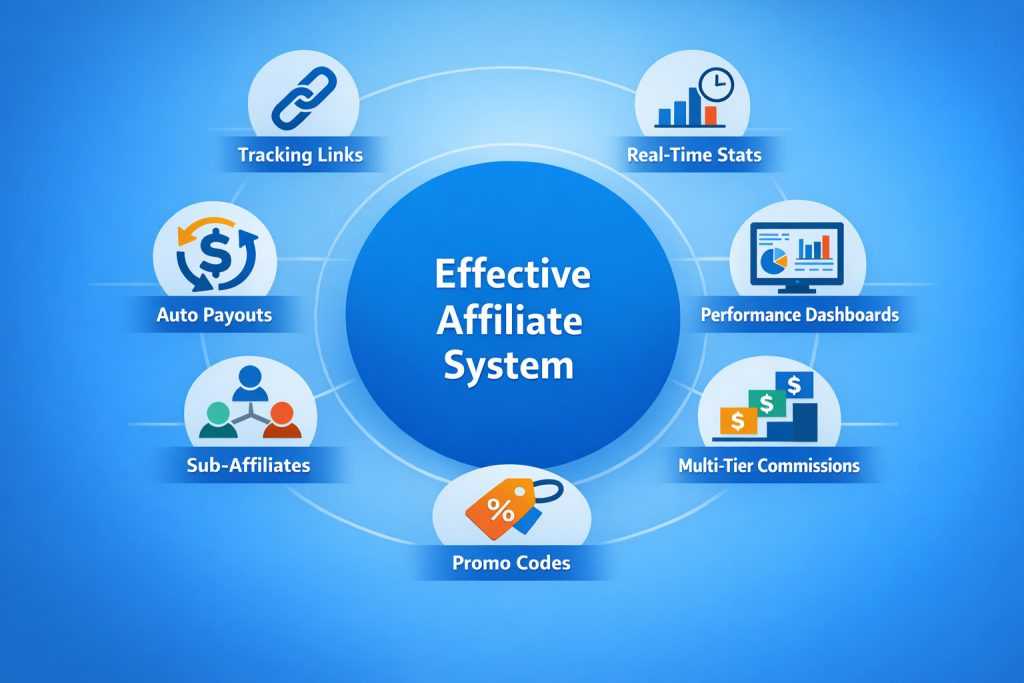
Key Features of an Effective Affiliate System
- Unique referral tracking links — each affiliate gets a trackable URL that attributes all conversions correctly across devices and sessions
- Real-time commission tracking — affiliates see their earnings update as referrals convert, improving motivation and transparency
- Automated commission payouts — commissions calculated and distributed without manual processing at any volume
- Performance dashboards — affiliates see clicks, conversions, earnings, and sub-affiliate activity in one interface
- Multi-tier commission logic — operators set commission rates at each level independently, with full flexibility
- Sub-affiliate management — top affiliates recruit and manage their own networks, extending the firm’s reach without additional marketing spend
- Affiliate-specific promo codes — each affiliate gets a branded discount code that simultaneously drives conversion and attributes the sale
The prop firm affiliate system that makes this infrastructure available to operators — including multi-level IB logic, automated commission calculation, and real-time reporting — is documented here.
3. Funded Trader Certificates — Recognition That Drives Referrals
The Psychology Behind Achievement Recognition
Passing a prop firm challenge is a genuine achievement. It requires trading discipline, consistent risk management, and sustained performance over a defined evaluation period. Traders who pass know this — and they want to share it.
A funded trader certificate gives them something concrete and shareable. Not just a notification in their dashboard that says “challenge passed” — but a branded, professionally designed certificate that they can post on LinkedIn, share in prop trading communities on Discord and Reddit, and show to peers who are considering funded trading.
What This Does for the Firm
Every shared certificate is organic marketing reaching a targeted, relevant audience — other traders — at zero cost to the firm. The certificate carries implicit social proof: this firm is legitimate, their challenges are passable, and this trader achieved it. In a market where prop firm credibility is a primary concern following the industry consolidation of 2024-2025, third-party social proof from real traders carries significant weight.
Certificate Design Considerations
- Branded design — consistent with firm visual identity and recognisable in social media feeds
- Trader name and achievement details — personalised to each recipient including challenge tier and account size
- Shareable format — optimised for LinkedIn, Twitter/X, and Discord dimensions
- Verifiable certificate ID — unique identifier that can be checked on the firm’s website, adding authenticity
- Automated generation — triggered automatically on challenge completion, capturing the peak sharing moment
For prop firms that want to implement funded trader certificates as part of their trader recognition program, the full implementation detail is available here.
4. Promo Code System — Precision Control Over Conversions and Campaigns
Why Promo Codes Are an Underutilised Tool in Prop Firm Marketing
Most prop firms use discount codes reactively — a Black Friday sale, an occasional percentage-off promotion posted on social media. This approach leaves significant conversion rate optimisation opportunity on the table.
A properly implemented promo code system gives operators precise, real-time control over promotional activity across every channel. Different codes for different marketing channels. Time-limited challenge discount codes that create urgency. Affiliate-specific codes that track which partner drove which conversion. Targeted codes sent to traders who abandoned checkout. Reactivation codes for traders who haven’t purchased in 60+ days.
Top-performing prop firms use coupon-based strategies deliberately — Maven Trading’s discount code model, for example, is cited as a significant driver of their affiliate conversion rates because affiliates can offer a tangible, trackable discount alongside their referral link.
Promo Code Use Cases for Prop Firms
- Channel attribution — unique codes per marketing channel to measure which drives the best ROI and lowest CAC
- Affiliate codes — each affiliate gets a branded code that simultaneously discounts and attributes the conversion
- Reactivation campaigns — targeted codes sent to lapsed traders who haven’t purchased in a defined window
- Seasonal campaigns — time-limited codes with automatic expiry that create purchase urgency
- Tiered discounts — different discount levels for different challenge tiers or account sizes
- Bundle promotions — codes that unlock specific challenge configurations or account upgrades
- Community-specific codes — exclusive codes for Discord servers, YouTube channels, or trading communities
The Operational Requirement
Promo codes only work as a growth tool when properly integrated with the challenge management system, the payment flow, and the reporting infrastructure. A code that requires manual application by support staff, or whose usage can’t be tracked in real time, creates operational overhead that negates the marketing benefit.
The promo code system built for prop firm operators — with full CRM integration, real-time usage tracking, and automated discount application — is outlined here.

How These Four Systems Work Together — The Engagement Flywheel
The real power of these mechanisms is not in deploying them individually — it is in the compound effect when they operate together as an integrated trader engagement stack.
The Engagement Flywheel
- Trader passes a challenge → receives a funded trader certificate → shares on LinkedIn and Discord
- Certificate post generates interest → peers click the affiliate referral link → some convert using the affiliate’s promo code
- New traders join → enter active competition → real-time leaderboard activity drives ongoing platform engagement
- Competition winner announced → generates firm content → drives further organic sign-ups
- Promo code sent to non-converting visitors → increases conversion rate on warm traffic
- Affiliates earn commissions → incentivised to promote more actively → brings in more referrals at zero CAC
Each mechanism feeds the next. Certificates drive affiliate conversions. Competitions increase the perceived value of being an active trader on the platform. Promo codes capture conversion that would otherwise be lost. The affiliate system monetises the social proof generated by certificates and competition results.
What Operators Need to Implement This
| System | Key Integration | Operational Benefit |
|---|---|---|
| Competitions | Challenge management + real-time leaderboard | Ongoing engagement, organic content, talent filtering |
| Affiliate System | CRM + payment processing + tracking | Zero-cost distribution, trackable referrals, LTV improvement |
| Certificates | Challenge completion trigger + design system | Organic social proof, shareable marketing, brand credibility |
| Promo Codes | Payment flow + CRM + attribution reporting | Conversion control, channel ROI measurement, reactivation |
Getting the Infrastructure Right
These systems are only as effective as the infrastructure running them. A competition module that updates leaderboards with a 24-hour delay loses the real-time urgency that makes competitions engaging. An affiliate system that calculates commissions manually becomes a support burden at scale. Certificates that take days to generate after challenge completion miss the peak sharing window.
The infrastructure question is therefore not just which systems to deploy — but whether those systems are properly integrated with the challenge management platform, the trader dashboard, the payment processing layer, and the CRM. When they are, the engagement stack operates automatically. When they aren’t, manual work accumulates and scales badly.
For prop firm operators building or upgrading their engagement infrastructure, evaluating each of these systems in the context of full platform integration is the right starting point — rather than treating them as standalone tools bolted on after the fact.

Request a Consultation on Building a Prop Firm Engagement Engine
Get expert guidance on structuring competitions, multi-level affiliates, funded trader certificates, and promo code systems into a unified growth framework. We’ll help you evaluate how each mechanism affects trader lifetime value, referral volume, and operational scalability.
Together, we’ll review your current trader engagement stack and outline a strategy designed to compound acquisition, retention, and organic growth.