


Acquiring a new trader costs 5 to 7 times more than keeping an existing one. Yet most forex brokerages spend the majority of their marketing budget on acquisition and treat retention as an afterthought.
The result is predictable: traders sign up, deposit, trade for a few weeks, then go quiet. Some move to a competitor. Most just drift away.
The brokers who reverse this pattern share one thing in common — they use their forex CRM as an active retention engine, not just a database. Here’s exactly how to do it.
Why Traders Churn — and When It Happens
Before you can automate retention, you need to understand where traders actually drop off. In most retail brokerages, churn clusters around three moments:
1. Early drop-off (days 1–14) The trader signs up, completes KYC, maybe makes a first deposit — then never trades, or trades once and disappears. This is almost always an onboarding failure. The trader didn’t get enough guidance, felt lost on the platform, or simply lost momentum before placing a real trade.
2. Post-loss churn (weeks 2–8) The trader was active, took a significant loss, and stopped. This is the most common churn pattern in retail forex. Without intervention, most of these traders never come back.
3. Gradual fade (months 2–6) The trader becomes less active over time — fewer logins, smaller positions, longer gaps between trades. This is the easiest churn to prevent because the signals appear weeks in advance. But most brokers miss them because no one is watching.
A CRM with the right automations catches all three.
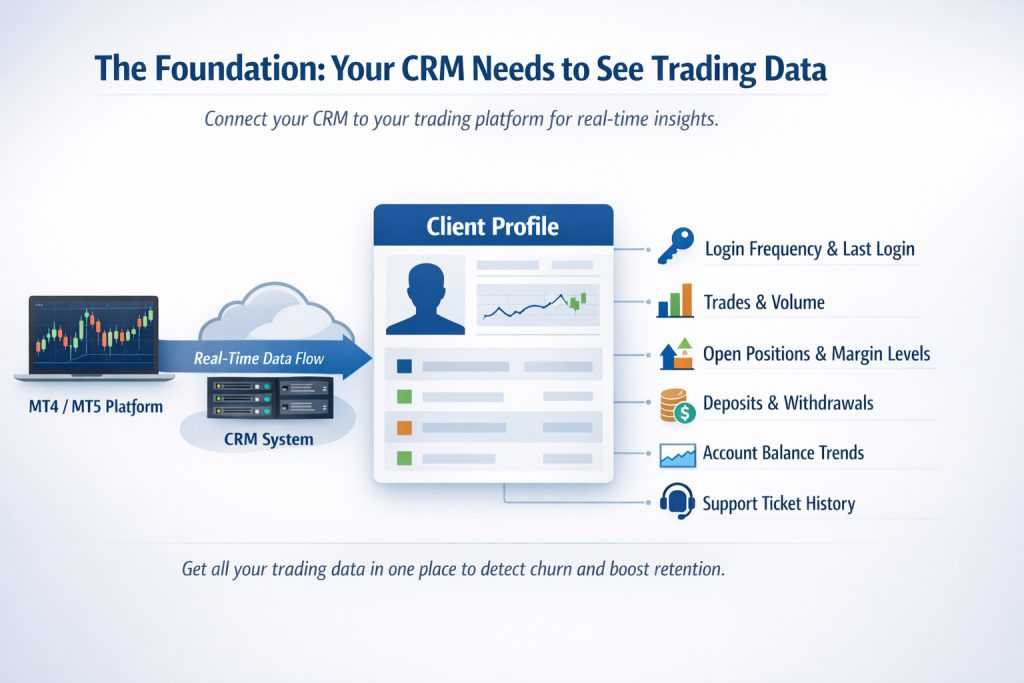
The Foundation: Your CRM Needs to See Trading Data
Retention automation only works if your CRM is connected to your trading platform. If your MT4/MT5 data and your CRM data live in separate systems, your retention team is flying blind.
What your CRM needs to receive in real time:
- Login frequency and last login date
- Number of trades placed and trading volume
- Open positions and margin levels
- Deposit and withdrawal history
- Account balance trends
- Support ticket history
With this data flowing into a single client profile, your CRM spots churn signals automatically and triggers the right response before the trader is already gone. This is exactly why choosing the right forex CRM and back office platform is a strategic decision, not just a technical one.
Automation 1: Onboarding Sequences That Actually Finish the Job
Most brokers send a welcome email and call it onboarding. That’s not enough.
A proper automated onboarding sequence keeps the trader moving through key milestones during their first two weeks. Each step is triggered by behavior — or the absence of it.
Example onboarding workflow:
- Day 0 — Account created → Welcome email with platform guide and first steps
- Day 1 — KYC incomplete → Automated reminder with direct link to complete verification
- Day 3 — KYC complete, no deposit → Email with deposit options and first-deposit incentive
- Day 5 — First deposit made, no trade → Push notification: “Your account is funded — here’s how to place your first trade”
- Day 7 — First trade placed → Congratulations message + introduce account manager
- Day 14 — No trade placed yet → Escalate to sales team for personal outreach
Every step that isn’t completed triggers the next prompt. The trader never falls through the cracks because the CRM is tracking their progress automatically.
A slow or manual verification flow is one of the biggest causes of early drop-off — getting KYC right from the start is essential to keeping traders in the funnel through onboarding.
Automation 2: Inactivity Detection and Re-engagement
Inactivity is the clearest churn signal there is. The challenge is catching it early enough to act.
Set up tiered inactivity triggers based on what’s normal for your client base:
| Inactivity period | Risk level | Action |
|---|---|---|
| 3 days no login | Low | Automated email: market update, what you missed |
| 7 days no trade | Medium | Personalized email from account manager |
| 14 days no login | High | Phone call from retention team + special offer |
| 30 days no activity | Dormant | Re-engagement campaign with reactivation bonus |
| 90 days no activity | Winback | Final winback sequence before moving to cold list |
The key is that different inactivity periods get different responses. A trader who hasn’t logged in for 3 days needs a gentle nudge. A trader who hasn’t logged in for 30 days needs a compelling reason to come back.
Automation 3: Post-Loss Intervention
A trader who just had a significant drawdown is at peak churn risk. They’re frustrated, possibly embarrassed, and questioning whether to continue.
This is exactly the moment to reach out — not to sell anything, but to support.
Set up a trigger in your CRM: when a trader’s account drops by a defined percentage in a single session, or hits a certain drawdown threshold, flag it automatically and trigger:
- An automated message acknowledging the tough session and offering a risk management resource
- An alert to their account manager to make personal contact within 24 hours
- Educational content relevant to what they were trading
Brokers who implement post-loss intervention consistently report higher retention among traders who experience early losses. The intervention costs almost nothing. Losing the trader costs everything.
Automation 4: Client Segmentation for Targeted Retention
Not all traders are the same, and not all retention efforts should be either. Your CRM should automatically segment your client base so your team knows exactly where to focus.
Segments to build:
- High-value active — Trading regularly, strong volume. Priority: VIP treatment, priority support
- High-value at risk — Previously high volume, now declining. Priority: urgent personal outreach within 48 hours
- Low-value active — Small accounts, trading regularly. Priority: light-touch automation, education to grow them
- Newly deposited, not trading — Fresh money sitting idle. Priority: onboarding automation + account manager contact
- Dormant — No activity in 30+ days. Priority: re-engagement campaigns with incentives
- Withdrawn, no re-deposit — Made a withdrawal and gone quiet. Priority: winback sequence
With these segments active, your retention team stops wasting effort on the wrong traders and concentrates where the return is highest. Trader retention using CRM and targeted outreach works best when it’s built on accurate segmentation — not broad campaigns sent to everyone.
Automation 5: Lifecycle Campaigns Based on Trading Behavior
Beyond inactivity, your CRM can trigger campaigns based on what traders actually do — not just when they stop.
Examples:
- Trader uses high leverage consistently → Send risk management guide + offer to speak with account manager
- Trader only trades one instrument → Introduce two or three related instruments they might be interested in
- Trader reaches a milestone (100 trades placed) → Send congratulations message, offer a loyalty reward
- Trader makes a second deposit → Thank them, upgrade service tier, flag for VIP consideration
- Trader requests a withdrawal → Trigger a check-in call to understand why and address concerns before the money leaves
Each of these touchpoints is automated but feels personal because it’s triggered by what that specific trader actually did.
What to Measure
Retention automation is only as good as your ability to measure it. Track these metrics consistently:
- 30-day retention rate — What percentage of first-time depositors are still active 30 days later
- 90-day retention rate — The industry standard for measuring real, sustained retention
- Reactivation rate — What percentage of dormant traders respond to re-engagement campaigns
- Time to first trade — How long from first deposit to first trade. Shorter is better
- Churn rate by segment — Which segments churn fastest so you know where to prioritize
- LTV by acquisition channel — Which sources bring traders who stay longest and trade most
CRM reports and automated triggers are what turn this raw trading data into decisions your team can actually act on. If your CRM can’t surface these metrics clearly, you can’t improve them.

The Real Cost of Not Automating Retention
Consider a brokerage with 1,000 active traders and a 5% monthly churn rate. That’s 50 traders leaving every month. At an average acquisition cost of $300 per trader, replacing those 50 costs $15,000 per month — $180,000 per year — just to stay flat.
Cutting churn from 5% to 3% with better CRM automation saves $7,200 per month. That’s before accounting for the increased lifetime value of traders who stay longer and trade more.
The economics of retention are simple. The only question is whether your CRM infrastructure is built to support it.
Bottom Line
Trader churn is expensive, predictable, and largely preventable. The brokers who retain traders best aren’t doing anything complicated — they’re using their CRM to watch for the right signals and respond at the right time.
The automations in this guide — onboarding sequences, inactivity triggers, post-loss intervention, segmentation, and lifecycle campaigns — are not complex to set up. But they require a CRM that’s connected to your trading platform, built for forex operations, and capable of triggering workflows based on real trading behavior. A generic CRM won’t do this. A forex-specific one will.
Request a Consultation on Building a Forex Retention Strategy
Get expert guidance on structuring a retention-first growth model for your brokerage. We’ll help you analyze churn patterns, lifecycle stages, and behavioral triggers to design a CRM-driven retention strategy that reduces acquisition dependency.
Together, we’ll review your current retention metrics and outline a structured approach to improving 30-day and 90-day trader retention.