


Economic cycles play a critical role in shaping financial markets — and prop trading firms are no exception. While many proprietary trading firms focus on trader performance, risk rules, and technology, broader macroeconomic conditions often determine whether a prop firm can scale sustainably or struggle to survive.
Understanding how economic cycles affect prop trading firms helps founders, operators, and traders make better long-term decisions, prepare for downturns, and adapt business models before market conditions change.
What Are Economic Cycles?
Economic cycles refer to recurring phases of expansion and contraction in the economy. While no two cycles are identical, they typically include four broad stages:
- Expansion – growing economic activity, rising asset prices, increased liquidity
- Peak – overheating markets, tightening monetary policy, rising volatility
- Contraction (Recession) – declining growth, reduced liquidity, risk aversion
- Recovery – stabilization followed by renewed growth
Each phase affects market behavior, trader psychology, and capital flows — all of which directly impact prop trading firms.
Why Economic Cycles Matter for Prop Trading Firms
Unlike traditional asset managers, prop trading firms operate with unique structural characteristics:
- fixed risk limits
- evaluation-based access to capital
- simulated or hybrid trading models
- performance-driven payouts
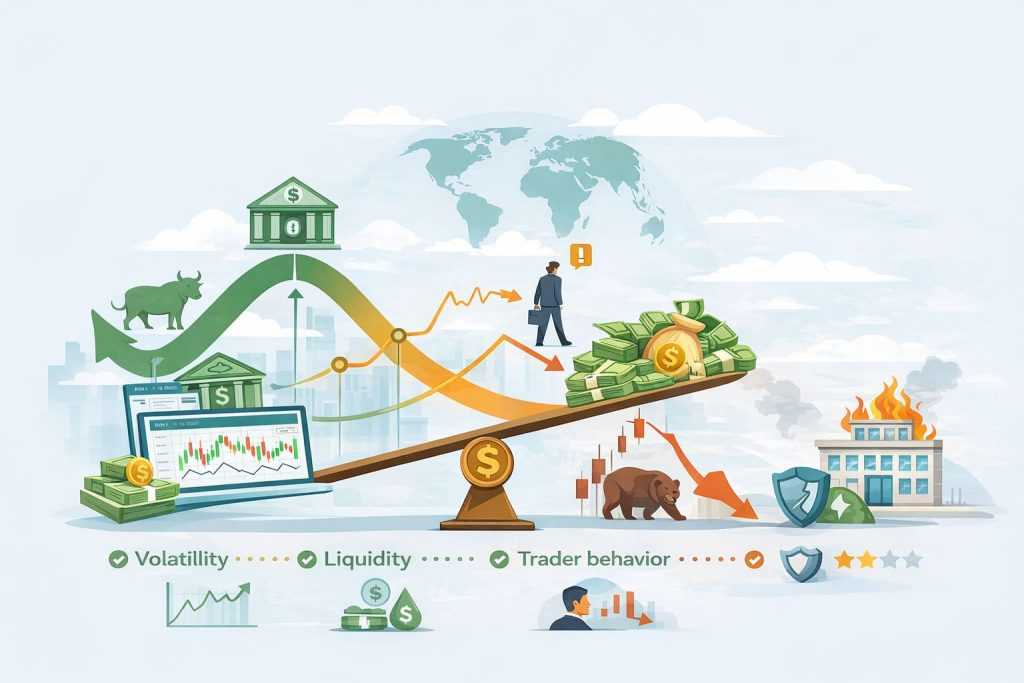
Because of this structure, prop firms are highly sensitive to volatility, liquidity, and trader behavior, all of which fluctuate across economic cycles.
Ignoring macroeconomic conditions can lead to:
- unsustainable payout models
- increased trader churn
- higher failure rates during downturns
- reputational damage during market stress
Prop Trading During Economic Expansion
During expansionary phases, prop trading firms often experience rapid growth.
Key Characteristics
- Higher market liquidity
- Strong trends across asset classes
- Increased retail trading interest
- Easier trader onboarding and retention
Impact on Prop Firms
- Higher challenge participation rates
- More funded traders reaching profit targets
- Increased payout frequency
- Faster firm scaling
However, expansions can also hide structural weaknesses. Firms may:
- loosen risk controls
- overestimate trader skill
- scale marketing faster than operations
These decisions often become problematic when the cycle turns.
The Peak Phase: Hidden Risks for Prop Firms
At economic peaks, volatility often increases while liquidity conditions begin to tighten.
Common Challenges
- Sudden regime shifts in market behavior
- Increased drawdowns among traders
- Rising correlation across markets
- Overconfident traders increasing risk
Risks for Prop Trading Firms
- Payout volatility spikes
- Risk models calibrated for trending markets fail
- Evaluation pass rates drop unexpectedly
- Disputes with traders increase
Prop firms that fail to adjust rules and expectations at this stage often enter downturns unprepared.
Prop Trading Firms in Economic Downturns
Economic contractions present the most serious test for prop trading firms.
Market Conditions
- Reduced liquidity
- Erratic price action
- Shorter trends
- Higher false breakouts
Impact on Traders
- Strategy breakdowns
- Psychological stress
- Increased rule violations
- Lower consistency
Impact on Prop Firms
- Falling evaluation success rates
- Lower long-term trader retention
- Increased operational pressure
- Higher support and dispute volumes
Firms that rely heavily on constant trader inflow or aggressive growth models are particularly vulnerable during downturns.
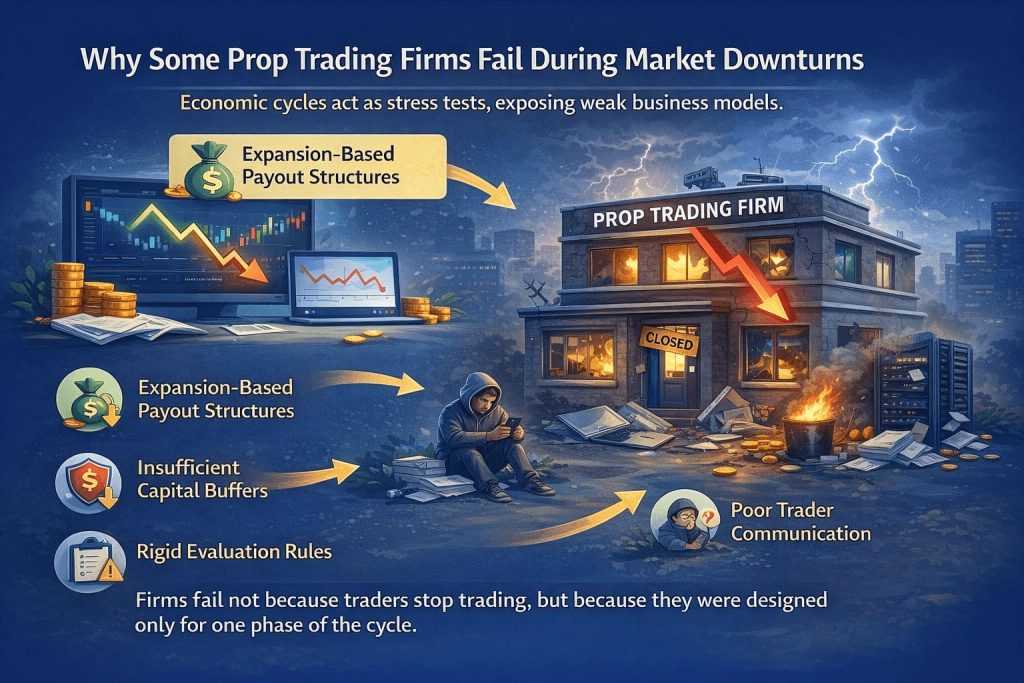
Why Some Prop Trading Firms Fail During Market Downturns
Economic cycles often act as stress tests that expose weak business models.
Common failure points include:
- payout structures dependent on expansion-level performance
- lack of capital buffers
- rigid evaluation rules unsuited to low-liquidity markets
- poor communication with traders.
In many cases, prop trading firms do not fail because traders stop trading — they fail because their models were designed for only one phase of the cycle.
Trader Behavior Across Economic Cycles
Economic cycles also influence trader decision-making, which directly affects prop firms.
During Expansions
- increased risk-taking
- trend-following dominance
- higher confidence
During Downturns
- overtrading
- revenge trading
- strategy hopping
- increased emotional decision-making
Prop firms that understand these behavioral shifts can:
- adjust evaluation rules
- modify educational content
- improve trader support systems
Ignoring trader psychology during market stress often leads to higher churn and reputational issues.
Volatility Is Not Always a Benefit
A common misconception is that volatility always benefits prop trading firms. In reality:
- healthy volatility supports skilled trading
- chaotic volatility increases failure rates
During certain economic phases, volatility becomes unpredictable rather than directional, making consistent performance harder for most traders.
Prop firms that fail to distinguish between these conditions often misinterpret rising volatility as a growth opportunity when it is actually a risk signal.
Adapting Prop Firm Models to Economic Cycles
Prop trading firms that survive multiple cycles typically share several characteristics:
Flexible Risk Frameworks
- adjustable drawdown limits
- dynamic daily loss thresholds
- instrument-specific risk controls
Cycle-Aware Evaluations
- longer evaluation periods during low-liquidity phases
- reduced pressure on short-term targets
- realistic performance expectations
Operational Discipline
- controlled marketing spend
- conservative payout assumptions
- strong data monitoring
These adjustments help firms remain stable even when market conditions deteriorate.
Long-Term Strategy: Planning Beyond the Current Cycle
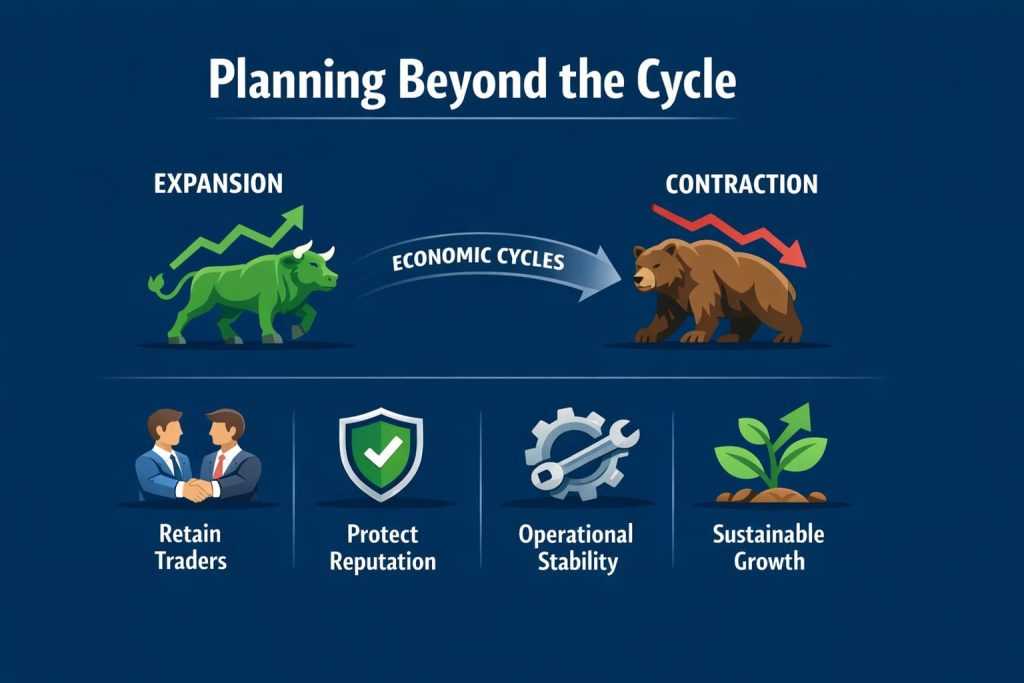
Economic cycles are inevitable. What separates resilient prop trading firms from fragile ones is the planning horizon.
Firms that plan only for favorable conditions often struggle when cycles reverse. In contrast, firms that design systems for both expansion and contraction tend to:
- retain traders longer
- protect brand reputation
- maintain operational stability
- scale more sustainably over time
Understanding economic cycles is not about predicting markets — it is about building a prop trading business that can operate under different market realities.
What Traders Should Consider
Traders evaluating prop firms should also account for economic cycles.
Key questions include:
- How does the firm adjust rules in changing markets?
- Are payout policies consistent during volatility spikes?
- Does the firm communicate clearly during market stress?
Prop firms that acknowledge economic cycles openly often provide a more stable trading environment in the long run.
Conclusion
Economic cycles shape market behavior, trader psychology, and business sustainability — making them a critical factor for prop trading firms.
Firms that understand how expansions, downturns, and recoveries affect trading performance are better equipped to adapt their models, manage risk, and build long-term credibility. Those that ignore macroeconomic realities often discover their weaknesses only when conditions turn unfavorable.
For prop trading firms aiming to survive and grow over multiple market cycles, economic awareness is not optional — it is foundational.
Request a Consultation on Cycle-Resilient Prop Firm Models
Get expert guidance on building and optimizing a prop trading firm that can adapt across economic cycles. We’ll help you assess your risk frameworks, evaluation rules, and payout structures to ensure they remain sustainable during both market expansions and downturns.
Together, we’ll identify vulnerabilities in your current model and design a prop firm setup that protects profitability, trader retention, and brand reputation — regardless of changing market conditions.