


The MT4 and MT5 Manager APIs are the underlying technology that connects broker and prop firm back-office systems to the trading platform layer. They enable two-way programmatic communication with MetaTrader servers — reading account data, executing account actions, and triggering events based on trading activity. For developers building custom brokerage or prop firm tools, these APIs represent more than 50% of the development work in most projects.
This article covers what the MT4 and MT5 JSON APIs can do, the most common applications developers build on top of them, how the data replication service works alongside the JSON API, and how they connect to the Kenmore Design CRM and Trader’s Room API layer. Full technical documentation is available on the Forex Developer API page.
What the MT4 and MT5 JSON API Can Do
The JSON API provides two-way communication with MT4 and MT5 trading servers. Developers can both read data from the platform and write actions back to it programmatically. Core capabilities include:
- Register new trading accounts
- Enable or disable accounts
- Update account personal details
- Change account group assignments
- Process deposits and withdrawals
- Execute credit actions
- Retrieve trader and account data
- Password operations — update, check, verify
- Close all open positions on an account
- Open accounts within a specified numeric range
The range of write operations — not just read — is what makes the MT Manager API the foundation for automation in brokerage and prop firm systems. Applications that need to respond to trading events in real time, enforce rules automatically, or manage accounts without manual intervention all depend on this write capability.
Common Applications Developers Build on the MT Manager API
Custom Bonus and Incentive Systems
Bonus logic that goes beyond standard deposit bonuses requires API-level access to trading activity. Common implementations include credit events triggered by trade volume — for example, crediting an account when a trader executes more than 20 lots within a defined period, at a rate of $2 per lot at period end. The same API calls that credit the account can remove the credit when conditions are no longer met, creating dynamic incentive structures that respond to actual trader behavior rather than just deposit amounts.
Other implementations use group changes as the underlying mechanism — moving high-volume traders to better execution groups, or moving accounts that breach risk parameters to restricted groups — all triggered automatically without manual intervention from the operations team.
Risk Management Tools
Commercial risk management packages for brokerages are expensive — often a significant portion of monthly operating costs. For brokers and prop firms with development resources, building custom risk tools on the MT Manager API is a practical alternative that delivers specific functionality at a fraction of the cost.
Common custom risk implementations include automatic MT group changes triggered by equity thresholds, drawdown breach detection with automated account disabling or position closing, exposure monitoring across multiple accounts, and B-book/A-book routing logic based on trader behavior patterns. For prop firms specifically, real-time equity monitoring with automated breach response is the most operationally critical use case — when a funded trader hits a drawdown limit, the system needs to act within the current trading session, not at the next manual review.
Reporting and Business Intelligence
Reporting is one of the most consistently underdeveloped areas in brokerage operations. Over 18+ years of working with forex brokers, the consistent feedback is the same: no amount of reports is ever enough. Every business develops new operational questions that the existing report set does not answer.
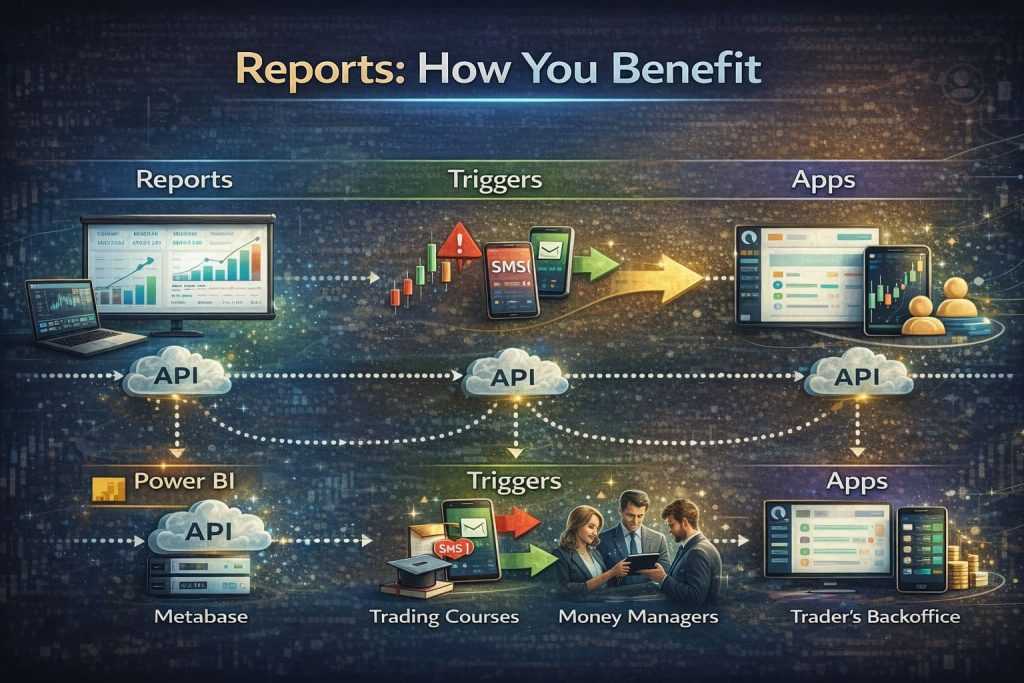
The MT Manager API feeds data into reporting systems either directly through API calls or through the data replication service (covered below). Connected to a BI tool — Microsoft Power BI, Metabase, or custom dashboards — this data enables reports across trading history, account performance, group behavior, equity trends, and operational metrics that are not available through the MT platform’s native reporting interface.
A practical implementation: if a trader records losses above a defined threshold within a specified period, the system automatically triggers a targeted communication — an email or SMS recommending an EA, a money manager, or an educational course. This kind of behaviorally triggered communication requires reading trading data from MT and writing actions to the CRM communication layer — exactly the integration the MT Manager API enables.
Mobile Applications
For brokerages and prop firms building mobile apps — trader dashboards, account management tools, challenge progress trackers — the MT Manager API provides the data layer. Account balances, open positions, trading history, equity values, and drawdown status all come from the MT server through this API. In a typical mobile app development project for a brokerage or prop firm, MT Manager API integration accounts for more than half of the total development effort.
Webhooks (covered below) complement the mobile use case by enabling real-time push notifications — alerting traders when they approach a margin call, when a drawdown threshold is reached, or when a challenge evaluation completes.
Custom Trader Back-Offices and Task Management Systems
Some brokers — particularly those with existing web development teams or those working with local development companies — build lightweight custom back-office tools and task management systems on top of the MT Manager API. These are not full CRM replacements but targeted tools that handle specific operational workflows: account review queues, compliance checklists, deposit approval flows, or team task management connected to trading account status.
For web development companies that want to expand their service portfolio into the forex or prop firm sector, the MT Manager API provides the technical foundation to build brokerage-specific products without developing deep MetaTrader expertise from scratch.
Prop Firm Applications — Threshold Monitoring and Automated Actions
For prop firms, the MT Manager API’s most critical function is real-time threshold monitoring. Prop firm challenge rules are defined by equity thresholds — daily loss limits, total drawdown limits, minimum trading days, consistency rules — and the operational requirement is that breaches are detected and acted on within the current trading session.
A breach detection system built on the MT Manager API polls account equity values at defined intervals, compares them against configured thresholds, and triggers automated actions — account disabling, position closing, status updates in the CRM — when a breach is detected. The alternative — manual monitoring — does not scale beyond a small number of funded accounts and introduces human error risk at the exact moment where capital is at stake.
In 2026, with regulators and payment providers increasing scrutiny of prop firm operations, having documented, automated, auditable rule enforcement is also a compliance advantage — not just an operational one.
The Data Replication Service — MySQL Sync From MT4/MT5
Alongside the JSON API, Kenmore Design provides a data replication service that connects to MT4 or MT5 and continuously synchronizes trading platform data to a MySQL (or MongoDB) database. The synchronized data includes all available MT data: users, accounts, trading history, groups, equity values, and positions.
This service addresses a performance problem that appears when building high-traffic applications on the JSON API directly. Using the JSON API to serve data to thousands of concurrent users puts significant load on the MetaTrader server — a server that is also handling live trading activity. Routing read requests through a locally hosted MySQL database shifts that load entirely off the MT server, allowing the trading platform to run without API-driven performance degradation.
The data replication service can be hosted on Kenmore Design’s infrastructure or on the broker’s own servers. It is the foundation for large-scale reporting systems, BI integrations, and applications that need to query historical trading data without impacting live platform performance.
Webhooks — Real-Time Event Notifications
Webhooks provide real-time notification of events on the MT server without requiring the application to poll continuously. Any event type can trigger a webhook — trade opens, trade closes, equity threshold crossings, account status changes, deposit and withdrawal completions.
Common webhook implementations include prop firm equity threshold alerts that trigger automated account actions, mobile app push notifications for margin call approach, trade confirmation notifications for client-facing applications, and compliance event triggers that update CRM records when specific trading activity occurs.
The combination of the JSON API (for write operations and targeted reads), the data replication service (for high-volume read operations), and webhooks (for real-time event handling) covers the full range of MT integration requirements for brokerage and prop firm applications.
Connecting to the Kenmore Design CRM API
For brokers and prop firms running Kenmore Design’s CRM and Trader’s Room, the MT Manager APIs connect directly to the CRM API layer. The Kenmore CRM is built on a comprehensive API set that exposes the same functionality available through the platform interface — client data, account management, IB relationships, payment records, KYC status, communication history, and reporting data.
This means developers can build applications that span both layers — reading MT trading data and writing to CRM records in the same workflow. Common combined implementations include custom landing pages that feed directly into the CRM onboarding flow, payment aggregator integrations that update both the CRM and the MT account simultaneously, marketing automation triggered by trading behavior, and affiliate tracking systems that connect MT volume data to CRM commission calculations.
Access to the CRM API is available to operators on request. The technical documentation, available on the Forex Developer API page, covers authentication, available endpoints, rate limits, and integration examples.
Conclusion
The MT4 and MT5 Manager APIs, combined with the data replication service and webhook system, give developers the full technical toolkit for building custom brokerage and prop firm applications — from targeted risk tools and reporting systems to complete mobile apps and custom back-office interfaces. Connected to the Kenmore Design CRM API, they enable integrations that span the full operational stack without requiring developers to work around platform limitations or build proprietary MT connectivity from scratch.
For specific technical requirements or integration questions, contact the Kenmore Design team directly.

Request a Consultation on Forex Developer APIs & Custom Integrations
Get expert guidance on using Forex Developer APIs to build custom tools for your brokerage or prop firm. We’ll help you evaluate API use cases, design secure integrations with MT4/MT5 and CRM systems, and determine the most efficient architecture for reports, risk tools, mobile apps, and automation.
Together, we’ll review your technical goals and outline a scalable API-driven approach that extends your platform’s capabilities without overloading your core infrastructure.