


A forex brokerage that runs on manual processes hits a ceiling fast. New lead arrives at 2 AM and sits in an inbox until the morning shift. A funded deposit isn’t reflected in the trading account or KYC documents pile up in a queue while sales waits to call the prospect. IB commissions get calculated by hand on a spreadsheet and a partner notices a mistake three months later.
Every one of these moments is a leak — of revenue, of trust, of the operator’s attention. The fix isn’t more headcount. It’s automation: a set of workflows that the CRM executes the moment they’re triggered, without waiting for a human to push the button.
This guide walks through the seven workflows every modern forex brokerage should automate, what the implementation actually looks like, and what to watch out for. By the end, you’ll have a clear picture of which automations to prioritize first and how they fit together.

Why CRM Automation Matters
Brokerages compete on margin, speed, and consistency. Manual processes erode all three.
The economics of manual work are straightforward. A back-office operator can verify maybe 30 to 50 KYC submissions per day. A sales agent can productively follow up with 40 to 80 fresh leads. A compliance officer can read maybe 200 transaction records per hour looking for red flags. As the business grows, these capacities are the bottlenecks — and the only way to expand them manually is to hire more people, which means more salary, more training, more management overhead.
Automation breaks that pattern. A workflow engine runs at the same speed whether you have 100 clients or 100,000. It doesn’t skip rules when it’s tired. It doesn’t forget to follow up. It doesn’t take vacation. And it gives the human team time to do the work that actually requires judgment — building relationships, handling edge cases, optimizing strategy.
The brokerages that scale past mid-size almost always have aggressive automation. The ones that stay stuck at fifteen back-office staff per thousand active clients are the ones that have outgrown their tooling. For a foundational overview of why this matters, see why your forex business needs a CRM.
Workflow 1: Lead Routing Automation
The moment a new lead lands in your CRM, the clock starts. Research consistently shows that leads contacted within five minutes of registration convert at multiple times the rate of leads contacted within an hour, and at twenty times the rate of leads contacted after a day. Manual lead routing — where leads sit in a queue until an agent grabs one — is the most common source of conversion leakage in retail brokerages.
Automated lead routing solves this with rules that fire instantly on registration.
Common routing dimensions:
- Geography: route leads from MENA to the Arabic-speaking team, LatAm leads to the Spanish team, EU leads to the regulated-entity desk.
- Source attribution: route paid-search leads to closers, organic leads to nurturers, partner-referred leads to the IB relationship manager.
- Lead score: route high-intent leads (those who filled in a full registration form, started KYC, watched the demo video) to senior agents; low-intent leads to nurture sequences.
- Team capacity: distribute leads round-robin within a routing pool, weighted by agent performance or current workload.
- Time zone alignment: route to agents who are working at the moment the lead arrives, not whichever shift owns the country.
A well-configured automation should be able to take a lead from a Facebook ad form, parse the country, identify it as a Spanish-speaking high-intent lead, push a Slack notification to the LatAm closer who’s online right now, and create a CRM task with a 5-minute SLA — all before the lead has finished closing the browser tab.
The advanced sales teams module covers the structural side of how to set up routing pools, team hierarchies, and override rules for this kind of workflow.
Workflow 2: KYC Automation
Manual KYC is the bottleneck at most growing brokerages. A new client submits ID and proof-of-address, the documents sit in a queue, a compliance officer eventually reviews them, an account is either approved or sent back for resubmission. The cycle takes hours at best, days at worst — during which the client cools off, considers competitors, or just forgets.
KYC automation breaks this into discrete steps that can run unattended:
- Document upload validation: Auto-reject obviously broken submissions (wrong file format, image too dark, text unreadable) at upload time, with clear feedback to the client.
- OCR and data extraction: Pull name, date of birth, document number, and expiry from ID documents automatically. Pre-fill the verification record.
- Liveness and face-match checks: Compare a real-time selfie against the ID document photo using a third-party provider’s API.
- Sanctions and PEP screening: Run the extracted name against OFAC, EU, UN, and PEP databases automatically.
- Risk scoring: Combine country of residence, source of funds declaration, document type, and screening results into a risk score that decides whether the account is auto-approved, sent for human review, or auto-rejected.
- Status notifications: Email and in-app status updates to the client at every stage, with clear next steps if anything fails.
The goal isn’t to remove the human compliance officer — for higher-risk cases, judgment is irreplaceable. The goal is to remove them from the 70 to 80 percent of submissions that are clearly legitimate and the 10 to 15 percent that are clearly fraudulent, leaving the human time for the edge cases that actually need it. Ways to process KYC in forex brokerages covers the underlying patterns.
Workflow 3: Trading Account Creation (MT4/MT5/cTrader/DXtrade)
Once KYC passes, the client expects to start trading. Any friction at this step is conversion friction. Manual trading-account creation — where a back-office operator logs into the MT4/MT5 manager terminal and creates the account by hand — is slow and error-prone.
Automated account creation should:
- Trigger immediately on KYC approval (or even registration, depending on the brokerage’s model).
- Pull the client’s identity data from the CRM and pass it to the trading platform via the platform’s manager API.
- Select the correct group on the trading server based on the client’s account type.
- Generate credentials and deliver them to the client through the secure portal or email
- Apply leverage, deposit currency, and any group-specific settings without operator intervention.
- Update the CRM with the new trading account number and link it to the client profile.
The same automation should support multiple platforms in parallel. A brokerage offering MT4, MT5, and cTrader needs the automation to know which platform the client selected and route the creation request accordingly. A side-by-side comparison of MT4 versus MT5 is worth reading for operators making the platform decision.
For brokerages running custom CRMs, this layer is typically built on top of the platform’s manager API. The CRM API documentation shows what kind of data interface modern CRMs expose for this.
Workflow 4: Deposits and Withdrawals Sync
The deposit-to-trading-account flow is one of the most operationally sensitive automations in a brokerage. Get it wrong and clients see their deposit credited late (or worse, not at all), trades fail because the balance hasn’t updated, and support volume spikes.
The automation chain typically looks like this:
- Client initiates a deposit through the trader room.
- The CRM creates a pending transaction record and redirects to the selected PSP.
- PSP processes the payment and returns a webhook callback.
- CRM verifies the callback (signature, amount, transaction ID).
- CRM credits the trading account via the platform’s manager API.
- CRM updates the client’s portal with the new balance.
- Notifications fire (in-app, email, SMS) confirming the deposit.
Withdrawals run in reverse but with an additional approval step. Most brokerages require either rule-based approval (auto-approve below a threshold, manual review above) or full manual approval for all withdrawals, depending on risk appetite.
| Operation | Manual approach | Automated approach |
|---|---|---|
| Deposit credit | 5 – 30 minutes from PSP callback to trading account | < 30 seconds end-to-end |
| Failed deposit reconciliation | Discovered next business day | Flagged in real time |
| Withdrawal processing | Multiple touches by ops, finance, compliance | Single approval, automated execution |
| FX conversion on multi-currency accounts | Manual lookup of rate, manual calculation | CRM applies live rate at credit time |
| Reconciliation reports | Built by hand from exports | Generated continuously |
Failed-payment reconciliation deserves special attention. PSPs occasionally fail to deliver webhooks, or deliver them out of order, or send duplicates. The automation needs idempotency (don’t credit twice if the same transaction is reported twice), retry logic (poll the PSP if a webhook is overdue), and clear escalation when something can’t be auto-resolved.
Workflow 5: IB Commission Automation
Introducing Broker (IB) and affiliate programs are major revenue channels for most brokerages, but the commission math is where manual processes break down most spectacularly.
Multi-tier structures, cash-per-lot, revenue share on net P&L, CPA bonuses, sub-IB overrides — calculating these by hand for a network of even fifty partners is a full-time job, and one error damages a relationship that took months to build.
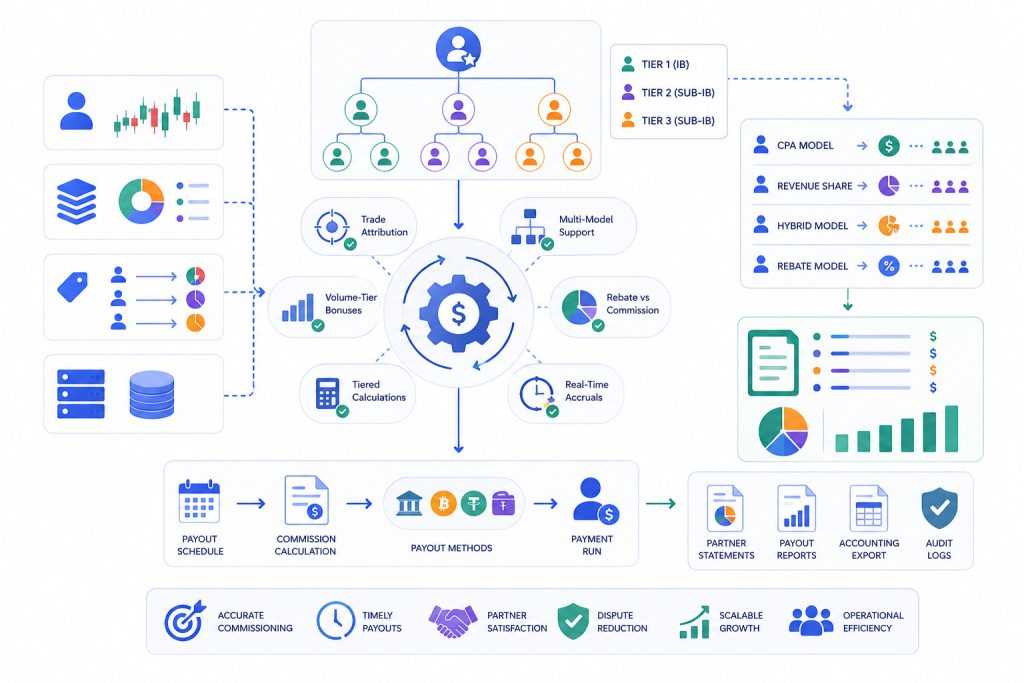
Automated commission calculation handles:
- Real-time trade attribution. Every trade is tagged with the IB hierarchy that brought the client. The CRM walks up the tree and credits each tier according to the configured split.
- Multi-model support. A single brokerage often runs CPA, revenue share, and hybrid models simultaneously across different partner tiers. The automation needs to apply the right model per partner per client.
- Rebate vs commission accounting. Some brokerages pay IBs from spread (rebate model); others from commission revenue. The automation needs to know which.
- Volume-tiered increases. Many IB contracts include volume-based bonuses (e.g., extra 10% above 1,000 lots/month). The automation tracks running totals and applies bonuses automatically.
- Payout scheduling. Calculate accrued commissions per partner per period, generate payout reports, and trigger payment runs via the appropriate rail (bank, crypto, e-wallet).
For brokerages with complex IB networks, this is one of the highest-ROI automations to invest in. The savings in operations time pay for the system multiple times over, and the reduction in commission disputes preserves partner relationships.
Workflow 6: Retention Workflows
Acquiring a forex trader is expensive. CPA in competitive markets can run from $300 to $1,500 depending on geography and channel. Losing that trader to inactivity, frustration, or a competitor within their first 90 days erases the marketing investment.
Retention workflows are CRM automations triggered by behavioral signals — events that indicate a client is at risk or, conversely, ready for an upsell.
Common retention triggers:
- Inactivity: No trades in 14 days → automated email check-in. No trades in 30 days → SMS plus a sales agent task. No trades in 60 days → reactivation campaign with a small bonus.
- First-deposit decline: Deposit attempted but failed → instant alert to the assigned closer, who calls within the hour.
- Withdrawal request: Especially first-time withdrawals → trigger a retention call (or at minimum a satisfaction check-in) before the funds clear.
- Losing streak: Five consecutive losing trades on a small account → trigger a risk-management educational sequence rather than a sales push.
- Win streak: Three consecutive winning trades on a small account → trigger an upsell to a larger account size or premium features.
- Inactivity after big deposit: A $5,000 deposit followed by no trades in 48 hours → immediate human follow-up.
These workflows depend on the CRM being tightly integrated with the trading platform — it needs to see trade activity, balance changes, and platform-side events in near real time. For a deeper view of how automation specifically reduces churn, see how to reduce trader churn using CRM automation.
Workflow 7: Compliance Alerting
Regulators (CySEC, FCA, ASIC, FSCA, and others) expect brokerages to detect and report suspicious activity. Doing this manually means reading transaction logs and trade activity by hand — an impossible task at any meaningful scale.
Automated compliance alerting flags:
- Unusual deposit patterns: A client whose monthly deposits suddenly increase tenfold, or who deposits and withdraws the same amount without trading (potential money laundering).
- High-risk geographies: Activity from sanctioned jurisdictions or high-risk countries flagged by FATF.
- PEP and watchlist updates: Daily re-screening of the existing client base against updated sanctions and PEP lists.
- Document expiry: ID documents approaching their expiry date — trigger a renewal request before the account is locked.
- Threshold breaches: Large transactions (over $10,000, configurable per jurisdiction) that may require enhanced due diligence or regulatory reporting.
- Pattern anomalies: Sudden change in trading behavior (e.g., a client who’s traded micro-lots for a year suddenly opening 50-lot positions) — could indicate account compromise.
Compliance alerts shouldn’t auto-block accounts (that’s a recipe for false-positive customer pain). They should generate prioritized work items for the compliance team with full context: what triggered the alert, what the client’s normal pattern looks like, and what action options are available.
Building the Stack: Implementation Order
Brokerages tackling CRM automation from scratch shouldn’t try to do everything at once. The right order maximizes ROI in the early phases and builds confidence in the later ones.
| Phase | Automation | Why first |
|---|---|---|
| Phase 1 | Lead routing | Highest immediate conversion impact |
| Phase 2 | KYC automation | Removes biggest operational bottleneck |
| Phase 3 | Trading account creation + deposit sync | Critical path for client activation |
| Phase 4 | Compliance alerting | Risk reduction, regulatory hygiene |
| Phase 5 | IB commission automation | High accuracy + partner trust |
| Phase 6 | Retention workflows | Maximizes lifetime value once everything else is solid |
A common mistake is starting with retention workflows because they’re the most “marketing-flavored.” But retention workflows depend on accurate behavioral data, which depends on solid account creation and deposit sync. Get the foundations right first.
Common Pitfalls
- Building automation without idempotency. Webhooks fail, retry, and duplicate. Every automation that creates records, credits balances, or sends notifications needs to be safe to run twice.
- Hardcoding business rules in code. Routing rules, commission splits, and compliance thresholds change. Hardcoded rules force a developer engagement every time the business needs to adjust. Build rules as configurable data, not as code.
- No fallback for system failures. A KYC provider goes down, a PSP webhook stops arriving, the trading platform’s manager API times out. Every critical automation needs documented manual fallback procedures.
- Insufficient logging. When something goes wrong six months later, you need to be able to trace exactly which automation fired, what data it had, and what it did. Log every automation execution with input, output, and outcome.
- Treating automation as set-and-forget. Markets change, partner contracts change, regulators change. Automation needs ongoing review — quarterly at minimum — to confirm it still matches the business reality.
Conclusion
A modern forex brokerage runs on automation. The seven workflows covered here — lead routing, KYC, trading account creation, deposit and withdrawal sync, IB commissions, retention, and compliance alerting — handle the operational load that would otherwise demand a back office twice the size.
The investment pays back fast. The operator time freed up by automating these flows is the difference between a brokerage that stalls at $200,000 monthly revenue and one that scales past $2,000,000 without proportional headcount growth.
The brokerages that get this right treat their CRM as the operating system of the business — not a contact database with some integrations bolted on, but the central nervous system that orchestrates everything from the first ad click to the IB payout three months later. Done well, automation isn’t about replacing people. It’s about freeing your team to do work that actually requires judgment, and letting the machine handle everything that doesn’t.

Request a Consultation on Building a Brokerage Automation Framework
Get expert guidance on identifying which workflows should be automated first and how to structure them for long-term scalability. We’ll help you evaluate lead routing, onboarding, payments, retention, compliance, and partner management processes to reduce operational friction as your brokerage grows.
Together, we’ll review your current workflow architecture and outline an automation strategy aligned with efficiency, consistency, and scale.