


Trader retention is the most financially significant operational metric a forex brokerage manages — and the one most consistently underserved by the systems brokers use to track it. Most brokerages know their monthly active trader count and their deposit volume. Fewer know which specific friction points are causing traders to go inactive, which onboarding steps are causing the most drop-off, or which segments of their trader base are at highest churn risk right now. The data to answer these questions exists inside every brokerage’s CRM — but most operators are not using it.
This article covers what forex traders actually want from a brokerage in 2026 — based on behavioral patterns that CRM data consistently surfaces — and how brokers can use that data to improve retention operationally rather than treating it as a reporting metric.

What CRM Data Actually Reveals About Trader Behavior
The most valuable retention insights in a forex brokerage CRM are not in the satisfaction survey scores — they are in behavioral data that most operators never formally analyse. The sequence of events in a trader’s lifecycle reveals their needs, frustrations, and decision points more accurately than any questionnaire.
Four behavioral patterns that CRM data consistently surfaces across forex brokerage deployments:
The Onboarding Drop-Off Pattern
Across most retail forex brokerages, a significant percentage of registrations never make a first deposit. The trader created an account, started the KYC process, and then stopped. CRM data shows exactly where in the onboarding funnel each dropout occurred — which KYC step, which verification requirement, which waiting period. When this data is mapped across all dropout events, the friction points become visible: a document upload requirement that is unclear, a verification delay that takes too long, a deposit step that requires more information than the trader expected.
What traders actually want at this stage is not a simpler KYC process — they want a predictable one. A trader who knows exactly what documents are required, exactly how long verification will take, and exactly what happens next will complete onboarding at significantly higher rates than one who encounters ambiguity at any step. The CRM data that reveals drop-off points directly identifies where the predictability is failing. For a full breakdown of how registration form design affects onboarding completion rates, see the guide on registration form types for forex brokerages.
The First-Deposit-to-First-Trade Gap
Traders who deposit but do not trade within the first seven days are at significantly higher churn risk than those who trade within 24 hours of their first deposit. CRM data that tracks the time between first deposit and first trade identifies which trader cohorts are experiencing this gap — and crucially, what happened during that gap. Did the trader open a support ticket? Did they log in multiple times without executing? Did they log in once and then not return?
What traders want at this stage is guided activation. A trader who deposits and then faces an unfamiliar platform interface without support will often delay their first trade indefinitely. Brokerages that send an automated educational sequence — platform tutorial, first trade walkthrough, market commentary — immediately after the first deposit consistently see higher rates of first-trade completion. This is a CRM automation trigger, not a manual outreach task, and it should fire within hours of the deposit event rather than the next business day.
The Withdrawal Pattern
Withdrawal behavior is one of the strongest predictors of churn that CRM data contains. A trader who makes a partial withdrawal — taking out a portion of their balance while leaving some funds in the account — is behaving differently from a trader who withdraws their entire balance. The first trader is managing their risk. The second trader may be leaving.
CRM data that tracks withdrawal events against subsequent account activity reveals the true churn signal: traders who withdraw fully and do not log in within 14 days are churned with high probability. Traders who withdraw partially and continue trading are not. The broker who treats both withdrawal events the same — no follow-up for either — is missing the retention opportunity that the full withdrawal creates. A targeted outreach from the account management team within 48 hours of a full withdrawal, when the trader’s experience with the brokerage is still fresh, produces measurably better retention outcomes than outreach after 30 days of inactivity.
The Support Ticket Escalation Pattern
Traders who submit support tickets about payment issues — deposit not credited, withdrawal delayed, payment method rejected — churn at significantly higher rates than traders whose support interactions are about platform usage or trading questions. Payment friction is the single strongest negative signal in the support ticket data of most retail forex brokerages.
CRM data that connects support ticket category to subsequent account activity reveals this pattern clearly. Traders who had a payment ticket resolved quickly — within 4 hours — continue trading at much higher rates than traders whose payment ticket took 24+ hours to resolve. Speed of resolution, not just resolution itself, is what traders actually want from payment support. Automating the first-response acknowledgment and setting team-level SLAs on payment ticket categories — rather than general support response times — directly addresses the retention risk that payment friction creates.
What Traders Want — Mapped to CRM Actions
| What traders want | CRM data signal | Automated action |
|---|---|---|
| Predictable onboarding | KYC step drop-off rate | Automated guidance message at each stuck step |
| Guided platform activation | Days between first deposit and first trade | Educational sequence triggered on first deposit |
| Fast payment resolution | Payment ticket response time vs churn rate | Priority routing for payment tickets, 4-hour SLA |
| Acknowledgment when inactive | Days since last login or trade | Re-engagement sequence at 14, 30, and 60 days |
| Recognised as high-value | Deposit volume and trading frequency | Automatic upgrade to senior account manager at threshold |
| Consistent communication | Email open rate and support contact frequency | Weekly digest segmented by trading activity level |
The Segment Brokers Most Consistently Neglect
CRM data consistently identifies one trader segment that most brokerages underserve: traders who were active, went dormant, and have not yet churned permanently. This segment — traders with account balances, prior trading history, and no formal closure request — represents recoverable revenue that most brokerages treat as lost.
The behavioral profile of this segment is specific: they logged in multiple times in their active period, they traded with sufficient frequency to suggest genuine interest, and they stopped. They did not close their account. They did not withdraw their full balance. They simply stopped logging in. In most CRMs, these traders sit in the same “inactive” category as traders who deposited once, never traded, and have had zero activity for 18 months — despite being fundamentally different retention opportunities.
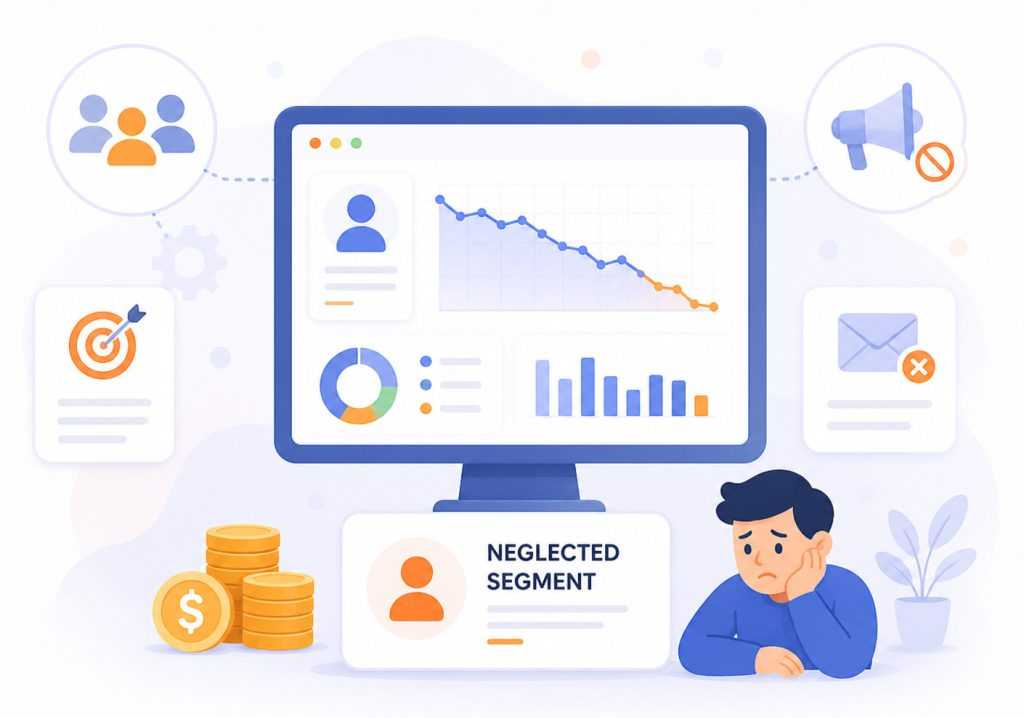
What this segment wants is a reason to return that is specific to their history with the platform — not a generic promotional email. A re-engagement message that references the instruments they traded, the time period they were active, and a specific market development relevant to those instruments performs dramatically better than a promotional offer with no personalization. This level of segmentation and personalization is only possible if the CRM contains the trading history data and the automation capability to use it. For a full overview of how CRM automation supports trader retention across the lifecycle, see the guide on reducing trader churn using CRM automation.
The IB Dimension — What Referred Traders Reveal
CRM data that tracks trader behavior by acquisition source — which IB or affiliate channel brought each trader — reveals patterns that most brokerages never formally analyse. Traders referred by different IB types behave differently: a trader referred by a YouTube educational creator has different expectations and behavior patterns than a trader referred by a Telegram signal group or a personal referral from an existing client.
The CRM data that connects acquisition source to long-term retention allows brokerages to identify which IB channels produce the highest-lifetime-value traders — not just the highest registration volume. A broker who pays the same commission rate to an IB whose traders average 90 days of activity and an IB whose traders average 14 days is not managing their acquisition economics correctly. Tiering commission structures to reflect trader quality — as revealed by CRM retention data — is one of the highest-return optimisations available to a brokerage’s IB program. For more on how to structure IB commission tiers around trader quality metrics, see the Multi-Level IB system documentation.
Turning CRM Data Into Retention Actions — The Practical Framework
The gap between brokerages that use CRM data for retention and those that do not is not a technology gap — it is a process gap. The data exists in every modern forex CRM. The question is whether the operations team has defined the triggers, built the workflows, and assigned the ownership that turns raw data into retention actions.
A practical retention framework built on CRM data requires three things:
- Defined trigger events — specific behavioral events that initiate a retention action: first deposit, KYC completion, first trade, 14 days inactive, full withdrawal, payment ticket opened, payment ticket resolved. Each trigger should have a defined response — automated, manual, or both
- Segment-specific responses — the response to a trigger should vary by trader segment. A high-value trader who goes 14 days inactive should receive a different response than a trader who deposited once and has never traded. The CRM data that defines these segments — deposit volume, trading frequency, acquisition source, account age — is already available in the system
- Closed-loop measurement — every retention action should be tracked against outcome. Did the re-engagement email produce a login? Did the account manager outreach produce a deposit? Did the payment ticket resolution result in continued trading? Without outcome measurement, retention programs cannot be optimised — and the CRM data that enables this measurement is the same data that powered the trigger in the first place
For brokerages that want to understand how their current CRM infrastructure supports these retention workflows — triggers, segmentation, automation, and outcome tracking — the Forex CRM reporting and triggers system covers the full capability set available within the Kenmore Design platform.

Request a Consultation on Implementing CRM-Based Retention Automation
Get expert guidance on implementing trigger-based workflows inside your forex CRM. We’ll help you configure onboarding sequences, inactivity alerts, payment ticket prioritization, withdrawal monitoring, and IB-tier adjustments tied directly to trading behavior.
Together, we’ll assess your current CRM setup and define a practical automation roadmap that reduces churn through structured, measurable actions.