


MetaTrader 4 and MetaTrader 5 have dominated retail forex infrastructure for two decades. In 2026, both platforms are still running in broker stacks worldwide — but the landscape has shifted significantly, and the decision you make today will shape your operations, your API integrations, and your CRM setup for years to come.
This guide is written for broker operators, not traders. Here’s what the MT4 vs MT5 decision actually means for your business.
The State of Play in 2026
The numbers tell a clear story. According to Finance Magnates Intelligence, MT5 overtook MT4 in trading volume in Q1 2025, capturing 54.2% of combined MetaTrader volume. Our and our competition public analysis of 900+ global brokerages found 68% offer MT5 while 40% still offer MT4 — with 23% running both platforms simultaneously.
The more critical development for new operators: MetaQuotes no longer issues MT4 white label licenses. If you’re launching a new brokerage today, MT4 is simply not available to you. MT5 is the only MetaTrader option for new entrants.
For existing MT4 brokers, the decision is whether and when to migrate — not if.
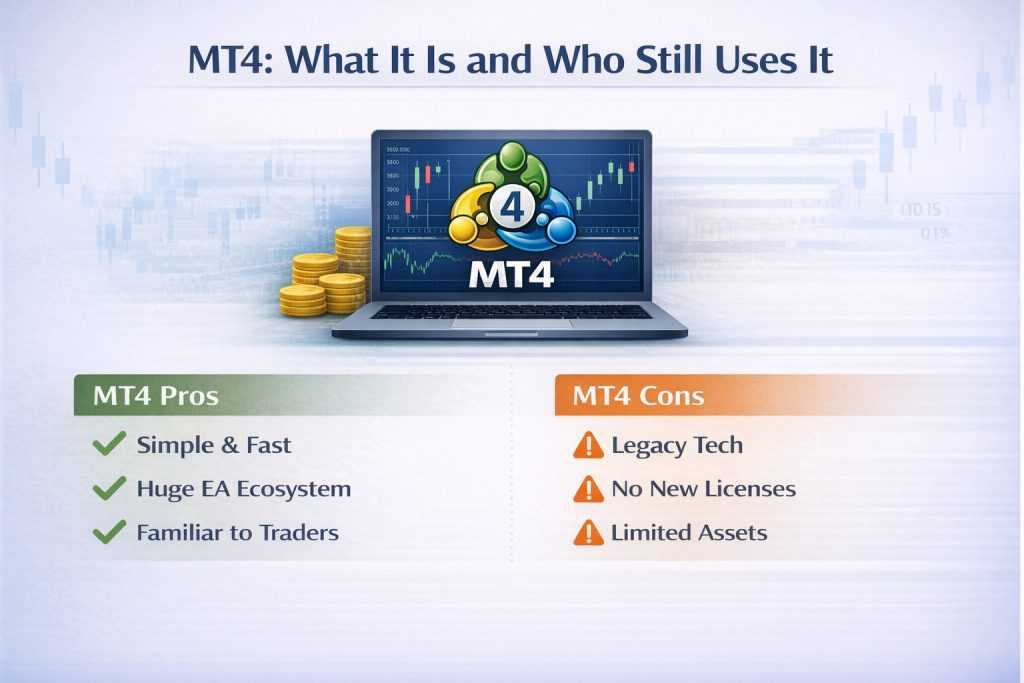
MT4: What It Is and Who Still Uses It
MetaTrader 4 launched in 2005 and became the foundation of retail forex trading. Its success came from simplicity, stability, and an enormous ecosystem built around it — thousands of Expert Advisors, custom indicators, liquidity bridges, and third-party tools developed over 20 years.
What MT4 does well:
- Lightweight and fast — runs reliably on low-spec hardware and slow connections
- Forex and CFD focused — clean, straightforward execution for pure FX operations
- Massive EA ecosystem — more automated trading tools than any other platform
- Familiar to retail traders — lower onboarding friction for your clients
- Hedging model — traders can hold simultaneous buy and sell positions on the same instrument
MT4 limitations for brokers:
- No new white label licenses — unavailable for new brokerage launches
- 32-bit, single-threaded architecture — technical debt for high-volume operations
- Limited to forex and CFDs — cannot natively support stocks, futures, or options
- No Depth of Market (DOM) — limits appeal to professional traders
- Maintenance mode only — MetaQuotes issues security fixes but no new features
- Single-currency backtesting — limits algorithmic strategy development
Who MT4 still makes sense for: Existing brokers with an established client base on MT4, particularly in markets with strong hedging culture (parts of Asia, MENA) where trader familiarity with the platform reduces churn risk during any potential migration.
MT5: The Modern Standard
MetaTrader 5 launched in 2010 with a fundamentally different architecture — built as a multi-asset platform from day one, not retrofitted from a forex-only foundation.
What MT5 does well:
- Multi-asset native — forex, CFDs, stocks, futures, options, bonds, and cryptocurrencies on a single platform
- 64-bit, multi-threaded — faster execution and better performance at scale
- 21 timeframes vs MT4’s 9 — more precise technical analysis
- 44 charting tools vs MT4’s 31 — better analytical depth
- 6 order types including Fill or Kill and Immediate or Cancel — essential for algorithmic and institutional flow
- Multi-currency backtesting — real tick data, faster strategy testing
- Economic calendar built in — no third-party integration needed
- Both hedging and netting modes — flexibility for different regulatory environments
MT5 limitations:
- Higher infrastructure cost — full server setup requires more resources than MT4
- MQL5 learning curve — developers familiar with MQL4 need time to adapt
- Smaller legacy EA library — though growing rapidly
- More complex initial setup — steeper operational learning curve for new teams
Who MT5 is right for: Any new brokerage launching today, brokers expanding into multi-asset offerings, operations targeting professional or institutional clients, and brokers in regulated jurisdictions where compliance reporting requirements favour MT5’s architecture.
Side-by-Side Comparison
| MT4 | MT5 | |
|---|---|---|
| Launch year | 2005 | 2010 |
| Architecture | 32-bit, single-threaded | 64-bit, multi-threaded |
| Asset classes | Forex, CFDs | Forex, CFDs, stocks, futures, options, bonds, crypto |
| Timeframes | 9 | 21 |
| Technical indicators | 30 | 38 |
| Charting tools | 31 | 44 |
| Order types | 4 pending | 6 pending + partial fill |
| Position model | Hedging | Hedging + netting |
| Backtesting | Single currency | Multi-currency, real tick data |
| White label availability | No (closed to new licenses) | Yes |
| EA ecosystem | Massive, mature | Growing |
| New feature development | None (maintenance only) | Active |
| Best for | Existing FX-focused brokers | New brokers, multi-asset, institutional |

MT4 vs MT5 API Integration: What Brokers Need to Know
This is where the decision gets operationally significant. Your trading platform needs to communicate with your CRM, back office, risk management tools, payment systems, and reporting infrastructure. The API layer is what makes all of that work.
MT4 API integration MT4 uses a bridge-based connectivity model. Third-party bridges connect the MT4 server to liquidity providers and external systems. The MT4 JSON API allows developers to access account data, trading history, position information, and client metrics programmatically — enabling real-time data flow between your trading platform and your back office systems.
Key integration points via MT4 API:
- Real-time account balance and equity data
- Trade history and execution logs
- Open position monitoring
- Client group and leverage management
- Commission and markup configuration
MT5 API integration MT5 was designed with more modern API architecture. The MT5 JSON API provides broader functionality than its MT4 counterpart — reflecting the platform’s multi-asset scope and more sophisticated data model.
Key advantages of MT5 API over MT4:
- Multi-asset data in a single API layer — no separate connections per instrument type
- Better real-time streaming of tick data and market depth
- More granular reporting data for compliance and risk
- Native support for netting and hedging position models in the same API
- Cleaner integration with modern CRM and back office systems
For brokers building or upgrading their technology stack, the forex API for developers sits between your trading platform and your operational systems — handling data synchronisation, client management, and reporting automation.
CRM Integration: How MT4 and MT5 Connect to Your Back Office
Your trading platform doesn’t operate in isolation. Every client action on MT4 or MT5 — deposits, withdrawals, trades, account changes — needs to flow into your CRM and back office in real time.
What a well-integrated CRM does with MT4/MT5 data:
- Automatically creates and updates client profiles from platform account data
- Syncs trading activity for retention triggers — inactivity alerts, risk flags, VIP identification
- Calculates IB and affiliate commissions based on traded volume
- Generates compliance reports from trade execution data
- Flags suspicious activity patterns for your risk desk
- Manages KYC status alongside trading account status
The quality of this integration determines how efficiently your operations team can work. A forex back office and CRM platform built with native MT4/MT5 connectivity eliminates the manual reconciliation that slows down brokerages running disconnected systems.
MT4 CRM integration considerations:
- Bridge middleware often required
- Data latency can be higher depending on bridge configuration
- Custom development frequently needed for non-standard reporting
MT5 CRM integration considerations:
- Cleaner native API reduces integration complexity
- Better real-time data streaming
- Multi-asset data model requires CRM that can handle instrument diversity
- More straightforward compliance reporting
The Dual Platform Strategy
Given that 23% of brokers now run both MT4 and MT5 simultaneously, it’s worth addressing this as a deliberate strategy rather than a compromise.
Why dual platform works:
- Retain existing MT4 clients without forcing migration
- Offer MT5 for new accounts and multi-asset products
- Allow traders to migrate at their own pace
- Test MT5 adoption before committing to full migration
The operational cost: Running two platforms means double the server infrastructure, double the LP bridge maintenance, and two separate API integrations. For smaller brokerages, this overhead may outweigh the benefits. For larger operations with a meaningful existing MT4 client base, it’s often the most commercially sensible path.
The Migration Question: When Should You Move from MT4 to MT5?
For brokers currently on MT4, the migration question is not if but when. MT4 will eventually reach end of life — MetaQuotes is clear that no new features are coming, and security support will not last indefinitely.
Indicators it’s time to migrate:
- You’re losing clients to competitors offering multi-asset products
- Your development team is struggling with MT4’s API limitations
- Regulatory requirements are pushing you toward better reporting infrastructure
- You’re launching new product lines that MT4 can’t support
- Your LP relationships are better served by MT5 connectivity
What migration requires:
- Client communication and education plan
- EA compatibility audit — not all MQL4 EAs run on MQL5 without modification
- Bridge and liquidity provider MT5 configuration
- CRM and back office re-integration on MT5 API
- Parallel running period to catch any data discrepancies
The social trading and copy trading infrastructure you build on MT5 can also become a retention tool during migration — giving traders a reason to move rather than a reason to resist.
Bottom Line
For new brokerages, the decision is straightforward: MT5 is the only option, and it’s the better platform for building a modern, scalable operation.
For existing MT4 brokers, the question is timing and commercial risk management. The platform is in maintenance mode, MetaQuotes has stopped issuing new licenses, and MT5 overtook MT4 in trading volume in 2025. The direction of travel is clear.
What matters operationally is not just which platform you run, but how well it integrates with your CRM, back office, API layer, and liquidity infrastructure. A trading platform is only as powerful as the systems connected to it.
Request a Consultation on MT4 vs MT5 Infrastructure Strategy
Get expert guidance on evaluating whether MT4, MT5, or a dual-platform setup aligns with your brokerage’s capital, client base, and regulatory environment. We’ll help you assess API integration, liquidity structure, CRM compatibility, and long-term scalability before making a structural commitment.
Together, we’ll review your current platform stack and outline a strategy that balances commercial stability with future-proof infrastructure.