


Understanding the operational differences between prime brokerage and retail brokerage infrastructure is critical for hedge fund managers, institutional traders, and finance professionals considering launching a brokerage business.
While both models operate in capital markets, their infrastructure, counterparty structure, risk management systems, and technology stacks differ significantly.
This guide explains how prime brokerage infrastructure compares to retail forex brokerage infrastructure — from execution mechanics to compliance architecture.
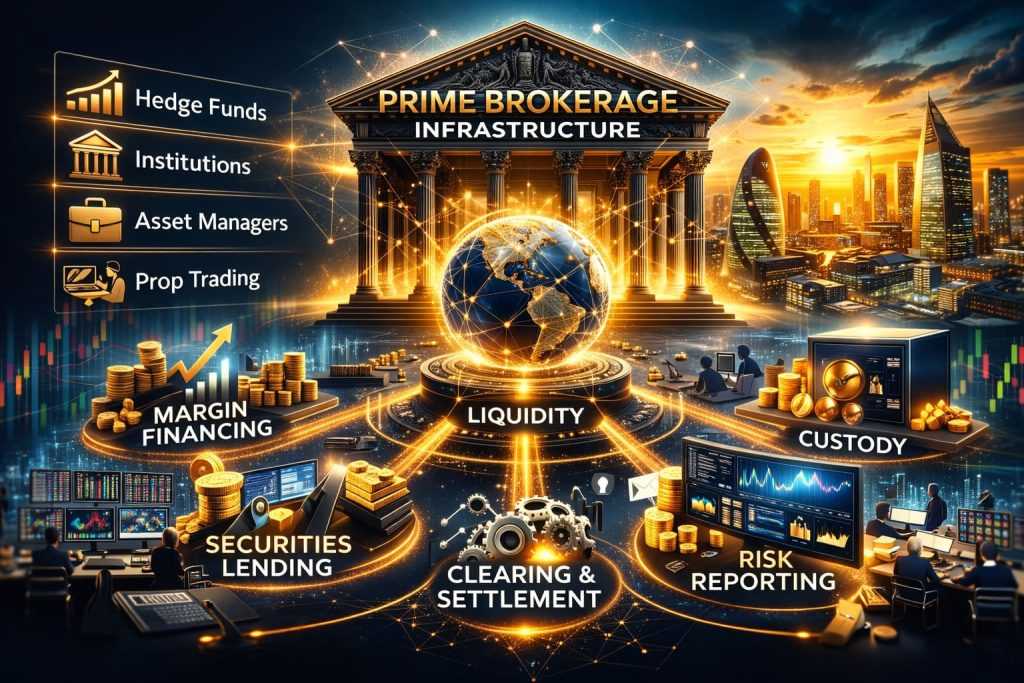
What Is Prime Brokerage Infrastructure?
Prime brokerage infrastructure is designed for:
- Hedge funds
- Institutional traders
- Asset managers
- Proprietary trading desks
A prime broker provides:
- Access to multiple liquidity venues
- Securities lending
- Margin financing
- Clearing and settlement
- Custody services
- Risk reporting
Prime brokerage operates at an institutional level and focuses on facilitating large-volume, multi-asset transactions.
What Is Retail Brokerage Infrastructure?
Retail brokerage infrastructure is built to:
- Onboard individual traders
- Process high-frequency small-ticket trades
- Manage deposits and withdrawals
- Provide trading platforms
- Automate risk exposure
Retail brokers generate revenue from:
- Spread markups
- Trading commissions
- Swap fees
- Internalized order flow (B-book)
Unlike prime brokerage, retail infrastructure is volume-driven and technology-centric.
Core Operational Differences
1. Client Type & Onboarding Process
Prime Brokerage
Clients are:
- Regulated funds
- Institutional entities
- Large proprietary firms
Onboarding includes:
- Extensive due diligence
- Legal documentation
- Prime brokerage agreements
- Credit assessment
- Collateral negotiation
The process can take weeks or months.
Retail Brokerage
Clients are:
- Individual traders
- Small proprietary teams
- Retail investors
Onboarding includes:
- KYC verification
- AML screening
- Account approval
- Payment method verification
Automation is essential.
Onboarding often takes minutes or hours.
2. Execution & Liquidity Model
Prime Brokerage Execution
Prime brokers:
- Provide access to Tier 1 liquidity
- Offer direct market access (DMA)
- Operate through clearing relationships
- Handle institutional order sizes
Trades are typically:
- Fully hedged
- Executed in the interbank market
- Cleared through prime-of-prime structures
There is no internalization model.
Retail Brokerage Execution
Retail brokers may operate as:
- A-Book (STP to LPs)
- B-Book (internalized flow)
- Hybrid model
Execution is optimized for:
- High-frequency micro-lot trading
- Automated systems
- Latency-sensitive retail flow
Retail brokers often manage exposure dynamically rather than hedging every trade externally.
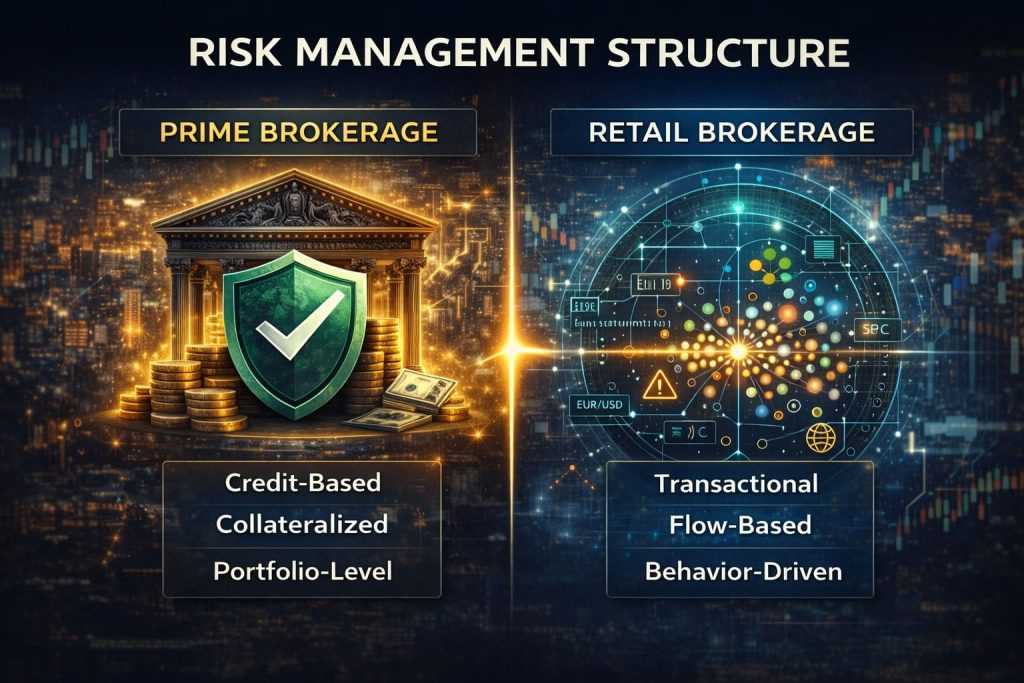
3. Risk Management Structure
Prime Brokerage
Risk is:
- Credit-based
- Collateralized
- Portfolio-level
Prime brokers assess:
- Counterparty exposure
- Margin requirements
- Clearing risk
- Settlement risk
The focus is institutional credit risk, not trade-by-trade exposure.
Retail Brokerage
Risk is:
- Transactional
- Flow-based
- Behavior-driven
Retail brokers monitor:
- Real-time exposure
- Instrument-level risk
- Trader clustering
- Toxic flow
- Arbitrage activity
Risk engines operate continuously.
Retail brokerage risk management is algorithmic and dynamic.
4. Technology Infrastructure
Prime Brokerage Stack
Typically includes:
- FIX API connectivity
- Clearing systems
- Margin systems
- Institutional reporting tools
- Custody infrastructure
- Back-office reconciliation tools
Technology is built for reliability and institutional integration.
It is not marketing-driven.
Retail Brokerage Stack
Includes:
- MT4/MT5 or proprietary platforms
- Liquidity bridges
- Aggregation engines
- Broker CRM systems
- Trader’s Room
- Payment gateway integration
- Affiliate & IB tracking
- Marketing automation
Retail infrastructure must combine:
- Trading technology
- Risk engine
- Payments
- Client management
- Marketing tools
It is operationally broader.
5. Revenue Structure
Prime Brokerage
Revenue sources:
- Financing spreads
- Commission structures
- Clearing fees
- Securities lending
Revenue depends on:
- Institutional relationships
- Balance sheet capacity
Retail Brokerage
Revenue sources:
- Spread markups
- Commission per lot
- Swap differentials
- Internalized order flow
Revenue scales with:
- Trading volume
- Client acquisition
- Retention
Retail is more scalable once infrastructure is built.
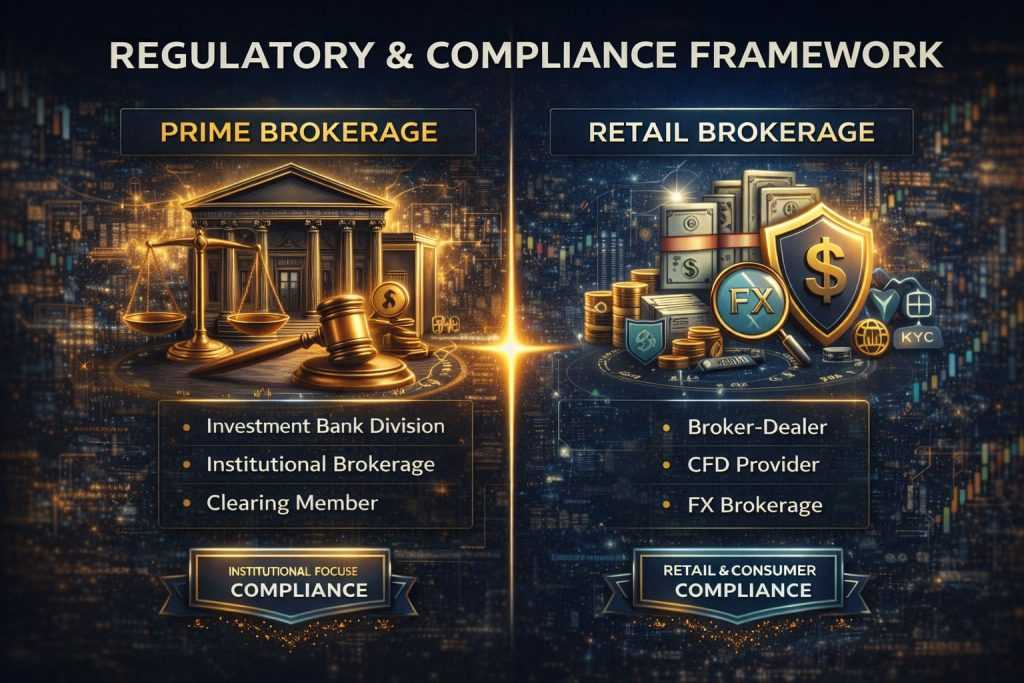
6. Regulatory & Compliance Framework
Prime Brokerage
Regulated as:
- Investment bank division
- Institutional brokerage
- Clearing member
Compliance is institution-focused.
Retail Brokerage
Regulated as:
- Broker-dealer
- CFD provider
- FX brokerage
Compliance includes:
- Retail disclosure
- Marketing regulation
- Client money segregation
- AML/KYC automation
Retail compliance includes both regulatory and consumer-protection elements.
Infrastructure Complexity Comparison
| Factor | Prime Brokerage | Retail Brokerage |
|---|---|---|
| Client Base | Institutional | Retail |
| Onboarding Speed | Slow | Fast |
| Risk Type | Credit-based | Transactional |
| Technology Focus | Clearing & custody | Execution + CRM + payments |
| Revenue Driver | Financing & clearing | Trading volume |
| Marketing Requirement | Low | High |
Why This Difference Matters
For hedge fund managers considering launching a brokerage, this operational shift is significant.
You move from:
- Managing institutional relationships
- Negotiating credit lines
- Portfolio-level risk oversight
To:
- Building scalable trading infrastructure
- Managing payment systems
- Handling retail flow
- Optimizing acquisition funnels
The skillset overlaps — but the business mechanics differ.
When Prime Brokerage Experience Becomes an Advantage
Former hedge fund managers have advantages:
- Deep understanding of liquidity mechanics
- Knowledge of interbank structure
- Institutional compliance experience
- Risk discipline
However, they must adapt to:
- Retail client behavior
- Marketing-driven growth
- Payment processing risk
- High-volume small-ticket transactions
Final Thoughts
Prime brokerage infrastructure and retail brokerage infrastructure serve different market layers.
Prime brokerage is credit-centric and institution-focused.
Retail brokerage is technology-centric and volume-driven.
For finance professionals transitioning from hedge fund management to running a forex brokerage, understanding these operational differences is essential.
The shift is not about trading expertise — it is about infrastructure architecture, automation, and scalable transaction management.
Request a Consultation on Brokerage Infrastructure Strategy
Get expert guidance on evaluating whether a retail brokerage infrastructure aligns with your institutional background and long-term objectives. We’ll help you assess execution architecture, liquidity models, risk structure, compliance requirements, and scalability considerations before making a structural transition.
Together, we’ll review your current operational model and outline a brokerage infrastructure strategy suited to institutional-grade standards.