


The rapid growth of proprietary trading firms has raised a critical question across the forex and trading industry: Are prop firms legal?
Traders want clarity before paying challenge fees, while companies launching or scaling prop trading models need to understand where the legal boundaries truly lie.
The reality is more nuanced than a simple “yes” or “no”. Most prop firms are legal, including forex prop firms, as long as they are structured and operated correctly. Legal issues arise not from the prop trading model itself but from how it is implemented, disclosed, and marketed.
This article provides a clear, legally grounded explanation of prop firms, proprietary trading, and funded accounts — without hype, affiliate language, or misleading claims.
What Is a Prop Firm (Legal Definition)
A prop firm, short for proprietary trading firm, is a business that allows individuals to trade using the firm’s capital or within a simulated trading environment. Traders are not investing their own funds into financial markets. Instead, they participate in an evaluation or challenge and may receive performance-based payouts.
From a legal standpoint, this distinction is fundamental.
In most jurisdictions, financial regulation applies when a company:
- accepts deposits for trading,
- executes trades on behalf of clients,
- manages or safeguards client funds,
- or provides regulated investment services.
Most proprietary trading firms are intentionally structured to avoid these activities. Traders typically pay a fee for evaluation, not a trading deposit. Any payout received is a contractual reward, not a return on invested capital.
Because of this, prop trading is usually treated as a commercial or contractual activity, not a financial service.
Why Prop Firms Are Not Forex Brokers (in Most Cases)
Confusion between prop firms and brokers is one of the main reasons people assume prop trading is illegal.
A forex broker:
- accepts client funds,
- provides access to live markets,
- executes trades on behalf of clients,
- and must be licensed and regulated.
A forex prop firm:
- does not accept funds for trading,
- does not place real trades for clients,
- does not provide investment advice,
- and does not manage customer portfolios.
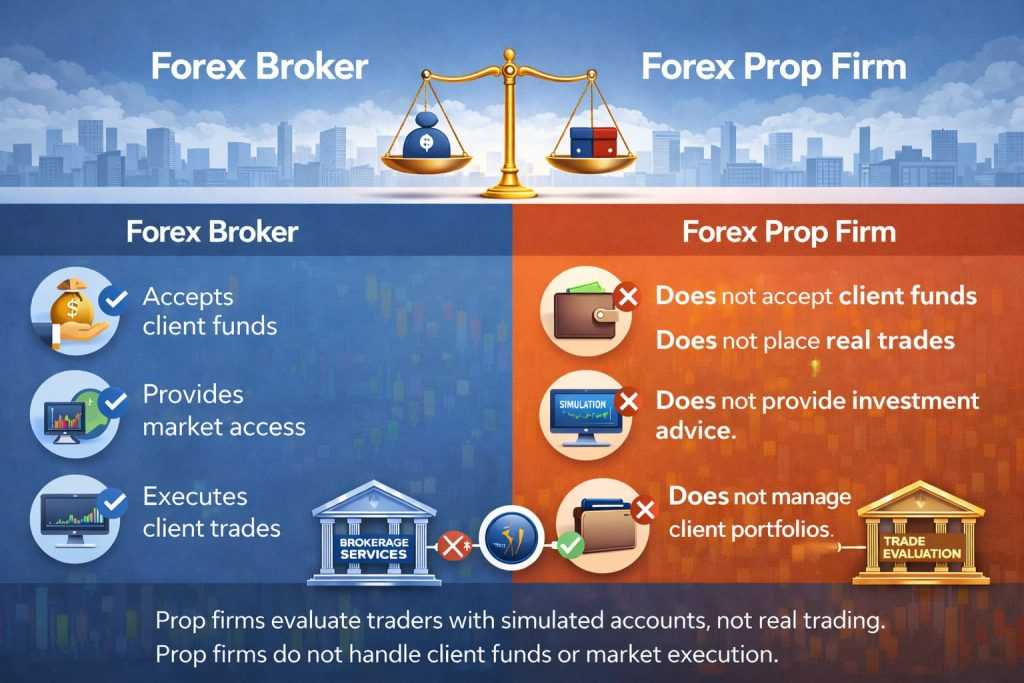
Instead of providing brokerage services, prop firms evaluate trading performance and compensate successful traders according to predefined rules.
Legally, this difference is decisive. Without client funds or market execution on behalf of customers, most proprietary trading firms fall outside traditional brokerage regulation.
Problems arise only when a prop firm starts to look like a broker, even unintentionally.
Simulation vs Real Capital — Why It Matters Legally
One of the most critical legal factors in prop trading is whether trading is simulated or live.
In the majority of modern prop firms:
- all trading accounts are simulated,
- including funded accounts,
- and trades do not reach live markets.
From a legal perspective, simulation significantly reduces regulatory exposure. When trading activity is simulated, the firm is not executing financial transactions or facilitating market access.
This is why clear disclosure of simulation is essential.
Legal risks appear when firms:
- suggest that funded accounts trade real capital,
- 使用暗示实时执行的措辞,
- 未能解释赔付是如何计算的,
- 或与其自身的《条款与条件》相互矛盾。
关于模拟的透明沟通,是一家自营交易公司最强的法律保障之一。
关键地区的法律地位(美国、欧盟、英国、亚洲)
尽管各司法辖区的法律不同,自营交易公司的法律处理在全球范围内遵循类似原则。
美国
在美国,监管机构主要关注:
- 误导性营销,
- 未经登记的投资发行,
- 以及对消费者保护的违规。
避免宣称提供实时交易或投资服务的自营交易公司,通常不直接受金融监管约束。法律问题往往通过争议、付款投诉或具有欺骗性的广告出现,而不是通过监管执法。
欧洲联盟
在欧盟,主管机构重点关注:
- 服务的呈现方式,
- 合同的公平性,
- 以及消费者权利。
即使不接受资金,若一家外汇自营交易公司在营销或披露方面具有误导性,也可能面临法律诉讼。透明度是安全运营的关键。
英国
在英国,主要的法律风险是被认定为提供受监管的投资服务。明确使用模拟并避免具备经纪商式功能的自营交易公司,通常不在许可要求范围内。
亚洲与离岸司法辖区
许多亚洲及离岸司法辖区对自营交易的看法更为灵活。然而,银行和支付服务提供商往往比当地监管机构执行更严格的合规标准。
在所有地区,支付处理和消费者法律往往是造成法律压力的最常见来源。
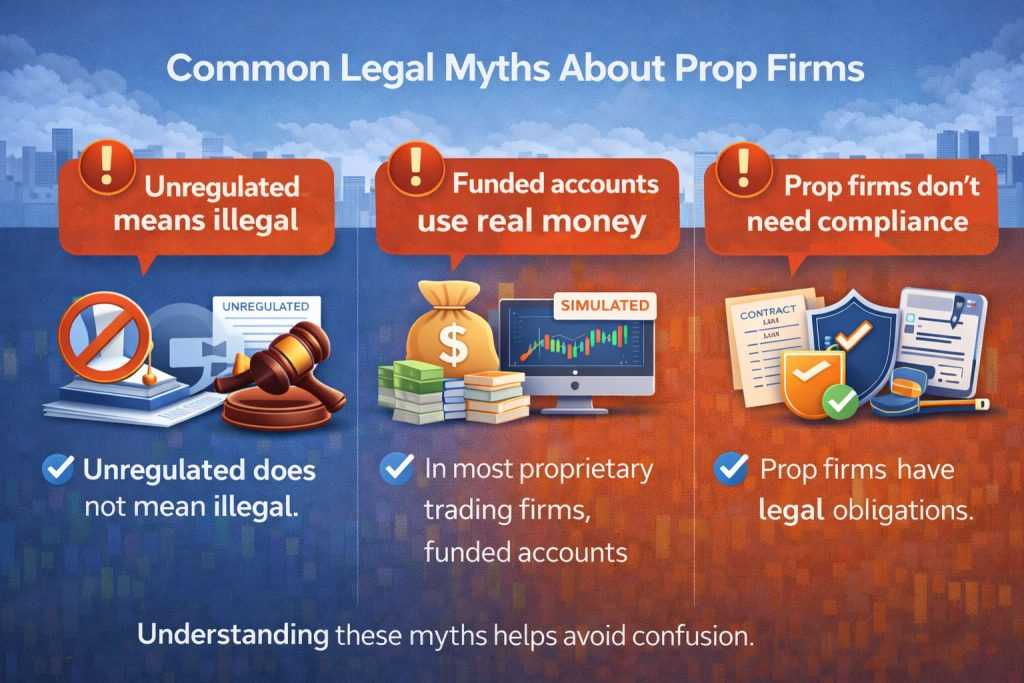
关于自营交易公司的常见法律谬误
一些反复出现的误解会在自营交易领域制造不必要的恐惧。
“自营交易公司违法,因为它们没有监管。”
“不受监管”并不等于“违法”。它仅意味着该活动不需要金融服务牌照。
“获得资金的账户总是在交易真实资金。”
在大多数自营交易公司中,获得资金的账户是模拟交易,赔付是基于合同的奖励。
“自营交易公司完全不需要合规。”
即使没有监管,自营交易公司仍受合同法、广告规则、数据保护法律以及支付服务提供商要求的约束。
理解这些要点有助于交易员和公司避免困惑与纠纷。
是什么让自营交易公司在法律上风险更高
当一家自营交易公司把自营交易与经纪服务的界限模糊化时,它就会在法律上变得更脆弱。
常见的法律 风险因素 包括:
- 将获得资金的账户作为实时交易来呈现,
- 保证利润或赔付,
- 赔付规则含糊不清或由酌情决定,
- 规则执行不一致,
- 经纪商风格的仪表盘或报表,
- 对争议和退款处理不当。
实际上,大多数自营交易公司面临的法律问题都是自找的、可预防的。
自营交易公司如何降低法律暴露
法律韧性的自营交易公司重视结构与清晰度,而不是走捷径。
最佳实践包括:
- 明确且一致的《条款与条件》(Terms & Conditions),
- 模拟账户与资金账户的明确说明,
- 透明的出金规则,
- 有据可依的规则执行,
- 合规的营销表述,
- 妥善的记录保存与审计日志。
强大的运营系统,包括 CRM和报告工具,有助于在出现争议时证明一致性与公平性。
最终裁决:自营(Prop)公司合法吗?
是的——在多数司法辖区,自营公司是合法的,包括外汇自营公司,只要它们:
- 不接受客户资金用于交易,
- 明确使用模拟交易环境,
- 避免类似经纪商的行为,
- 并与交易员进行透明沟通。
自营交易的合法性不取决于标签,而取决于该业务实际如何运作。
对于那些将透明度、良好结构和符合基本法律标准放在首位的公司,自营交易仍是一种合法且可规模化的商业模式。

常见问题解答
- 自营公司在全球范围内合法吗?自营公司在许多地区是合法的,但合法性取决于组织结构、披露内容以及当地消费者法律。
- 自营交易是否受监管?自营交易本身通常不受监管,但公司仍需遵守一般的法律与合同义务。
- 资金账户是真实交易账户吗?在大多数情况下,资金账户是模拟的,出金基于绩效规则,而非实时市场利润。
- 外汇自营公司可以不持牌运营吗?是的,在许多司法辖区,只要它不提供受监管的金融服务或管理客户资金。
- 自营公司最大的法律风险是什么?误导性的营销、条款不清、出金争议以及支付处理方面的问题。

咨询:自营交易公司法律架构
获取关于如何以合法且透明的方式构建自营交易公司的专业指导。我们将帮助你理解模拟、出金、披露以及商业模式在不同司法辖区中的处理方式——从而在法律风险变成问题之前降低风险。
我们将共同审查你的方案或现有设置,并提出一种符合合规意识的路径,使其与消费者法、支付服务提供商以及市场预期保持一致。