


In today’s fast-moving forex market, access to deep liquidity, competitive pricing, and fast execution is critical. This is where a forex aggregator—also known as an FX aggregator or a Bridge plays a key role.
Whether you are a broker, liquidity provider, prop trading firm, or professional trader, understanding how a forex aggregator works can help you reduce trading costs and scale operations more efficiently.
This article explains what a forex aggregator is, how it works, and why it is essential component of modern FX trading infrastructure.
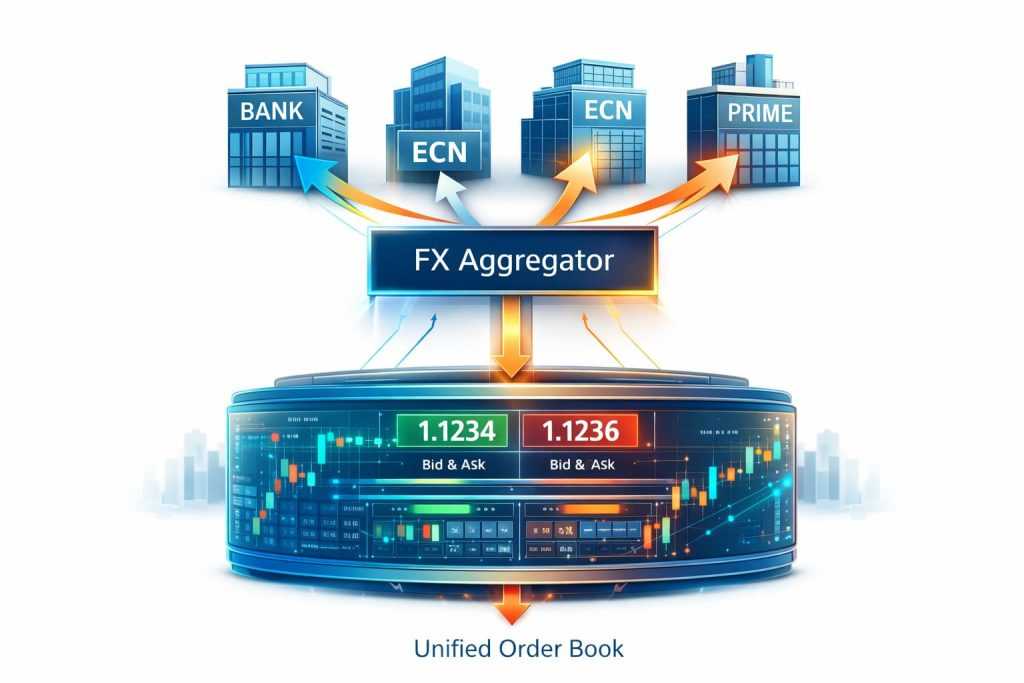
What Is a Forex Aggregator?
A forex aggregator is a technology solution that collects price feeds and liquidity from multiple liquidity providers (LPs) and combines them into a single, unified execution layer, usually exposed via an API.
Instead of relying on a single bank or liquidity source, an FX aggregator allows brokers and trading venues to:
- Access deeper, pooled liquidity
- Compare bid/ask prices across multiple providers in real time
- Execute trades at the best available price
- Reduce spreads and minimize slippage
In simple terms, a forex aggregator acts as a central hub that optimizes trade execution by dynamically selecting the best liquidity available at any given moment.
From “Bridge” to Modern Aggregator
Originally, what we now call a forex aggregator was known as a bridge.
The early purpose of a bridge was straightforward:
take an order from a trading platform (such as MT4 or MT5) and pass it to a bank or liquidity provider over the FIX protocol, aiming to get the best possible price at that moment.
Over time, these technologies evolved significantly.
Modern forex aggregators no longer operate on a single-order, single-bank basis. Instead:
- Orders from the broker’s entire A-Book flow are aggregated
- Positions are consolidated on a designated hedge or aggregation account
- Execution is routed dynamically to whichever LP can offer the best price and depth at that exact moment
As a result, today’s forex aggregators are not just connectors — they are intelligent execution engines that manage liquidity, pricing, and routing decisions across the whole brokerage in real time.
How an FX Aggregator Works
An aggregator FX system typically operates in real time and follows several key steps:
- Liquidity Collection
The aggregator connects to multiple liquidity providers such as banks, prime brokers, non-bank LPs, and ECNs. - Price Normalization
Incoming quotes are normalized into a consistent format to ensure accurate comparison. - Best Price Selection
The system continuously evaluates prices and available volumes to determine the best bid and ask. - Order Routing
When a trade is placed it is aggregated with others and routed to the liquidity provider offering the optimal execution conditions. - Execution and Reporting
Trades are executed instantly, with full transparency and post-trade reporting.
This process happens in milliseconds, making speed and stability critical components of any forex aggregator solution.
Who Uses Forex Aggregators?
A forex aggregator is used by a wide range of market participants:
Forex Brokers
Brokers rely on aggregators to offer competitive pricing, reliable execution, and scalable liquidity to their clients IN A-Book.
Liquidity Providers
LPs use aggregation to distribute liquidity efficiently and manage exposure across multiple venues.
Proprietary Trading Firms
Prop firms use FX aggregators to access liquidity for the Funded Accounts to minimize risks.
Key Features of a Modern FX Aggregator
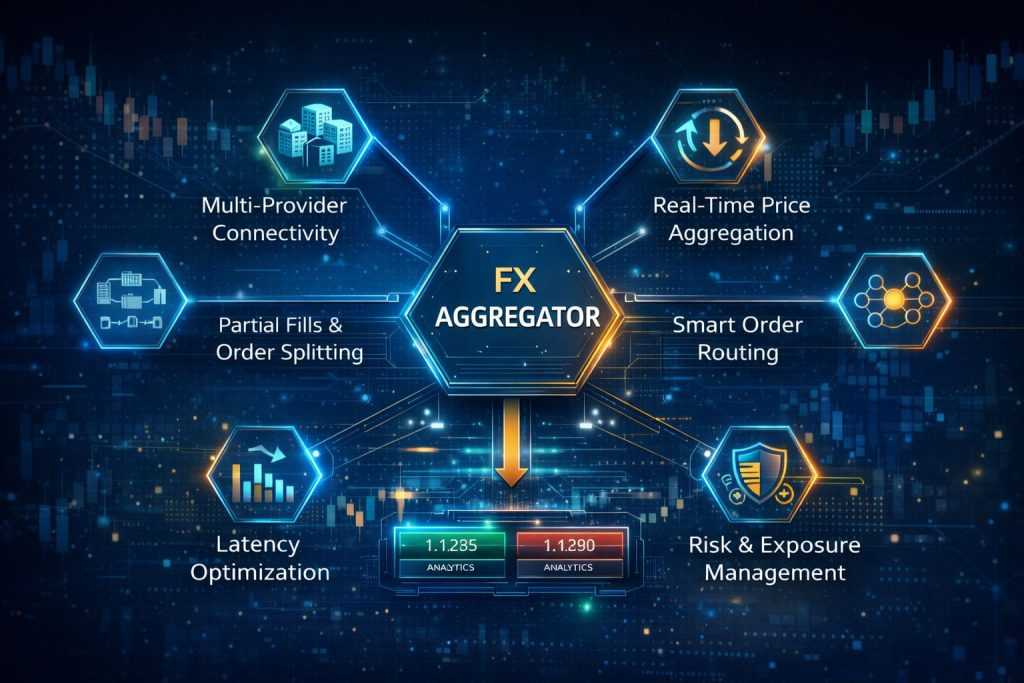
A high-quality aggregator FX solution typically includes:
- Multi-liquidity provider connectivity
- Real-time price aggregation
- Smart order routing
- Partial fills and order splitting
- Latency optimization
- Risk and exposure management
- Detailed execution analytics
These features allow firms to operate efficiently in both low- and high-volume trading environments.
Forex Aggregator vs Single Liquidity Provider
| Aspect | Forex Aggregator | Single LP |
|---|---|---|
| Liquidity Depth | High (multiple sources) | Limited |
| Pricing | Competitive, dynamic | Fixed to one provider |
| Slippage Control | Advanced | Basic |
| Scalability | High | Limited |
| Risk Diversification | Yes | No |
For most professional setups, relying on a single liquidity provider is no longer sufficient, especially as trading volumes grow.
How Forex Aggregators Support Scalability
As trading activity increases, execution infrastructure must scale accordingly. A forex aggregator allows firms to:
- Add new liquidity providers without disruption
- Balance order flow across LPs
- Adapt to changing market conditions
- Maintain execution quality at higher volumes
This scalability makes FX aggregators especially valuable for growing brokers and institutional trading operations.
Common Use Cases for Aggregator FX Technology
- Retail and institutional forex brokerage platforms
- ECN / STP trading models
- High-frequency and algorithmic trading
- Multi-asset trading environments
- White-label brokerage solutions
In all these cases, aggregation improves execution efficiency and market access.
Choosing the Right Forex Aggregator
When selecting a forex aggregator, consider the following factors:
- Latency and execution speed
- Number and quality of liquidity providers
- Stability under high load
- Transparency and reporting tools
- Integration with existing trading platforms
- Risk management and compliance support
The right aggregator FX solution should align with both technical requirements and business goals.
In an increasingly competitive environment, forex aggregators will remain a cornerstone of institutional-grade FX trading.
Conclusion
A forex aggregator is a critical component of modern FX trading infrastructure. By combining liquidity from multiple sources, an aggregator FX solution delivers better pricing, deeper liquidity, and more reliable execution.
For brokers, trading firms, and professional traders, using a forex aggregator is no longer a luxury—it is a necessity for staying competitive in today’s global forex market.
FAQ: Forex Aggregator / Aggregator FX
Q1: What is a forex aggregator?
A forex aggregator is a system that combines price feeds and liquidity from multiple liquidity providers into one stream, helping route orders to the best available price.
Q2: Is “aggregator FX” the same as a forex aggregator?
Yes. “Aggregator FX” is a common industry phrase that refers to the same concept: aggregating liquidity and quotes from multiple sources for better pricing and execution.
Q3: How does a forex aggregator reduce spreads and slippage?
By comparing quotes across multiple liquidity providers in real time, the aggregator can select the best bid/ask and split large orders across providers to improve fills and reduce slippage.
Q4: Who typically uses a forex aggregator?
Forex brokers, prop trading firms, institutional traders, and liquidity providers use forex aggregators to minimize risk, access deeper liquidity, improve execution quality, and scale trading operations.
Q5: What’s the difference between a forex aggregator and an ECN?
A forex aggregator is technology that combines liquidity sources and routes orders. An ECN is a trading venue/network. In practice, an aggregator may connect to one or more ECNs and LPs.
Q6: What should I look for when choosing an aggregator FX solution?
Key factors include latency, stability under high load, number/quality of LP connections, smart order routing, reporting/analytics, and how easily it integrates with your existing infrastructure.

Request a Consultation on Implementing a Forex Aggregator
Get expert guidance on implementing a forex aggregator within your trading platform or brokerage setup. We’ll help you design liquidity connections, smart order routing, reporting, and integration with your existing execution and risk management systems.
Together, we’ll assess your current infrastructure and define a practical FX aggregator implementation that improves pricing, reduces slippage, and supports growth.