


Choosing your execution model is one of the first — and most consequential — decisions you’ll make when setting up a forex brokerage. It determines how you make money, how much capital you need, what risks you carry, and what technology you’ll need to manage it all.
Here’s a straightforward breakdown of each model and what it actually means for your business.
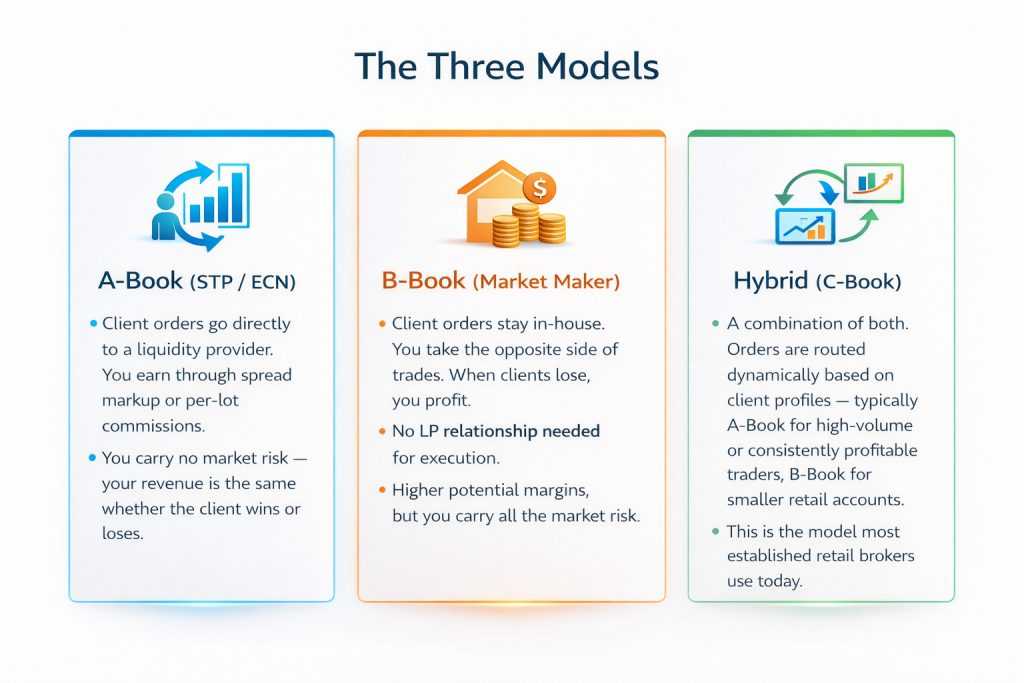
The Three Models
A-Book (STP / ECN) Client orders go directly to a liquidity provider. You earn through spread markup or per-lot commissions. You carry no market risk — your revenue is the same whether the client wins or loses.
B-Book (Market Maker) Client orders stay in-house. You take the opposite side of trades. When clients lose, you profit. No LP relationship needed for execution. Higher potential margins, but you carry all the market risk.
Hybrid (C-Book) A combination of both. Orders are routed dynamically based on client profiles — typically A-Book for high-volume or consistently profitable traders, B-Book for smaller retail accounts. This is the model most established retail brokers use today.
A-Book
Revenue
You earn from spread markup and per-lot commissions. Revenue is predictable and scales directly with trading volume. A client trading 1,000 lots per month at $5 commission generates $5,000 monthly — regardless of whether they’re profitable or not.
Capital
Higher than B-Book. You need margin with liquidity providers, regulatory capital buffers, and reserves for operations. Prime of Prime relationships typically require meaningful upfront capital.
Risk
Minimal. You’re not exposed to client P&L. This makes A-Book the cleaner model from a regulatory standpoint — especially under FCA, ASIC, or MiFID II where execution transparency is scrutinized.
Best for
- Brokers targeting professional or institutional clients
- Regulated entities in strict jurisdictions
- High-volume operations where commission revenue is substantial
- Brokers building long-term reputation
Infrastructure
You need a reliable liquidity bridge, stable LP relationships, and a CRM that accurately tracks volume-based commissions and IB payouts. Execution quality and latency matter — your clients will notice.
B-Book
Revenue
Revenue comes from the spread and from client losses. Since over 70% of retail forex traders lose money, B-Book can be highly profitable with the right retail flow — particularly in the short to medium term.
Capital
Lower than A-Book. No LP relationships needed for execution, which reduces infrastructure and margin costs. The technology is simpler because everything runs internally.
Risk
This is where it gets serious. You carry market risk on every open client position. A single large winning trader or a sharp market move can create significant exposure quickly. Without a proper risk desk and selective hedging, you’re exposed.
It’s a manageable model — plenty of brokers run it successfully — but it demands discipline, the right tools, and someone watching the book at all times.
Best for
- Brokers with a dedicated risk desk
- Operations targeting retail flow with smaller account sizes
- Markets with lighter regulatory scrutiny on execution models
- Brokers with sufficient capital reserves to absorb short-term variance
Infrastructure
You need real-time P&L monitoring per client and per instrument. Your back office needs to surface large positions automatically, track net book exposure, and give your risk desk the data to hedge selectively. Your CRM should flag high-risk profiles — scalpers, news traders, consistently profitable accounts — before they become a problem.
Hybrid
The hybrid model is what most professional retail brokerages actually run. The logic is straightforward: route your expected losers to B-Book where you capture margin directly, route your expected winners to A-Book where you transfer market risk to LPs and earn commission instead.
Done well, it’s the highest-margin structure available. Done poorly, misclassification eats your profits.
How routing works in practice
Brokers build profiling systems that classify traders based on:
- Account size — smaller deposits correlate with unprofitable trading behavior
- Trade history — win rate, average hold time, drawdown patterns
- Strategy type — scalpers, news traders, and arbitrage traders go straight to A-Book
- Leverage usage — high leverage on small accounts signals B-Book
- Volume — large lot sizes increase B-Book exposure and trigger A-Book routing
Classification needs to be dynamic and reviewed regularly. A trader who starts losing may have been routed A-Book based on early wins — catching that shift matters.
Revenue
Hybrid combines commission income from A-Book flow with internalized margin from B-Book flow. Margins typically exceed pure A-Book, with more variance. A well-run hybrid operation is usually the most profitable structure available to retail brokers.
Risk
Moderate to high depending on your B-Book ratio and profiling quality. The main failure mode is misclassifying a profitable trader onto B-Book and absorbing their gains. Good data and fast response to profile changes are essential.
Best for
- Brokers with enough client data to build accurate profiles
- Operations with a dedicated risk management function
- Most mid-to-large retail forex brokers
Quick Comparison
| A-Book | B-Book | Hybrid | |
|---|---|---|---|
| Revenue | Spread + commission | Spread + client losses | Both |
| Market risk | None | High | Medium |
| Capital needed | High | Low–Medium | Medium |
| LP relationships | Required | Not required | Partial |
| Regulatory complexity | Lower | Higher | Medium |
| Profit margin | Lower, stable | Higher, variable | Highest potential |
| Tech complexity | Medium | Low | High |
| Best for | Institutional/professional | Pure retail | Most retail brokers |
What This Means for Your CRM and Back Office
Your execution model has a direct impact on the systems you need beyond the trading platform.
A-Book requires your CRM to track volume-based commissions accurately, manage IB payouts by traded lots, and reconcile what goes to LPs against what clients see in their accounts.
B-Book requires real-time exposure monitoring. Your back office needs to show large open positions, net book exposure per instrument, and give your risk desk the data to act fast. Without this visibility, you’re managing risk blind.
Hybrid is the most demanding. Your CRM needs to support dynamic client segmentation, maintain an audit trail of routing decisions, and give compliance full transparency. As regulations tighten — particularly in the EU and Australia — being able to demonstrate fair execution practices is becoming a business requirement, not just a nice-to-have.
A CRM built specifically for forex operations will have these workflows built in. A generic CRM won’t.

Five Questions to Ask Before You Decide
1. How much capital do you have to start? A-Book is difficult to sustain with limited capital. A conservative B-Book or hybrid approach is more realistic until you build volume and LP relationships.
2. Who are your clients? Professional traders and algorithmic systems expect A-Book execution and will test your pricing. Retail flow from emerging markets fits naturally into hybrid or B-Book.
3. Where are you regulated? FCA, ASIC, and CySEC are tightening oversight of execution models. B-Book operations face more scrutiny. Factor compliance costs into your model choice from day one.
4. Do you have risk management in place? B-Book and hybrid require a skilled risk desk. If you don’t have that capability in-house, starting with A-Book reduces your operational exposure significantly.
5. Does your technology support the model? Your trading platform, liquidity bridge, and CRM all need to support your chosen execution model. Hybrid in particular requires sophisticated routing logic and detailed reporting.
Where the Market Is Heading
Most of the industry is converging on hybrid. Pure A-Book at the retail level is difficult to make profitable without very high trading volumes. Pure B-Book is facing increasing regulatory pressure and reputational risk in markets where traders are becoming more informed.
The direction is toward smarter, data-driven hybrid models — using client behavioral data to route more precisely, automate hedging decisions, and reduce risk without sacrificing margin. AI-assisted routing is already being deployed by leading brokerages.
If you’re building a new brokerage today, a hybrid model with a conservative initial B-Book ratio — and the infrastructure to grow it intelligently — is the most defensible long-term position.
Bottom Line
There’s no universally correct execution model. The right choice depends on your capital, your clients, your jurisdiction, and your operational maturity.
What matters is that you make this decision deliberately — with a clear picture of the revenue implications, risk exposure, and infrastructure requirements of each model. The execution model you choose should drive your CRM, back office, and reporting requirements. Not the other way around.
Request a Consultation on Choosing the Right Execution Model
Get expert guidance on selecting the execution model that fits your capital structure, target market, and regulatory environment. We’ll help you evaluate A-Book, B-Book, and hybrid models from a revenue, risk, and infrastructure perspective before committing to a long-term structure.
Together, we’ll review your brokerage goals and outline an execution strategy aligned with scalability, compliance, and operational stability.