


A solid tech foundation is key to any trading firm’s success. Nowadays, firms rely more and more on their own trading software to keep risk in check, see how they’re doing, and handle where capital goes as they expand.
The world of trading is changing. Prop trading software isn’t just about doing order executions anymore. Now, it affects how traders think, how payouts work, keeping things legal, and even how big a business can grow.
This piece looks at how tech directly changes what happens inside current trading firms.

Prop Trading Software: It’s a Risk System, Not Just a Platform
In the past, trading desks often made risk decisions by hand. Modern prop trading software changes this to something more organized.
Instead of just people watching over things, firms now put in place:
- Automatic daily loss limits
- Tracking loss calculations
- Checking where exposures are grouped
- Spotting strategy patterns
- Real-time checks on account status
Now, risk is handled automatically.
This change lowers the chance of big losses and keeps things steady across many accounts.
Capital Now Managed by Algorithms
How firms allocate capital is one of the biggest upgrades in proprietary trading software.
Modern systems keep tabs on:
- How consistent things are
- Profit-to-risk numbers
- How unstable behaviors are
- How accounts relate to each other
- How often trades happen
Instead of growing traders just based on profit, firms use data models inside their own systems.
The decisions on where capital go are becoming automated or supported by organized dashboards – getting rid of emotional choices and personal favorites.
Watching Behavior as Standard
A good trading environment does more than just calculate profit and loss.
Good software can spot things like:
- Sudden jumps in balance
- Changing strategies before payouts
- Same IP addresses across accounts
- Taking big risks around major news
- Activity across evaluation phases that looks the same
Checking behavior is now a key part of how risk is handled.
This is super important for firms that work with evaluation-based funding models.
Why Just Executing Trades Isn’t Enough Anymore
Many of the first trading systems were all about execution. But modern software needs to handle:
- Getting traders started
- Checking who they are
- Keeping track of account status
- Logging when rules are broken
- Setting off payments
- Reporting structures
The business is not just about trading terminals now.
The basic setup now defines how well you can bounce back.
Firms that depend on just execution tools often struggle when things get more complex.
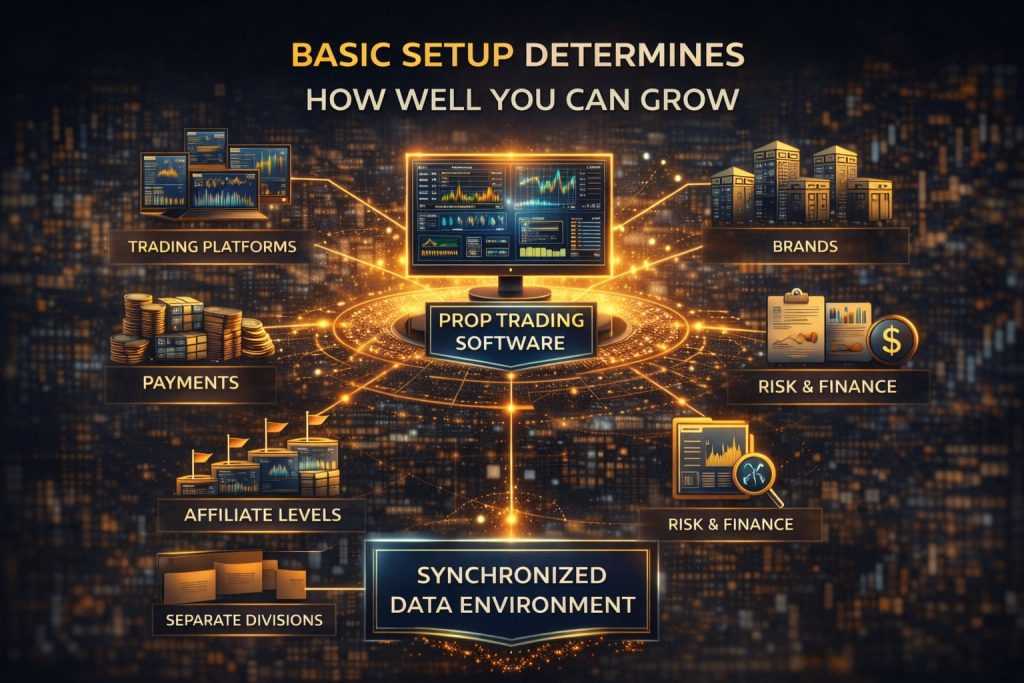
Basic Setup Determines How Well You Can Grow
As firms get bigger, things get more complex:
- Multiple platforms for trading
- Routing payments in different areas
- Structures with multiple brands
- Affiliate levels
- Internal reporting for risk and finance
To grow, prop trading software needs to bring these things together in a synchronized data environment.
Without a central setup, divisions work separately – raising the risk.
Usually, firms put in place layers designed to support evaluation flows, funded stages, and risk coordination across divisions.
The Edge of Having a Structured Prop Firm Software
Firms that put money into advanced systems get clear gains:
Less issues with daily tasks
Automation cuts down manual work.
Better Risk Control
Engines with clear rules lower how much losses change.
Faster Growth
Dashboards let multi-desk grow.
Clear Audit Trails
Everything is logged.
Better Trader Retention
Clear rules build trust.
Tech helps in growth.
What’s to Come in Prop Trading Software
The future software is expected to add:
- AI to spot strange activity
- Predicting behavior
- Scoring risk
- Modular architecture
- Real-time alerts
As the market matures, good infrastructure will separate firms from short operations.
Final Thoughts
Modern trading firms aren’t just where capital goes — they’re run by tech.
Prop trading software shapes risk, capital, trader behavior, and how long a business lasts.
While being able to do the executions is still important, the architecture decides if a firm can grow without losing control.
In a tough prop environment, software is not just a tool — it’s the base of the business.
Request a Consultation on Prop Trading Software Strategy
Get expert guidance on how to structure your prop trading software architecture to support scalable risk management, capital allocation, and behavioral monitoring. We’ll help you evaluate whether your current infrastructure can sustain growth without compromising operational control.
Together, we’ll review your technology stack and outline a structured software strategy aligned with long-term stability and governance.