


The Forex industry is more competitive, regulated, and technology-driven than ever before. Whether you operate a brokerage, a proprietary trading firm, or a hybrid Forex business, managing traders, leads, operations, and risk manually is no longer sustainable. This is exactly why your Forex business needs a CRM.
A modern Forex CRM is not just a contact database. It is the operational backbone of your business—connecting traders, trading platforms, compliance workflows, payments, analytics, and customer support into a single ecosystem.
1. Centralized Management for a Complex Forex Operation
Forex businesses deal with multiple moving parts:
- Traders and clients
- Trading accounts and platforms
- KYC and compliance processes
- Deposits, withdrawals, and payouts
- Support tickets and communications
Without a CRM, these elements are often spread across disconnected tools, spreadsheets, and manual processes. This fragmentation leads to errors, slow response times, and operational risk.
A Forex CRM centralizes all trader and client data in one system, giving your team a complete, real-time view of every account, interaction, and transaction. This centralized control is one of the core reasons why your Forex business needs a CRM to scale efficiently.

2. Faster and More Reliable Trader Onboarding
Onboarding is a critical moment in the trader lifecycle. A slow or confusing onboarding process directly reduces conversion rates and increases abandonment.
With a dedicated Forex CRM, onboarding becomes automated and structured:
- Account creation is synchronized with the trading platform
- KYC and verification workflows are tracked and logged
- Documents are stored securely and linked to user profiles
- Approval processes are standardized
This not only improves the trader experience but also reduces the workload on your operations team. Automation ensures consistency, compliance, and speed—key advantages in a competitive Forex market.
3. Improved Compliance and Risk Control
Regulatory pressure in the Forex industry continues to increase. Even businesses operating in less restrictive jurisdictions are expected to maintain clear audit trails and risk controls.
A Forex CRM helps your business:
- Track user activity and account changes
- Log verification status and compliance actions
- Monitor trading behavior and risk exposure
- Maintain structured records for audits and reviews
This is another major reason why your Forex business needs a CRM: it reduces regulatory risk while improving transparency and internal accountability.
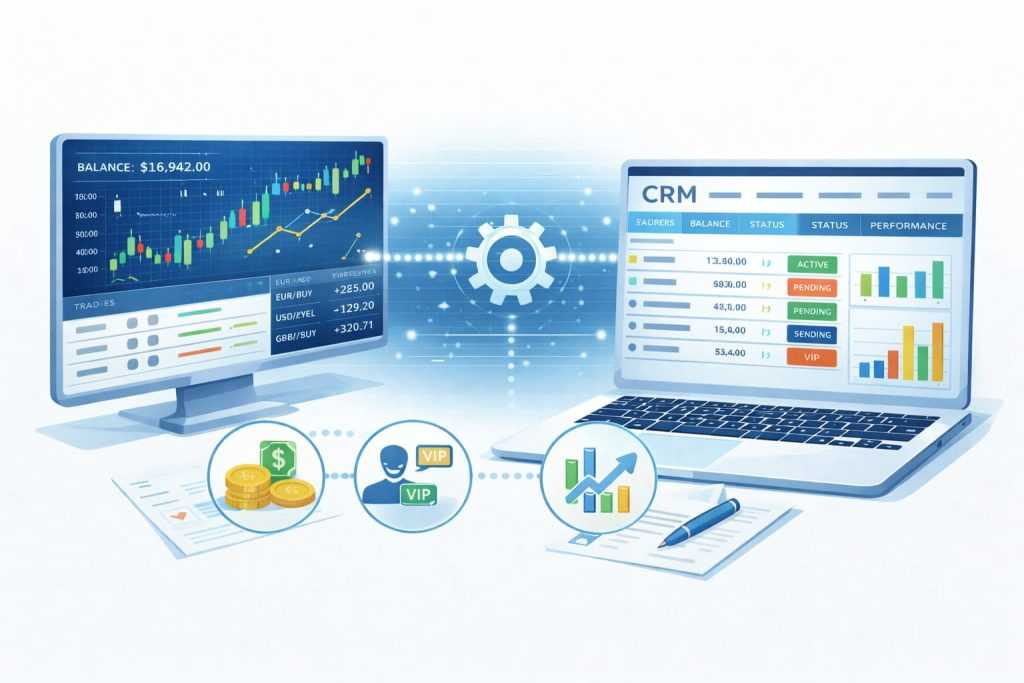
4. Seamless Integration with Trading Platforms
Forex businesses rely on trading platforms for execution, but platforms alone do not manage the business side of operations.
A CRM bridges this gap by integrating directly with your trading infrastructure:
- Account balances and trading activity sync automatically
- User status updates reflect real trading behavior
- Performance metrics are available in real time
- Manual errors caused by duplicate data entry are eliminated
By connecting operational logic with trading data, a Forex CRM enables smarter decisions and more responsive management.
5. Better Client and Trader Retention
Acquiring traders is expensive. Retaining them is where long-term profitability is built.
A Forex CRM allows you to:
- Track trader engagement and activity levels
- Identify inactive or at-risk accounts early
- Personalize communication and support
- Segment users based on behavior, performance, or region
When your team understands how traders interact with your platform, you can act proactively instead of reactively. This directly improves lifetime value and brand trust.
6. Scalable Operations Without Linear Cost Growth
One of the biggest growth challenges in Forex businesses is operational scaling. Without automation, adding more traders means hiring more staff, increasing overhead, and introducing inefficiencies.
A CRM enables scalability by:
- Automating repetitive workflows
- Reducing manual intervention
- Standardizing internal processes
- Supporting thousands of users with the same team size
This operational leverage is a key strategic reason why your Forex business needs a CRM—not just to grow, but to grow profitably.
7. Advanced Reporting and Business Intelligence
Data-driven decision-making is essential in Forex. A CRM provides structured reporting on:
- Trader acquisition and conversion rates
- Revenue and payout flows
- Affiliate and referral performance
- Operational bottlenecks
Instead of relying on assumptions or incomplete data, management teams gain access to real-time dashboards and actionable insights. This visibility allows faster optimization and more confident strategic planning.

8. Stronger Security and Data Control
Forex businesses handle sensitive financial and personal data. A professional CRM system offers:
- Role-based access control
- Secure data storage
- Activity logging
- Reduced reliance on unsecured spreadsheets or emails
By consolidating data into a secure, purpose-built system, you significantly lower operational and reputational risk.
Conclusion: A CRM Is No Longer Optional
The question is no longer whether you need a CRM, but how long you can operate without one. From onboarding and compliance to scalability and retention, the reasons are clear why your Forex business needs a CRM.
A modern Forex CRM is not just a tool—it is the foundation for sustainable growth, operational efficiency, and long-term competitiveness in an increasingly demanding market.
Frequently Asked Questions (FAQ)
What is a Forex CRM?
A Forex CRM is a specialized customer relationship management system designed for Forex brokers and proprietary trading firms. It centralizes trader data, automates onboarding, integrates with trading platforms, and manages compliance, payments, and reporting.
Why does a Forex business need a CRM instead of a regular CRM?
A standard CRM does not support trading accounts, platform integrations, KYC workflows, or financial operations. This is why your Forex business needs a CRM built specifically for Forex—it aligns operational logic with trading activity and regulatory requirements.
Can a Forex CRM integrate with trading platforms?
Yes. A professional Forex CRM integrates directly with trading platforms to sync accounts, balances, trading activity, and user status in real time, eliminating manual data handling and reducing errors.
Does a Forex CRM help with compliance?
Absolutely. A Forex CRM tracks verification status, logs user actions, stores documents, and maintains audit trails, helping businesses meet compliance and risk management requirements more efficiently.
Is a Forex CRM suitable for both brokers and prop firms?
Yes. Modern Forex CRMs are flexible and can be configured for brokers, prop firms, or hybrid models, supporting different account structures, workflows, and business rules.
Request a Consultation on CRM Strategy for Forex Businesses
Get expert guidance on how a purpose-built Forex CRM supports scalability, compliance, and operational control. We’ll help you evaluate your current workflows, growth plans, and business model to determine what a CRM should handle today—and what it must support tomorrow.
Together, we’ll outline a CRM strategy that aligns with brokers, prop firms, or hybrid Forex operations and supports sustainable long-term growth.