


A modern FX business is no longer defined by the trading terminal alone. The real scalability, compliance readiness, and operational control come from the combination of a strong forex back office and a purpose-built CRM trading platform.
Whether you operate a forex brokerage, a CFD brand, or a prop trading model, the right crm trading solution and forex back office software will determine how smoothly you onboard clients, manage payments, control affiliates, produce audit-ready reporting, and resolve disputes.
This guide explains:
- what a forex back office system is and what modules matter most,
- how a crm trading platform differs from a generic CRM,
- how to choose the best forex CRM systems and the right provider,
- what to look for in fx back office solution architecture,
- and why regulatory and operational readiness is now a competitive advantage.
Practical Experience: How Back Office Problems Actually Appear in Real FX Operations
At Kenmore Design, we work with FX businesses where operational issues rarely come from the trading platform itself. Most problems emerge from the “invisible layer” — back office logic and CRM workflows.
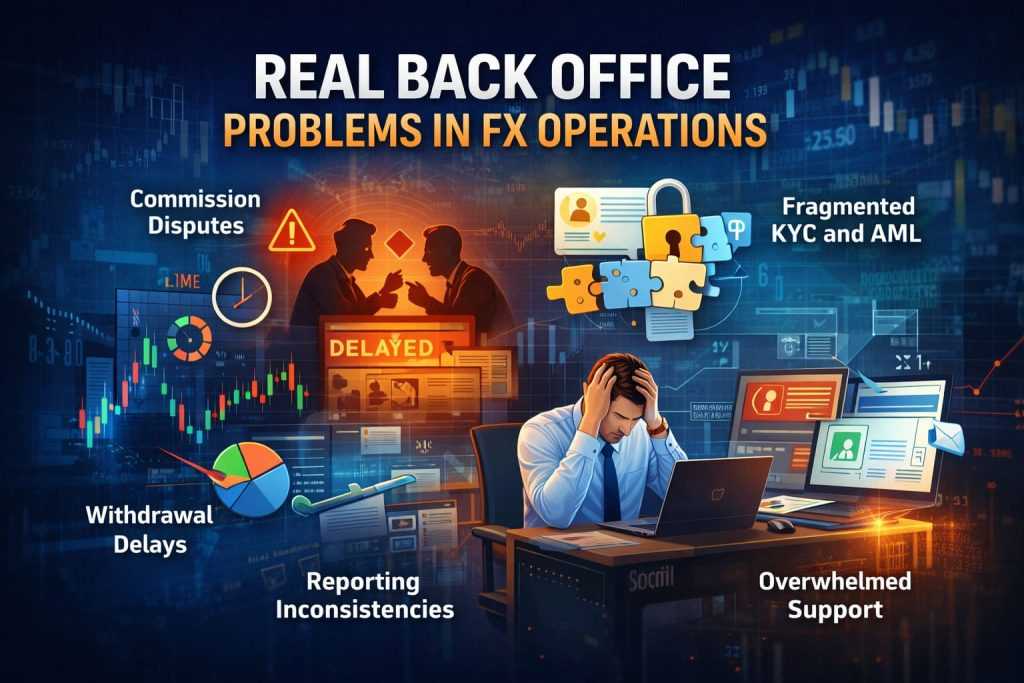
In practice, the biggest operational bottlenecks typically show up in:
- delayed or inconsistent withdrawals,
- affiliate/IB commission disputes,
- fragmented KYC and AML workflows,
- reporting inconsistencies between platform data and internal records,
- support teams lacking a single source of truth.
This hands-on experience shapes how we design forex back office solutions and CRM trading platforms: we build around real operational scenarios, not generic templates.
What Is a Forex Back Office System
A forex back office is the operational layer that manages everything around trading activity: onboarding, compliance, transactions, reporting, partner programs, and data control.
A modern fx back office system usually covers:
- client and account management,
- KYC/AML workflows and audit trails,
- payment processing and withdrawal approvals,
- affiliate and IB tracking (multi-tier structures),
- financial and operational reporting,
- dispute management and internal controls,
- role-based access and security logs.
In short: the forex back office solution is your operational command center.
Forex CRM vs. Generic CRM
A Forex CRM is not the same as a general-purpose CRM.
Generic CRMs typically manage leads, deals, and emails. A Forex CRM integrated with the Trading Platform as well as:
- trading accounts, balances, and wallet logic,
- deposits/withdrawals and payment routing,
- trading activity synchronization,
- compliance status and document flows,
- partner hierarchies (affiliates/IBs),
- multi-currency and multi-brand operations.
That’s why a specialized Forex CRM is essential if you want fewer manual processes and Client Portal access.
Core Modules of Forex Back Office Software
1) Client, Account, and Permission Management
A reliable forex CRM should provide:
- unified client profiles and history,
- multiple trading accounts per user,
- status controls (verified, restricted, flagged),
- segmentation for sales/support/compliance.
This reduces operational friction and speeds up support resolution.
2) KYC and AML Workflows (Compliance Readiness)
Even firms that started with minimal compliance tooling are now implementing structured workflows.
A strong forex back office software should support:
- document collection and verification stages,
- risk scoring and manual review queues,
- audit logs (who approved what and when),
- secure storage and access control.
This is critical for brokers, and increasingly expected for prop firms working with payment providers and operating across borders.
3) Payments, Withdrawals, and Internal Ledger Logic
The fx back office solution should centralize:
- payment provider integrations,
- multi-currency wallets,
- approval flows for withdrawals,
- transaction recordkeeping (audit-ready),
- payout logic for prop firms.
Poor payout and withdrawal workflows are one of the fastest ways to lose trust and generate complaints.
4) Reporting, Analytics, and Audit Trails
The best forex back office system provides:
- real-time operational dashboards,
- compliance and risk reporting,
- affiliate/IB performance reporting,
- transaction exports and audit-ready logs,
- consistent data reconciliation.
Reporting is not “nice to have” — it’s how you prove control and consistency.
5) Affiliates, IBs, and Partner Management
Growth in FX often comes through partners. A professional back office should handle:
- multi-tier commission structures,
- automated commission calculations,
- transparent reporting.
If you’re comparing top forex CRM providers, pay special attention to partner/affiliate tooling — this is where many “feature list” products fail in real operations.

Forex CRM Open Source: Is It a Real Alternative?
Many teams search for forex CRM open source options to reduce licensing costs. While open-source is appealing, it is not readily available for forex operations. Therefore it introduces complexity that open-source stacks often struggle with:
- Trader’ Back Office
- Payments and wallet logic,
- High-volume partner structures,
- Role-based access control and operational security.
For most firms, a robust custom or professionally built system is more cost-effective long term than maintaining a fragile stack internally.
How to Choose the Best Forex CRM (Checklist)
If you’re evaluating how to choose the best forex CRM, use this practical checklist.
A) Integration & Data Consistency
- Can the CRM integrate with your trading platform and keep data consistent?
- Is synchronization reliable and auditable?
B) Compliance & Control
- Does it support KYC/AML workflows, audit logs, and role-based access?
- Can you prove operational control during audits or partner reviews?
C) Payments & Transaction Recordkeeping
- Does it support your payment providers and payout models?
- Are transactions stored in a way that is audit-ready?
D) Partner/Affiliate Capabilities
- Multi-tier IB logic?
- Custom commission rules?
- Transparency and fraud safeguards?
E) Scalability & Customization
- Will the system scale with your volume and new jurisdictions?
- Can workflows be adjusted without rebuilding everything?
This is the real difference between “a CRM product” and the best forex CRM systems that support growth.
Best Forex CRM Products, Systems, and Companies: What Actually Matters
Search terms like best forex crm products, best forex crm systems, and best forex crm companies often lead to long lists of tools. But a feature checklist doesn’t guarantee operational success.
When comparing vendors and top forex CRM providers, focus on:
- architectural quality (performance, reliability, audit trails),
- real integration depth (platform + payments + reporting),
- customization speed (how fast changes can be safely implemented),
- operational readiness (workflows that match how FX businesses operate),
- security practices and access controls.
A system that looks great in a demo can fail under real volume and real workflows.
Best Forex CRM Agency vs Off-the-Shelf Software
Many firms choose between buying a ready-made product or partnering with an agency. If you are searching for a best forex CRM agency (including keywords like best forex crm agency in India), here’s the key difference:
Products often enforce their own workflow.
Agencies can build around your workflow.
A strong agency partner can deliver:
- custom onboarding and compliance flows,
- deeper integration with your specific stack,
- faster adaptation to regulation and market changes,
- a system roadmap aligned to your business model.
If your operation includes multi-brand structures, unusual payout logic, advanced partner hierarchies, or multi-jurisdiction constraints, an agency-built solution often wins.
Forex Back Office Solution as a Competitive Advantage
Regulatory readiness is no longer optional. Markets are moving toward more transparency in:
- marketing and affiliate oversight,
- payout logic and recordkeeping,
- dispute handling,
- clarity between simulated and real exposure (for prop/evaluation models).
Firms with a mature forex back office solution and a strong crm trading platform reduce operational risk and build long-term trust with clients, partners, and service providers.
Why Kenmore Design (A Practical, Non-Hype Summary)
Kenmore Design helps FX businesses build and improve:
- forex back office software,
- fx back office system modules,
- custom crm trading platform and crm trading solution architecture.
What clients typically value in our approach:
- long-term support and evolution rather than “one-time delivery”.
- operational-first design (built around real workflows),
- modular architecture that scales,
- clean integrations (platform, payments, reporting),
- audit-ready logging and access control,
- long-term support and evolution rather than “one-time delivery”.

FAQ
What is a forex back office system?
A forex back office system is the operational infrastructure used by brokers and prop firms to manage client accounts, KYC/AML workflows, payments, reporting, partner programs, and audit-ready controls behind the trading platform.
What is the difference between a CRM trading platform and a regular CRM?
A CRM trading platform is built specifically for trading businesses. It supports trading accounts, wallet logic, deposits/withdrawals, compliance workflows, affiliate/IB structures, and reporting — features that generic CRMs typically do not provide.
Why is forex back office software important?
It improves operational efficiency, reduces manual errors, strengthens compliance readiness, centralizes reporting, and supports scalable growth across regions and payment systems.
How to choose the best forex CRM?
Focus on integration depth, compliance and audit logs, payments and transaction recordkeeping, affiliate/IB capabilities, scalability, customization speed, and long-term support.
Are open-source forex CRM solutions a good choice?
Open-source can work for teams with strong internal engineering, but many open stacks lack compliance tooling, secure audit trails, and reliable integrations required in FX operations.
What features should a forex back office solution include?
At minimum: client/account management, KYC/AML workflows, payments/withdrawals, transaction records, reporting, partner management, role-based access, and audit logs.
Who needs a forex back office solution?
Forex and CFD brokers, prop firms, evaluation platforms, and hybrid models that need operational control, consistent reporting, and scalable compliance-ready processes.
Why choose a forex CRM agency instead of off-the-shelf software?
An agency can build around your workflow, integrate with your stack, and adapt faster to business model and regulatory changes, often delivering better long-term ROI.
Request a Consultation on Implementing a Forex Back Office & CRM Platform
Get expert guidance on implementing a robust forex back office and CRM trading solution. We’ll help you design KYC/AML workflows, payment and withdrawal logic, partner management, reporting, and audit-ready controls—fully integrated with your trading platform.
Together, we’ll assess your current infrastructure and define a practical, scalable setup that improves operational control and regulatory readiness.