


When people search what is IB in forex, they are usually trying to understand how introducing brokers work, how they earn money, and why IB programs are so important in the forex industry.
An IB (Introducing Broker) is a partner who refers traders to a forex broker and earns commissions based on the trading activity of those referred clients. IBs play a critical role in broker growth, client acquisition, and regional market expansion.
This article explains the IB meaning in forex, how IB programs operate, commission models, and why brokers rely on structured IB systems.
What Does IB Mean in Forex?
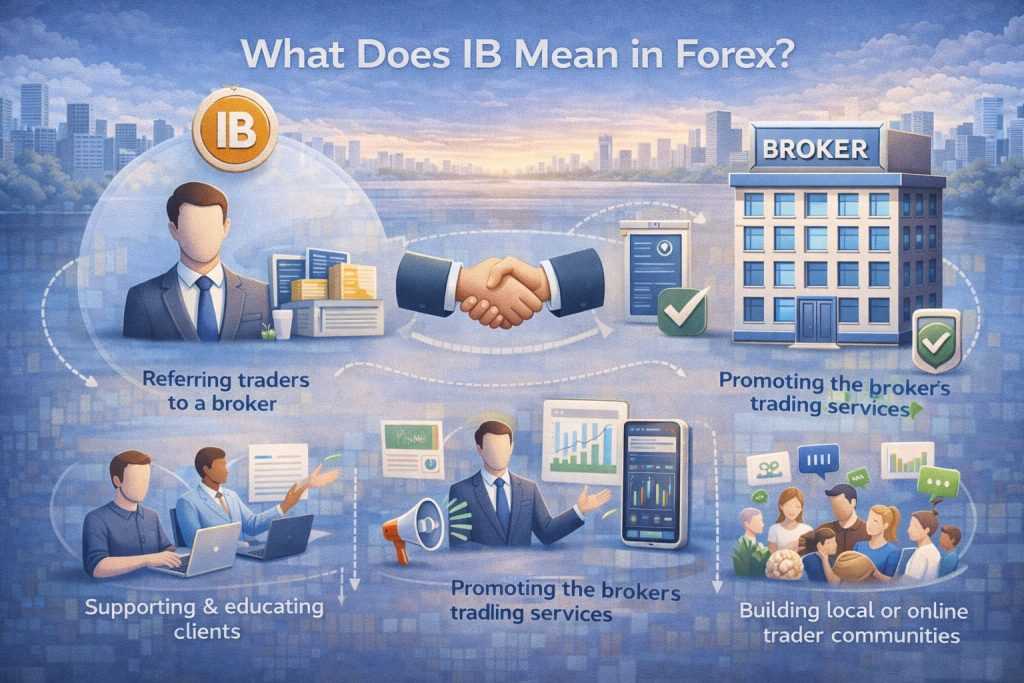
In forex, IB stands for Introducing Broker.
An introducing broker acts as an intermediary between traders and a forex broker but does not execute trades or hold client funds.
Instead, an IB focuses on:
- Referring traders to a broker
- Supporting and educating clients
- Promoting the broker’s trading services
- Building local or online trader communities
The broker handles trading infrastructure, regulation, and execution, while the IB focuses on client acquisition and relationship management.
How an IB Works in Forex Trading
The IB forex model is simple in principle but structured in execution.
- The broker creates an IB partnership program
- The IB receives a unique referral link or partner ID
- Traders register through the IB’s referral
- The broker tracks trading activity
- The IB earns commissions based on predefined rules
IBs do not provide financial advice or manage trades. Their role is strictly introducing and supporting clients, not trading on their behalf.
Why Forex Brokers Use IB Programs
IBs are one of the most scalable acquisition channels in the forex industry.
Forex brokers use IB programs to:
- Enter new geographic markets
- Acquire clients with lower upfront marketing costs
- Leverage local trust and language expertise
- Build long-term partner-driven growth
Compared to paid advertising, IBs offer performance-based acquisition, where commissions are paid only when trading volume is generated.
IB Commission Models in Forex
Understanding IB commission models is a core part of answering the question what is IB in forex, because commissions define how introducing brokers earn income and how long-term IB partnerships are structured.
Forex brokers typically offer several commission models, depending on their trading setup, target markets, and partner strategy.
1. Revenue Share Model
In a revenue share model, the IB earns a percentage of the broker’s revenue generated by referred traders. This revenue usually comes from spreads, trading commissions, or swaps.
Key characteristics:
- Commission is calculated as a percentage of broker revenue
- Earnings depend on trader activity and trading volume
- Strong long-term income potential if clients remain active
This model is common among IBs who focus on building long-term trader relationships rather than short-term traffic.
2. Lot-Based Commission Model
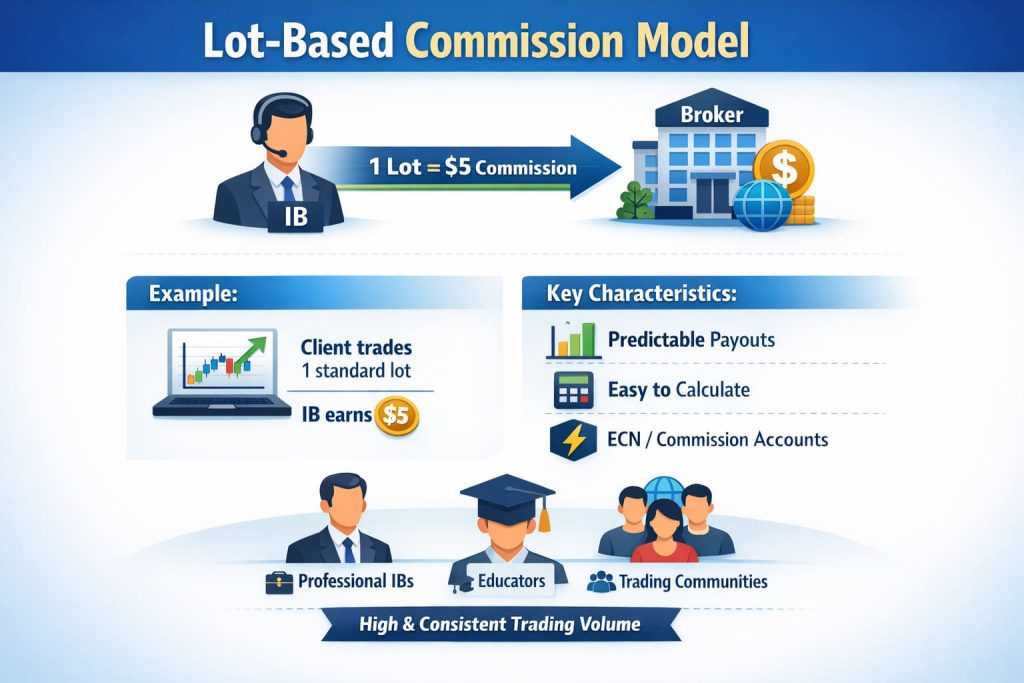
With a lot-based commission, the IB earns a fixed amount for each traded lot executed by referred clients.
Example:
An IB earns $5 per standard lot traded by their clients.
Key characteristics:
- Predictable and transparent payouts
- Easy to calculate and track
- Often used by brokers with ECN or commission-based accounts
This model is popular with professional IBs, educators, and trading communities that generate consistent trading volume.
3. Hybrid IB Commission Models
A hybrid model combines revenue share and lot-based commissions.
For example:
- A percentage of broker revenue
- Plus a fixed payout per traded lot
Hybrid models balance stability and scalability, offering IBs both predictable earnings and long-term upside as their client base grows.
4. Multi-Level IB Commission Structures
In a multi-level IB structure, introducing brokers can recruit sub-IBs and earn commissions not only from their own referred traders but also from additional referral levels.
How it works:
- Level 1: Traders referred directly by the IB
- Level 2: Traders referred by sub-IBs
- Level 3+: Additional referral layers (depending on broker rules)
Multi-level IB models are widely used by large forex brokers to scale partner networks globally and expand into new regions through local representatives.
Why Commission Transparency Matters
Regardless of the model, transparent commission calculation is critical for successful IB programs. Most brokers rely on dedicated IB CRM systems to ensure:
- Accurate referral tracking
- Automated commission calculation
- Clear reporting for IBs
- Fewer disputes and payment conflicts
Without reliable tracking and transparent rules, even well-designed IB programs struggle to scale.
What Is a Multi-Level IB in Forex?
A multi-level IB structure allows IBs to recruit other IBs under them.
Example:
- Level 1 IB refers traders
- Level 2 IB refers new IBs
- Commissions are distributed across multiple levels
This model incentivizes network growth and is often managed through a dedicated IB CRM or IB module inside the broker’s back office.

The Role of IB CRM and Tracking Systems
Modern IB programs rely on technology.
An IB CRM system typically includes:
- Referral tracking
- Commission calculation
- IB hierarchy management
- Payout automation
- Performance analytics
- Transparent reporting for brokers and partners
Without proper IB tracking and CRM tools, brokers risk disputes, inaccurate payouts, and partner dissatisfaction.
IB vs Affiliate in Forex: What’s the Difference?
Although often confused, IBs and affiliates are not the same.
| IB in Forex | Affiliate |
|---|---|
| Long-term partner | Short-term traffic source |
| Ongoing client support | No client relationship |
| Revenue-based commissions | CPA or one-time payouts |
| Often multi-level | Usually single-level |
IBs are relationship-driven partners, while affiliates focus on traffic and conversions.
Benefits of Becoming an IB in Forex
For individuals or businesses, becoming an IB offers:
- Recurring commission income
- No need for trading licenses
- Low startup costs
- Flexible marketing strategies
- Ability to scale via sub-IBs
Successful IBs often operate educational platforms, signal services, communities, or regional offices.
Final Thoughts: What Is IB in Forex?
To summarize:
An IB in forex is a partner who introduces traders to a broker and earns commissions based on trading activity, without executing trades or handling funds.
IB programs are a cornerstone of the forex brokerage business model. They combine performance-based marketing, local expertise, and long-term partnerships supported by technology, tracking, and transparent commission systems.
Understanding how IBs work is essential for anyone planning to:
- Become an introducing broker
- Launch a forex brokerage
- Build scalable partner networks
Request a Consultation on Building an IB Program for Forex Brokers
Get expert guidance on designing a structured and scalable IB program for your forex brokerage. We’ll help you define commission models, partner roles, regional strategies, and long-term incentives that attract and retain high-quality IBs.
Together, we’ll review your growth goals and outline an IB strategy that supports sustainable client acquisition and partner-driven expansion.