


The rapid growth of proprietary trading firms has raised a critical question across the forex and trading industry: Are prop firms legal?
Traders want clarity before paying challenge fees, while companies launching or scaling prop trading models need to understand where the legal boundaries truly lie.
The reality is more nuanced than a simple “yes” or “no”. Most prop firms are legal, including forex prop firms, as long as they are structured and operated correctly. Legal issues arise not from the prop trading model itself but from how it is implemented, disclosed, and marketed.
This article provides a clear, legally grounded explanation of prop firms, proprietary trading, and funded accounts — without hype, affiliate language, or misleading claims.
What Is a Prop Firm (Legal Definition)
A prop firm, short for proprietary trading firm, is a business that allows individuals to trade using the firm’s capital or within a simulated trading environment. Traders are not investing their own funds into financial markets. Instead, they participate in an evaluation or challenge and may receive performance-based payouts.
From a legal standpoint, this distinction is fundamental.
In most jurisdictions, financial regulation applies when a company:
- accepts deposits for trading,
- executes trades on behalf of clients,
- manages or safeguards client funds,
- or provides regulated investment services.
Most proprietary trading firms are intentionally structured to avoid these activities. Traders typically pay a fee for evaluation, not a trading deposit. Any payout received is a contractual reward, not a return on invested capital.
Because of this, prop trading is usually treated as a commercial or contractual activity, not a financial service.
Why Prop Firms Are Not Forex Brokers (in Most Cases)
Confusion between prop firms and brokers is one of the main reasons people assume prop trading is illegal.
A forex broker:
- accepts client funds,
- provides access to live markets,
- executes trades on behalf of clients,
- and must be licensed and regulated.
A forex prop firm:
- does not accept funds for trading,
- does not place real trades for clients,
- does not provide investment advice,
- and does not manage customer portfolios.
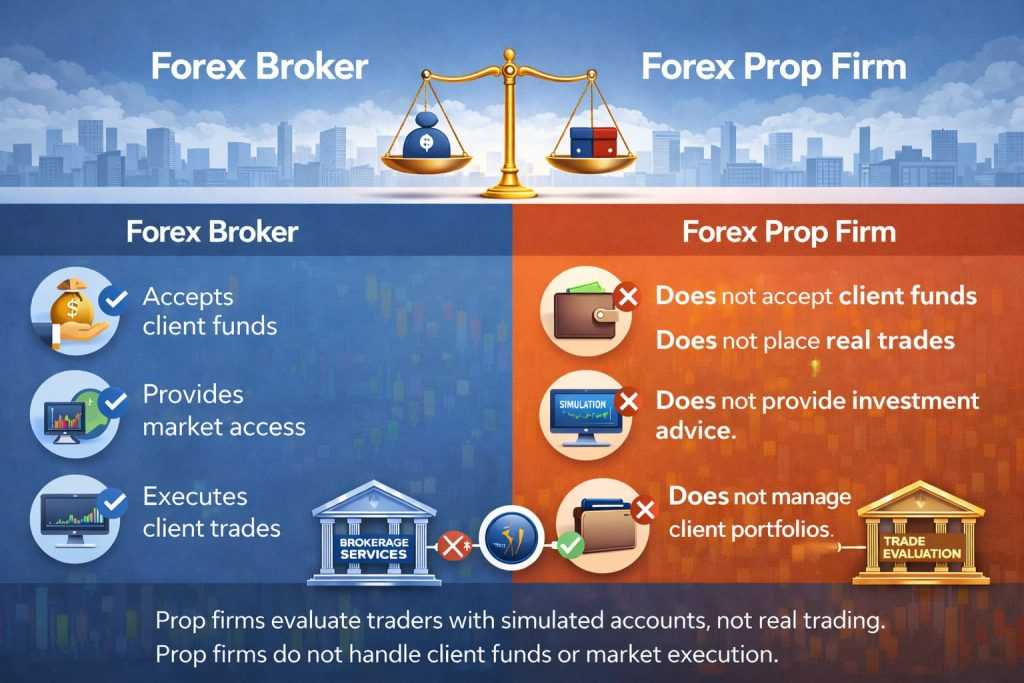
Instead of providing brokerage services, prop firms evaluate trading performance and compensate successful traders according to predefined rules.
Legally, this difference is decisive. Without client funds or market execution on behalf of customers, most proprietary trading firms fall outside traditional brokerage regulation.
Problems arise only when a prop firm starts to look like a broker, even unintentionally.
Simulation vs Real Capital — Why It Matters Legally
One of the most critical legal factors in prop trading is whether trading is simulated or live.
In the majority of modern prop firms:
- all trading accounts are simulated,
- including funded accounts,
- and trades do not reach live markets.
From a legal perspective, simulation significantly reduces regulatory exposure. When trading activity is simulated, the firm is not executing financial transactions or facilitating market access.
This is why clear disclosure of simulation is essential.
Legal risks appear when firms:
- suggest that funded accounts trade real capital,
- use language implying live execution,
- fail to explain how payouts are calculated,
- or contradict their own Terms & Conditions.
Transparent communication about simulation is one of the strongest legal protections a prop firm can have.
Legal Status in Key Regions (US, EU, UK, Asia)
While laws vary by jurisdiction, the legal treatment of prop firms follows similar principles worldwide.
United States
In the US, regulators focus primarily on:
- misleading marketing,
- unregistered investment offerings,
- and consumer protection violations.
Prop firms that avoid claiming live trading or investment services generally operate outside direct financial regulation. Legal issues usually emerge through disputes, payment complaints, or deceptive advertising rather than regulatory enforcement.
European Union
In the EU, authorities pay close attention to:
- how services are presented,
- fairness of contracts,
- and consumer rights.
Even without accepting funds, a forex prop firm can face legal action if its marketing or disclosures are misleading. Transparency is essential for operating safely.
United Kingdom
In the UK, the main legal risk is being classified as providing regulated investment services. Prop firms that clearly use simulation and avoid broker-like functionality typically remain outside licensing requirements.
Asia and Offshore Jurisdictions
Many Asian and offshore jurisdictions take a more flexible view of proprietary trading. However, banks and payment providers often apply stricter compliance standards than local regulators.
Across all regions, payment processing and consumer law tend to be the most common sources of legal pressure.
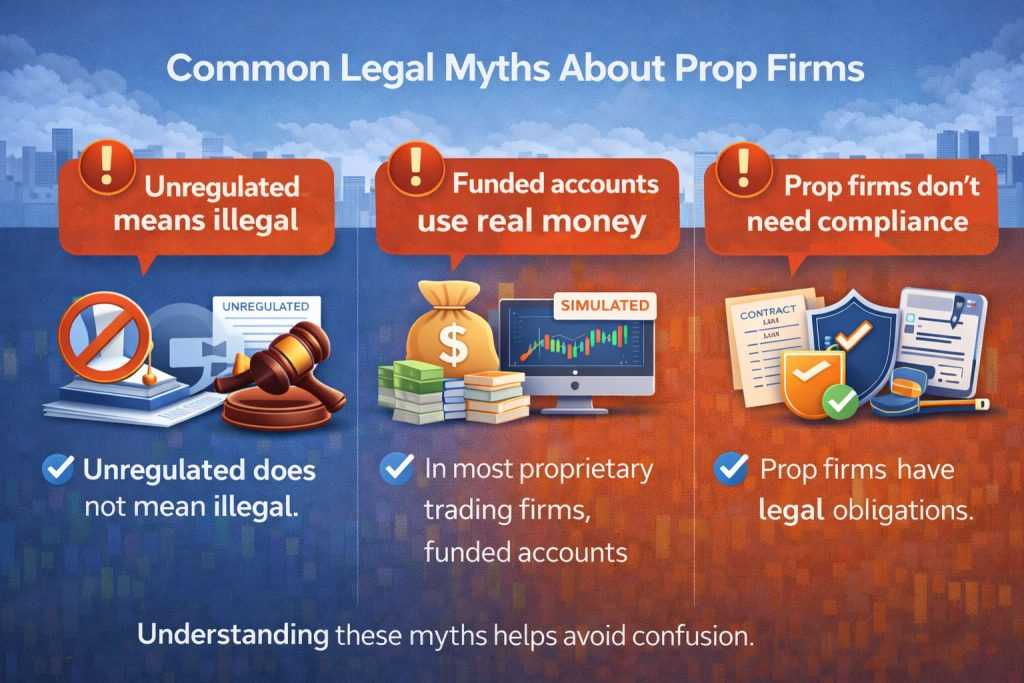
Common Legal Myths About Prop Firms
Several persistent myths create unnecessary fear around prop trading.
“Prop firms are illegal because they are unregulated.”
Unregulated does not mean illegal. It simply means that the activity does not require a financial services license.
“Funded accounts always trade real money.”
In most proprietary trading firms, funded accounts are simulated, and payouts are contractual rewards.
“Prop firms don’t need compliance at all.”
Even without regulation, prop firms are subject to contract law, advertising rules, data protection laws, and payment provider requirements.
Understanding these points helps traders and firms avoid confusion and disputes.
What Makes a Prop Firm Legally Risky
A prop firm becomes legally vulnerable when it blurs the line between proprietary trading and brokerage services.
Common legal risk factors include:
- presenting funded accounts as live trading,
- guaranteeing profits or payouts,
- vague or discretionary payout rules,
- inconsistent rule enforcement,
- broker-style dashboards or statements,
- poor handling of disputes and refunds.
In practice, most legal problems faced by proprietary trading firms are self-inflicted and preventable.
How Prop Firms Reduce Legal Exposure
Legally resilient prop firms focus on structure and clarity rather than shortcuts.
Best practices include:
- clear and consistent Terms & Conditions,
- explicit explanation of simulation and funded accounts,
- transparent payout rules,
- documented rule enforcement,
- compliant marketing language,
- proper record-keeping and audit logs.
Strong operational systems, including CRM and reporting tools, help demonstrate consistency and fairness if disputes arise.
Final Verdict: Are Prop Firms Legal?
Yes — prop firms are legal in most jurisdictions, including forex prop firms, when they:
- do not accept client funds for trading,
- clearly use simulated trading environments,
- avoid broker-like behavior,
- and communicate transparently with traders.
The legality of prop trading does not depend on labels, but on how the business actually operates.
For firms that prioritize transparency, proper structure, and compliance with basic legal standards, proprietary trading remains a legitimate and scalable business model.

FAQ
- Are prop firms legal worldwide? Prop firms are legal in many regions, but legality depends on structure, disclosures, and local consumer laws.
- Is proprietary trading regulated? Proprietary trading itself is usually not regulated, but firms are still subject to general legal and contractual obligations.
- Are funded accounts real trading accounts? In most cases, funded accounts are simulated, and payouts are based on performance rules rather than live market profits.
- Can a forex prop firm operate without a license? Yes, in many jurisdictions, provided it does not provide regulated financial services or manage client funds.
- What is the biggest legal risk for prop firms? Misleading marketing, unclear terms, payout disputes, and payment processing issues.
Request a Consultation on the Legal Structure of a Prop Trading Firm
Get expert guidance on structuring a prop trading firm in a legally sound and transparent way. We’ll help you understand how simulation, payouts, disclosures, and business models are treated across different jurisdictions—so you can reduce legal risk before it becomes a problem.
Together, we’ll review your concept or existing setup and outline a compliance-aware approach aligned with consumer law, payment providers, and market expectations.